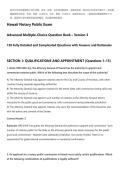
刚才打开的页面提供了关于资格、考试、印章、日志等详细规定,信息很全面。现在可以开始设计题目了。题目要
覆盖资格与任命、考试、印章、公证行为、日志、费用、不当行为、远程在线公证、一般规定和情景题等多个方
面,确保每个部分都有足够多的题目,并且要详细和复杂。
Hawaii Notary Public Exam
Advanced Multiple-Choice Question Bank – Version 3
150 Fully Detailed and Complicated Questions with Answers and Rationales
SECTION 1: QUALIFICATIONS AND APPOINTMENT (Questions 1–15)
1. Under HRS §456-1(a), the Attorney General of Hawaii has the authority to appoint and
commission notaries public. Which of the following best describes the scope of this authority?
A) The Attorney General may appoint notaries only for the City and County of Honolulu, with other
counties having separate appointing authorities
B) The Attorney General may appoint notaries for the entire State, with commissions being valid only
within the county of issuance
C) The Attorney General may appoint such number of notaries as the Attorney General deems
necessary for the public good and convenience, with commissions having statewide jurisdiction
D) The Attorney General may appoint notaries only upon the recommendation of the Governor and
with the advice and consent of the Senate
Correct Answer: C
Rationale: HRS §456-1(a) grants the Attorney General the authority to appoint and commission "such
number of notaries public for the State as the attorney general may deem necessary for the public
good and convenience." Notaries have statewide jurisdiction, not county-limited. There is no
requirement for gubernatorial recommendation or senatorial confirmation.
2. An applicant for a notary public commission in Hawaii must satisfy certain qualifications. Which
of the following combinations of qualifications is legally sufficient?
,A) Age 19, resident of Hawaii, U.S. citizen, able to read and write English with understanding
B) Age 17, resident of Hawaii, permanent resident alien authorized to work in the U.S., able to speak
English
C) Age 22, non-resident but owns a vacation home in Hawaii, U.S. citizen, able to read and write
English
D) Age 25, resident of Hawaii, U.S. national, unable to speak English but able to read and write it
Correct Answer: A
Rationale: The qualifications under HRS §456-2 and HAR §5-11-21(b)(5) require: (a) at least 18 years
old; (b) a resident of Hawaii; (c) a U.S. citizen, U.S. national, or permanent resident alien authorized to
work in the U.S.; and (d) ability to read, write, speak, and understand English. A 17-year-old is too
young (B). Non-residents do not qualify (C). The ability to speak English is required; being unable to
speak it is disqualifying (D).
3. The Hawaii Administrative Rules provide specific grounds for denial of a notary commission.
Which of the following is NOT a statutory or regulatory ground for denial?
A) The applicant is addicted to or a habitual user of narcotics, barbiturates, amphetamines,
hallucinogens, opium, cocaine, or other drugs or derivatives of a similar nature
B) The applicant has been convicted of a felony or a misdemeanor involving fraud, false statements,
perjury, forgery, or counterfeiting
C) The applicant practices as a notary while impaired by alcohol, drugs, or mental instability
D) The applicant has failed to maintain a minimum credit score of 650
Correct Answer: D
Rationale: HAR §5-11-39 provides specific grounds for denial, including drug addiction or habitual use,
practicing while impaired, and criminal convictions involving fraud or dishonesty. There is no credit
score requirement for notary applicants in Hawaii.
4. A notary public applicant must submit a letter of character recommendation. Under HAR §5-11-
21(b)(7), which of the following individuals is qualified to provide such a letter?
,A) The applicant's spouse, who is a resident of Hawaii
B) The applicant's employer, who is a resident of Hawaii
C) A neighbor who is a resident of Hawaii and has known the applicant for 10 years, and who is not a
relative or employer
D) The applicant's adult child, who is a resident of Hawaii
Correct Answer: C
Rationale: The letter of character recommendation must come from "a person residing in this State,
who is not a relative or an employer of the applicant" and who can attest to the applicant's honesty,
trustworthiness, financial integrity, and moral character. A spouse (A), employer (B), or adult child (D)
are all relatives or employers and are disqualified.
5. Under HAR §5-11-21(b)(6), a self-employed notary applicant must provide a letter of justification.
Who must author this letter?
A) A business partner or associate
B) A long-standing customer or client
C) The applicant themselves
D) The applicant's spouse
Correct Answer: C
Rationale: The letter of justification must come from the applicant's employer or, if the applicant is
self-employed, from the applicant, explaining in detail the reasons why the commission is being
sought. A self-employed applicant cannot have a business partner, customer, or spouse provide this
letter.
6. The application for a notary public commission requires disclosure of criminal convictions. Under
the applicable statutes and rules, which of the following convictions must be disclosed?
A) A traffic violation for speeding that occurred 15 years ago
B) A misdemeanor conviction for petty theft that occurred 20 years ago
, C) A misdemeanor conviction for fraud involving false statements that occurred 10 years ago
D) A juvenile adjudication for a minor offense that has been expunged
Correct Answer: C
Rationale: The application requires disclosure of "any felony, or a misdemeanor related to the
qualifications, functions, or duties of a notary public or involving fraud, false statements or omissions,
wrongful taking of property, bribery, perjury, forgery, counterfeiting, extortion, or a conspiracy to
commit any of these offenses." Traffic violations (A) are generally not required. Petty theft (B) may or
may not be related to notary duties, but fraud-related offenses (C) are specifically required. Expunged
juvenile adjudications (D) typically need not be disclosed.
7. A notary public's commission is issued for a term of four years. Under HRS §456-1(a) and HAR §5-
11-12, when does the term begin?
A) On the date the application is submitted
B) On the date the applicant passes the examination
C) On the date of the commission as stated on the commission certificate
D) On the date the bond is approved by the circuit court judge
Correct Answer: C
Rationale: The term of office of a notary public shall be four years "from the date of the notary's
commission" as stated on the commission certificate. The term does not begin on the application date,
exam date, or bond approval date.
8. Under HRS §456-1(c), what is the consequence if a notary public knowingly fails to renew their
commission in a timely manner?
A) The commission is automatically extended for an additional 30 days
B) The commission may be forfeited, and the notary must pay a $200 administrative fine
C) The commission may be forfeited, and the notary must submit a new application
D) The commission may be forfeited, and the notary is permanently disqualified from reappointment
Correct Answer: C
覆盖资格与任命、考试、印章、公证行为、日志、费用、不当行为、远程在线公证、一般规定和情景题等多个方
面,确保每个部分都有足够多的题目,并且要详细和复杂。
Hawaii Notary Public Exam
Advanced Multiple-Choice Question Bank – Version 3
150 Fully Detailed and Complicated Questions with Answers and Rationales
SECTION 1: QUALIFICATIONS AND APPOINTMENT (Questions 1–15)
1. Under HRS §456-1(a), the Attorney General of Hawaii has the authority to appoint and
commission notaries public. Which of the following best describes the scope of this authority?
A) The Attorney General may appoint notaries only for the City and County of Honolulu, with other
counties having separate appointing authorities
B) The Attorney General may appoint notaries for the entire State, with commissions being valid only
within the county of issuance
C) The Attorney General may appoint such number of notaries as the Attorney General deems
necessary for the public good and convenience, with commissions having statewide jurisdiction
D) The Attorney General may appoint notaries only upon the recommendation of the Governor and
with the advice and consent of the Senate
Correct Answer: C
Rationale: HRS §456-1(a) grants the Attorney General the authority to appoint and commission "such
number of notaries public for the State as the attorney general may deem necessary for the public
good and convenience." Notaries have statewide jurisdiction, not county-limited. There is no
requirement for gubernatorial recommendation or senatorial confirmation.
2. An applicant for a notary public commission in Hawaii must satisfy certain qualifications. Which
of the following combinations of qualifications is legally sufficient?
,A) Age 19, resident of Hawaii, U.S. citizen, able to read and write English with understanding
B) Age 17, resident of Hawaii, permanent resident alien authorized to work in the U.S., able to speak
English
C) Age 22, non-resident but owns a vacation home in Hawaii, U.S. citizen, able to read and write
English
D) Age 25, resident of Hawaii, U.S. national, unable to speak English but able to read and write it
Correct Answer: A
Rationale: The qualifications under HRS §456-2 and HAR §5-11-21(b)(5) require: (a) at least 18 years
old; (b) a resident of Hawaii; (c) a U.S. citizen, U.S. national, or permanent resident alien authorized to
work in the U.S.; and (d) ability to read, write, speak, and understand English. A 17-year-old is too
young (B). Non-residents do not qualify (C). The ability to speak English is required; being unable to
speak it is disqualifying (D).
3. The Hawaii Administrative Rules provide specific grounds for denial of a notary commission.
Which of the following is NOT a statutory or regulatory ground for denial?
A) The applicant is addicted to or a habitual user of narcotics, barbiturates, amphetamines,
hallucinogens, opium, cocaine, or other drugs or derivatives of a similar nature
B) The applicant has been convicted of a felony or a misdemeanor involving fraud, false statements,
perjury, forgery, or counterfeiting
C) The applicant practices as a notary while impaired by alcohol, drugs, or mental instability
D) The applicant has failed to maintain a minimum credit score of 650
Correct Answer: D
Rationale: HAR §5-11-39 provides specific grounds for denial, including drug addiction or habitual use,
practicing while impaired, and criminal convictions involving fraud or dishonesty. There is no credit
score requirement for notary applicants in Hawaii.
4. A notary public applicant must submit a letter of character recommendation. Under HAR §5-11-
21(b)(7), which of the following individuals is qualified to provide such a letter?
,A) The applicant's spouse, who is a resident of Hawaii
B) The applicant's employer, who is a resident of Hawaii
C) A neighbor who is a resident of Hawaii and has known the applicant for 10 years, and who is not a
relative or employer
D) The applicant's adult child, who is a resident of Hawaii
Correct Answer: C
Rationale: The letter of character recommendation must come from "a person residing in this State,
who is not a relative or an employer of the applicant" and who can attest to the applicant's honesty,
trustworthiness, financial integrity, and moral character. A spouse (A), employer (B), or adult child (D)
are all relatives or employers and are disqualified.
5. Under HAR §5-11-21(b)(6), a self-employed notary applicant must provide a letter of justification.
Who must author this letter?
A) A business partner or associate
B) A long-standing customer or client
C) The applicant themselves
D) The applicant's spouse
Correct Answer: C
Rationale: The letter of justification must come from the applicant's employer or, if the applicant is
self-employed, from the applicant, explaining in detail the reasons why the commission is being
sought. A self-employed applicant cannot have a business partner, customer, or spouse provide this
letter.
6. The application for a notary public commission requires disclosure of criminal convictions. Under
the applicable statutes and rules, which of the following convictions must be disclosed?
A) A traffic violation for speeding that occurred 15 years ago
B) A misdemeanor conviction for petty theft that occurred 20 years ago
, C) A misdemeanor conviction for fraud involving false statements that occurred 10 years ago
D) A juvenile adjudication for a minor offense that has been expunged
Correct Answer: C
Rationale: The application requires disclosure of "any felony, or a misdemeanor related to the
qualifications, functions, or duties of a notary public or involving fraud, false statements or omissions,
wrongful taking of property, bribery, perjury, forgery, counterfeiting, extortion, or a conspiracy to
commit any of these offenses." Traffic violations (A) are generally not required. Petty theft (B) may or
may not be related to notary duties, but fraud-related offenses (C) are specifically required. Expunged
juvenile adjudications (D) typically need not be disclosed.
7. A notary public's commission is issued for a term of four years. Under HRS §456-1(a) and HAR §5-
11-12, when does the term begin?
A) On the date the application is submitted
B) On the date the applicant passes the examination
C) On the date of the commission as stated on the commission certificate
D) On the date the bond is approved by the circuit court judge
Correct Answer: C
Rationale: The term of office of a notary public shall be four years "from the date of the notary's
commission" as stated on the commission certificate. The term does not begin on the application date,
exam date, or bond approval date.
8. Under HRS §456-1(c), what is the consequence if a notary public knowingly fails to renew their
commission in a timely manner?
A) The commission is automatically extended for an additional 30 days
B) The commission may be forfeited, and the notary must pay a $200 administrative fine
C) The commission may be forfeited, and the notary must submit a new application
D) The commission may be forfeited, and the notary is permanently disqualified from reappointment
Correct Answer: C