

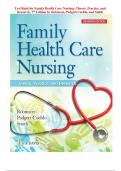
Test Bank for Family Health Care Nursing: Theory, Practice, and Research, 7th Edition by Melissa Robinson, Deborah Padgett Coehlo, and Paul S. Smith
Test Bank for Family Health Care Nursing: Theory, Practice, and Research, 7th Edition by Melissa Robinson, Deborah Padgett Coehlo, and Paul S. Smith Strengthen your understanding of family-centered nursing care with the Test Bank for Family Health Care Nursing: Theory, Practice, and Research, 7th Edition by Melissa Robinson, Deborah Padgett Coehlo, and Paul S. Smith. Designed as a supplemental study resource, this comprehensive test bank helps nursing students reinforce essential concepts in family nursing, health promotion, evidence-based practice, and patient-centered care across the lifespan. The companion textbook emphasizes a theory-guided, evidence-based approach to caring for families in diverse healthcare settings throughout the United States and Canada. This study aid is organized to align with the chapters and learning objectives presented in the seventh edition of the textbook. It provides learners with structured practice opportunities that reinforce classroom instruction, improve critical-thinking skills, and support preparation for quizzes, examinations, clinical evaluations, and comprehensive nursing assessments. Whether you are enrolled in a Practical Nursing (PN), Licensed Practical Nursing (LPN), Associate Degree Nursing (ADN), Bachelor of Science in Nursing (BSN), or graduate nursing program, this resource serves as an effective supplement to your academic studies. The material covers the foundations of family nursing, emphasizing the family as the unit of care. Students explore major family nursing theories, family systems concepts, developmental and family life cycle theory, bioecological theory, family assessment models, communication strategies, cultural competence, ethical decision-making, and evidence-based nursing interventions. These topics help learners understand how family structure, relationships, health behaviors, and environmental influences affect health outcomes across generations. A major strength of this study resource is its emphasis on applying theoretical knowledge to realistic clinical situations. Practice questions encourage students to analyze patient and family scenarios, prioritize nursing interventions, recognize psychosocial and environmental influences, and develop individualized family-centered plans of care. Rather than focusing solely on memorization, the questions promote clinical reasoning, professional judgment, and effective decision-making. The resource includes a wide variety of assessment formats commonly used in nursing education. These may include multiple-choice questions, select-all-that-apply (SATA), matching exercises, prioritization questions, sequencing activities, case-based scenarios, and application-focused questions that reflect the style of modern nursing examinations. Practicing with different question formats helps students build confidence while preparing for classroom tests and competency assessments. Comprehensive topic coverage includes family health assessment, health promotion, disease prevention, family development, parenting, child and adolescent health, reproductive health, maternal and newborn care, adult health, aging families, chronic illness management, disability, caregiving, mental health, substance use, domestic violence, crisis intervention, palliative care, end-of-life care, grief, bereavement, environmental health, community resources, health disparities, healthcare policy, and interprofessional collaboration. The seventh edition also incorporates updated evidence related to changing family structures, environmental health, and current healthcare policies affecting families. Evidence-based practice remains a central focus throughout the learning experience. Students strengthen their ability to identify appropriate nursing interventions, interpret assessment findings, recognize health risks, promote wellness, coordinate community resources, and provide culturally responsive care for individuals and families from diverse backgrounds. This practical approach supports the development of safe, compassionate, and effective nursing practice. Family assessment is another important component of this educational resource. Learners practice evaluating family strengths, communication patterns, developmental stages, coping mechanisms, support systems, environmental influences, and social determinants of health. These assessments enable nursing students to develop holistic care plans that address not only individual patient needs but also the broader family context influencing health and recovery. The resource also explores the nurse's role in health education and family advocacy. Students examine strategies for promoting healthy lifestyles, preventing illness, improving health literacy, supporting chronic disease self-management, and empowering families to participate actively in healthcare decision-making. These competencies are increasingly important across hospitals, community health centers, primary care clinics, schools, home healthcare agencies, long-term care facilities, and public health settings. Nurse educators may find this companion useful for developing classroom activities, review sessions, discussion topics, formative assessments, and examination preparation exercises. Its chapter-based organization allows instructors to integrate questions directly with lecture content while encouraging active participation and collaborative learning. Students preparing for standardized nursing examinations also benefit from repeated self-assessment. Regular practice strengthens content mastery, improves recall of key concepts, and enhances confidence before course examinations and clinical competency evaluations. Scenario-based questions help bridge the gap between theoretical learning and practical nursing application by encouraging learners to think critically when prioritizing care and responding to complex family health situations. This supplemental educational resource is intended to complement the official textbook, classroom instruction, clinical experiences, and faculty guidance. It is designed to reinforce learning, encourage independent study, and deepen understanding of family nursing principles rather than replace the primary textbook or formal nursing education. Whether you are reviewing family assessment techniques, studying health promotion strategies, exploring family nursing theories, or preparing for comprehensive nursing examinations, the Test Bank for Family Health Care Nursing: Theory, Practice, and Research, 7th Edition provides a structured and effective way to reinforce your knowledge. By supporting active learning, evidence-based practice, and clinical reasoning, this companion resource helps nursing students build the confidence and competence needed to provide high-quality family-centered care throughout professional practice.
Document information
- Uploaded on
- July 4, 2026
- Number of pages
- 154
- Written in
- 2025/2026
- Type
- Exam (elaborations)
- Contains
- Questions & answers


