
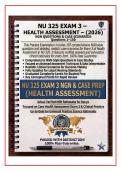
, NU 325 Exam 3 – Health Assessment – NGN Questions
& Case Scenarios
200 Questions with Correct Answers & Detailed
Rationales
Exam 3 Overview
Exam 3 covers the following topics:
• Heart and Neck Vessels
• Peripheral Vascular and Lymphatic System
• Abdomen
• Musculoskeletal System
• Neurologic System
• Breasts and Axillae
• NGN-Style Case Scenarios with Clinical Judgment
Questions
SECTION 1: Heart and Neck Vessels (Questions 1-30)
,1. The nurse is assessing a patient's heart sounds. The
S1 heart sound ("lub") is best heard at which location?
A) The base of the heart
B) The apex of the heart
C) The left sternal border
D) The right second intercostal space
Answer: B
Rationale: S1 is the closure of the mitral and tricuspid
valves (atrioventricular valves) and is best heard at the
apex (mitral area). S2 is best heard at the base.
2. A patient with a history of hypertension has a
sustained, heaving PMI at the 6th intercostal space,
anterior axillary line. This finding suggests:
A) Right ventricular hypertrophy
B) Left ventricular hypertrophy (pressure overload)
C) Dilated cardiomyopathy
D) Pericardial effusion
Answer: B
Rationale: A sustained, forceful PMI displaced laterally
and inferiorly indicates left ventricular hypertrophy from
chronic pressure overload (e.g., hypertension).
, 3. The nurse auscultates a patient's heart and hears an S3
k k k k k k k k k k
gallop. In an adult, this finding is most consistent with:
k k k k k k k k k k
A) A normal finding
k k k
B) Heart failure
k k
C) Aortic stenosis
k k
D) Atrial fibrillation
k k
Answer: B k
Rationale: S3 is caused by rapid ventricular filling in early
k k k k k k k k k
diastole and is often heard in conditions of increased
k k k k k k k k k
ventricular volume, such as heart failure. In adults, S3 is
k k k k k k k k k k
abnormal.
k
4. A split S2 that widens on inspiration and narrows on
k k k k k k k k k k
expiration is described as:
k k k k
A) Paradoxical splitting
k k
B) Fixed splitting
k k
C) Physiologic (normal) splitting
k k k
D) Reverse splitting
k k
Answer: C k
& Case Scenarios
200 Questions with Correct Answers & Detailed
Rationales
Exam 3 Overview
Exam 3 covers the following topics:
• Heart and Neck Vessels
• Peripheral Vascular and Lymphatic System
• Abdomen
• Musculoskeletal System
• Neurologic System
• Breasts and Axillae
• NGN-Style Case Scenarios with Clinical Judgment
Questions
SECTION 1: Heart and Neck Vessels (Questions 1-30)
,1. The nurse is assessing a patient's heart sounds. The
S1 heart sound ("lub") is best heard at which location?
A) The base of the heart
B) The apex of the heart
C) The left sternal border
D) The right second intercostal space
Answer: B
Rationale: S1 is the closure of the mitral and tricuspid
valves (atrioventricular valves) and is best heard at the
apex (mitral area). S2 is best heard at the base.
2. A patient with a history of hypertension has a
sustained, heaving PMI at the 6th intercostal space,
anterior axillary line. This finding suggests:
A) Right ventricular hypertrophy
B) Left ventricular hypertrophy (pressure overload)
C) Dilated cardiomyopathy
D) Pericardial effusion
Answer: B
Rationale: A sustained, forceful PMI displaced laterally
and inferiorly indicates left ventricular hypertrophy from
chronic pressure overload (e.g., hypertension).
, 3. The nurse auscultates a patient's heart and hears an S3
k k k k k k k k k k
gallop. In an adult, this finding is most consistent with:
k k k k k k k k k k
A) A normal finding
k k k
B) Heart failure
k k
C) Aortic stenosis
k k
D) Atrial fibrillation
k k
Answer: B k
Rationale: S3 is caused by rapid ventricular filling in early
k k k k k k k k k
diastole and is often heard in conditions of increased
k k k k k k k k k
ventricular volume, such as heart failure. In adults, S3 is
k k k k k k k k k k
abnormal.
k
4. A split S2 that widens on inspiration and narrows on
k k k k k k k k k k
expiration is described as:
k k k k
A) Paradoxical splitting
k k
B) Fixed splitting
k k
C) Physiologic (normal) splitting
k k k
D) Reverse splitting
k k
Answer: C k


