
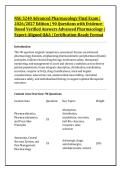
NSG 5240 Advanced Pharmacology Final Exam |
2026/2027 Edition | 90 Questions with Evidence-
Based Verified Answers Advanced Pharmacology |
Expert-Aligned Q&A | Certification-Ready Format
Introduction
This 90-question original competency assessment focuses on advanced
pharmacology domains, emphasizing pharmacokinetic and pharmacodynamic
principles, evidence-based drug therapy, medication safety, therapeutic
monitoring, and management of acute and chronic conditions across diverse
patient populations. Items integrate absorption, distribution, metabolism,
excretion, receptor activity, drug classifications, renal and hepatic
considerations, interaction risk, antimicrobial stewardship, controlled
substance safety, and individualized therapy to support optimal therapeutic
outcomes.
Content Area Overview: 90 Questions
Content Area Questions Key Topics Weight
Absorption,
Pharmacokinetics, distribution,
Pharmacodynamics, metabolism, excretion,
18 20%
and Prescriber half-life, clearance,
Principles receptors, dose
selection
Autonomic, Central
Nervous System, and Adrenergic drugs,
18 anticholinergics, 20%
Pain Management
Pharmacology antidepressants, seizure
,Content Area Questions Key Topics Weight
therapy, opioids, pain
safety
Hypertension, heart
Cardiovascular, Renal,
failure, anticoagulants,
and Endocrine System 23 25%
lipids, thyroid, diabetes,
Pharmacology
renal dosing
Antibiotic stewardship,
Anti-infective,
antivirals, antifungals,
Immune, and
18 corticosteroids, 20%
Inflammatory
immunomodulators,
Pharmacology
toxicity
Older adults, pregnancy,
Prescriber Safety, lactation, pediatrics,
Ethics, and Special 13 cost, controlled 15%
Populations substances, medication
reconciliation
1. A patient with chronic kidney disease is prescribed a medication
primarily eliminated unchanged in the urine. Which action is most
appropriate?
A. Give the usual adult dose without adjustment
B. Adjust dose or interval based on renal function and therapeutic need
C. Double the dose to overcome renal impairment
D. Stop all medications metabolized by the liver
Correct Answer: B. Adjust dose or interval based on renal function and
therapeutic need
,Rationale: Reduced renal clearance increases drug exposure and toxicity risk,
so dosage individualization is required.
2. Which pharmacokinetic parameter best determines a loading dose?
A. Half-life only
B. Clearance only
C. Protein binding only
D. Volume of distribution
Correct Answer: D. Volume of distribution
Rationale: Loading dose is based on target concentration and volume of
distribution, because it estimates the amount needed to fill body
compartments.
3. A medication with high first-pass metabolism is administered orally.
Which statement best describes the expected outcome?
A. Increased bioavailability compared to intravenous administration
B. Significant reduction in bioavailability before reaching systemic circulation
C. No effect on drug concentration in the bloodstream
D. Complete absorption with no hepatic extraction
Correct Answer: B. Significant reduction in bioavailability before
reaching systemic circulation
Rationale: First-pass metabolism in the liver reduces the amount of active
drug entering systemic circulation after oral administration.
4. Which factor most significantly increases the risk of digoxin toxicity in
an elderly patient?
A. Increased glomerular filtration rate
B. Decreased lean body mass and reduced renal clearance
C. Enhanced hepatic metabolism
D. Increased protein binding capacity
, Correct Answer: B. Decreased lean body mass and reduced renal
clearance
Rationale: Aging reduces renal function and lean body mass, altering digoxin
distribution and elimination, increasing toxicity risk.
5. A patient is started on a drug with a narrow therapeutic index. Which
monitoring strategy is most appropriate?
A. Monitor only for adverse effects
B. Check trough levels at steady state and adjust dose as needed
C. No monitoring is required due to high safety margin
D. Monitor peak levels only
Correct Answer: B. Check trough levels at steady state and adjust dose as
needed
Rationale: Narrow therapeutic index drugs require therapeutic drug
monitoring to maintain levels within safe and effective ranges.
6. Which pharmacokinetic process is primarily responsible for drug
elimination from the body?
A. Absorption
B. Distribution
C. Metabolism and excretion
D. Protein binding
Correct Answer: C. Metabolism and excretion
Rationale: Metabolism converts drugs to more water-soluble forms, and
excretion removes them from the body.
7. A patient with hepatic cirrhosis is prescribed a medication extensively
metabolized by the liver. Which action is most appropriate?
A. Administer the usual dose without adjustment
B. Increase the dose to compensate for impaired metabolism
2026/2027 Edition | 90 Questions with Evidence-
Based Verified Answers Advanced Pharmacology |
Expert-Aligned Q&A | Certification-Ready Format
Introduction
This 90-question original competency assessment focuses on advanced
pharmacology domains, emphasizing pharmacokinetic and pharmacodynamic
principles, evidence-based drug therapy, medication safety, therapeutic
monitoring, and management of acute and chronic conditions across diverse
patient populations. Items integrate absorption, distribution, metabolism,
excretion, receptor activity, drug classifications, renal and hepatic
considerations, interaction risk, antimicrobial stewardship, controlled
substance safety, and individualized therapy to support optimal therapeutic
outcomes.
Content Area Overview: 90 Questions
Content Area Questions Key Topics Weight
Absorption,
Pharmacokinetics, distribution,
Pharmacodynamics, metabolism, excretion,
18 20%
and Prescriber half-life, clearance,
Principles receptors, dose
selection
Autonomic, Central
Nervous System, and Adrenergic drugs,
18 anticholinergics, 20%
Pain Management
Pharmacology antidepressants, seizure
,Content Area Questions Key Topics Weight
therapy, opioids, pain
safety
Hypertension, heart
Cardiovascular, Renal,
failure, anticoagulants,
and Endocrine System 23 25%
lipids, thyroid, diabetes,
Pharmacology
renal dosing
Antibiotic stewardship,
Anti-infective,
antivirals, antifungals,
Immune, and
18 corticosteroids, 20%
Inflammatory
immunomodulators,
Pharmacology
toxicity
Older adults, pregnancy,
Prescriber Safety, lactation, pediatrics,
Ethics, and Special 13 cost, controlled 15%
Populations substances, medication
reconciliation
1. A patient with chronic kidney disease is prescribed a medication
primarily eliminated unchanged in the urine. Which action is most
appropriate?
A. Give the usual adult dose without adjustment
B. Adjust dose or interval based on renal function and therapeutic need
C. Double the dose to overcome renal impairment
D. Stop all medications metabolized by the liver
Correct Answer: B. Adjust dose or interval based on renal function and
therapeutic need
,Rationale: Reduced renal clearance increases drug exposure and toxicity risk,
so dosage individualization is required.
2. Which pharmacokinetic parameter best determines a loading dose?
A. Half-life only
B. Clearance only
C. Protein binding only
D. Volume of distribution
Correct Answer: D. Volume of distribution
Rationale: Loading dose is based on target concentration and volume of
distribution, because it estimates the amount needed to fill body
compartments.
3. A medication with high first-pass metabolism is administered orally.
Which statement best describes the expected outcome?
A. Increased bioavailability compared to intravenous administration
B. Significant reduction in bioavailability before reaching systemic circulation
C. No effect on drug concentration in the bloodstream
D. Complete absorption with no hepatic extraction
Correct Answer: B. Significant reduction in bioavailability before
reaching systemic circulation
Rationale: First-pass metabolism in the liver reduces the amount of active
drug entering systemic circulation after oral administration.
4. Which factor most significantly increases the risk of digoxin toxicity in
an elderly patient?
A. Increased glomerular filtration rate
B. Decreased lean body mass and reduced renal clearance
C. Enhanced hepatic metabolism
D. Increased protein binding capacity
, Correct Answer: B. Decreased lean body mass and reduced renal
clearance
Rationale: Aging reduces renal function and lean body mass, altering digoxin
distribution and elimination, increasing toxicity risk.
5. A patient is started on a drug with a narrow therapeutic index. Which
monitoring strategy is most appropriate?
A. Monitor only for adverse effects
B. Check trough levels at steady state and adjust dose as needed
C. No monitoring is required due to high safety margin
D. Monitor peak levels only
Correct Answer: B. Check trough levels at steady state and adjust dose as
needed
Rationale: Narrow therapeutic index drugs require therapeutic drug
monitoring to maintain levels within safe and effective ranges.
6. Which pharmacokinetic process is primarily responsible for drug
elimination from the body?
A. Absorption
B. Distribution
C. Metabolism and excretion
D. Protein binding
Correct Answer: C. Metabolism and excretion
Rationale: Metabolism converts drugs to more water-soluble forms, and
excretion removes them from the body.
7. A patient with hepatic cirrhosis is prescribed a medication extensively
metabolized by the liver. Which action is most appropriate?
A. Administer the usual dose without adjustment
B. Increase the dose to compensate for impaired metabolism


