

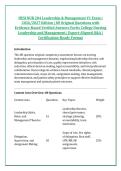
HESI NUR 204 Leadership & Management V1 Exam |
2026/2027 Edition | 80 Original Questions with
Evidence-Based Verified Answers Fortis College Nursing
Leadership and Management | Expert-Aligned Q&A |
Certification-Ready Format
Introduction
This 80-question original competency assessment focuses on nursing
leadership and management domains, emphasizing leadership theories, safe
delegation, prioritization of care, quality improvement initiatives, risk
reduction, ethical decision-making, legal accountability, and interprofessional
collaboration. Items integrate evidence-based standards, clinical judgment,
communication tools, scope of role, assignment-making, time management,
documentation, and patient safety principles to support effective healthcare
team management and optimal patient outcomes.
Content Area Overview: 80 Questions
Content Area Questions Key Topics Weight
Leadership theories,
Leadership Styles, shared governance,
Roles, and 16 strategic planning, 20%
Management Theories accountability, team
motivation
Scope of role, five rights
Delegation, of delegation, float staff,
Supervision, and 20 LPN/RN/AP 25%
Assignment Making assignments,
supervision
,Content Area Questions Key Topics Weight
Airway priorities,
Prioritization, Time urgent cues, clinical
Management, and 16 judgment, time 20%
Decision Making management, provider
notification
Falls, medication safety,
Quality Improvement, infection prevention,
Patient Safety, and 16 root cause analysis, 20%
Risk Management documentation, near
misses
Healthcare Ethics, Autonomy, fidelity,
Legal Issues, and mandatory reporting,
12 15%
Interprofessional privacy, SBAR, unsafe
Collaboration orders, teamwork
1. A nurse manager invites staff nurses to help redesign the medication-
room workflow and uses their feedback before making the final
decision. Which leadership style is being demonstrated?
• A. Autocratic leadership
• B. Democratic leadership
• C. Laissez-faire leadership
• D. Transactional leadership only
Correct Answer: B
Rationale: Democratic leadership uses staff participation, shared input, and
collaborative decision-making while the leader remains accountable for final
outcomes.
,Why Wrong: A, C, D are incorrect because they delay priority care, exceed
role limits, weaken accountability, or conflict with leadership standards and
client safety requirements.
Reference: 2026 HESI NUR 204-aligned Module 1; Marquis and Huston
leadership theory chapters; Yoder-Wise leadership text.
2. A charge nurse makes an immediate staffing decision during a power
outage and clearly directs each staff member where to go. Which
leadership style is most appropriate in this urgent situation?
• A. Autocratic leadership
• B. Democratic leadership
• C. Laissez-faire leadership
• D. Transformational leadership
Correct Answer: A
Rationale: Autocratic leadership is most effective in emergencies where
quick, decisive action is needed without time for group discussion.
Why Wrong: B, C, D are incorrect because democratic and transformational
approaches require time for input, and laissez-faire provides insufficient
direction in emergencies.
Reference: 2026 HESI NUR 204-aligned Module 1; emergency management
protocols.
3. A nurse leader focuses on inspiring staff to achieve excellence and
promotes a shared vision for patient care improvements. Which
leadership theory is being applied?
• A. Transactional leadership
• B. Transformational leadership
• C. Bureaucratic leadership
, • D. Situational leadership
Correct Answer: B
Rationale: Transformational leadership inspires and motivates followers to
achieve exceptional outcomes through shared vision and intellectual
stimulation.
Why Wrong: A focuses on rewards and punishments; C emphasizes rules; D
adapts to situations but doesn't specifically inspire transformation.
Reference: 2026 HESI NUR 204-aligned Module 1; transformational
leadership theory.
4. A new graduate nurse asks about the purpose of shared governance.
Which response by the nurse manager is most accurate?
• A. It eliminates all management decisions
• B. It empowers nurses to participate in decisions affecting their
practice
• C. It replaces the need for nurse managers
• D. It only applies to unionized facilities
Correct Answer: B
Rationale: Shared governance provides a structure for nurses to have input
into practice decisions, policy development, and quality improvement.
Why Wrong: A, C, D are incorrect as shared governance complements
management rather than replacing it and applies broadly, not only to union
settings.
Reference: 2026 HESI NUR 204-aligned Module 1; shared governance
models.
5. A nurse manager uses rewards and corrective actions to ensure staff
compliance with policies. This approach reflects which leadership
theory?
2026/2027 Edition | 80 Original Questions with
Evidence-Based Verified Answers Fortis College Nursing
Leadership and Management | Expert-Aligned Q&A |
Certification-Ready Format
Introduction
This 80-question original competency assessment focuses on nursing
leadership and management domains, emphasizing leadership theories, safe
delegation, prioritization of care, quality improvement initiatives, risk
reduction, ethical decision-making, legal accountability, and interprofessional
collaboration. Items integrate evidence-based standards, clinical judgment,
communication tools, scope of role, assignment-making, time management,
documentation, and patient safety principles to support effective healthcare
team management and optimal patient outcomes.
Content Area Overview: 80 Questions
Content Area Questions Key Topics Weight
Leadership theories,
Leadership Styles, shared governance,
Roles, and 16 strategic planning, 20%
Management Theories accountability, team
motivation
Scope of role, five rights
Delegation, of delegation, float staff,
Supervision, and 20 LPN/RN/AP 25%
Assignment Making assignments,
supervision
,Content Area Questions Key Topics Weight
Airway priorities,
Prioritization, Time urgent cues, clinical
Management, and 16 judgment, time 20%
Decision Making management, provider
notification
Falls, medication safety,
Quality Improvement, infection prevention,
Patient Safety, and 16 root cause analysis, 20%
Risk Management documentation, near
misses
Healthcare Ethics, Autonomy, fidelity,
Legal Issues, and mandatory reporting,
12 15%
Interprofessional privacy, SBAR, unsafe
Collaboration orders, teamwork
1. A nurse manager invites staff nurses to help redesign the medication-
room workflow and uses their feedback before making the final
decision. Which leadership style is being demonstrated?
• A. Autocratic leadership
• B. Democratic leadership
• C. Laissez-faire leadership
• D. Transactional leadership only
Correct Answer: B
Rationale: Democratic leadership uses staff participation, shared input, and
collaborative decision-making while the leader remains accountable for final
outcomes.
,Why Wrong: A, C, D are incorrect because they delay priority care, exceed
role limits, weaken accountability, or conflict with leadership standards and
client safety requirements.
Reference: 2026 HESI NUR 204-aligned Module 1; Marquis and Huston
leadership theory chapters; Yoder-Wise leadership text.
2. A charge nurse makes an immediate staffing decision during a power
outage and clearly directs each staff member where to go. Which
leadership style is most appropriate in this urgent situation?
• A. Autocratic leadership
• B. Democratic leadership
• C. Laissez-faire leadership
• D. Transformational leadership
Correct Answer: A
Rationale: Autocratic leadership is most effective in emergencies where
quick, decisive action is needed without time for group discussion.
Why Wrong: B, C, D are incorrect because democratic and transformational
approaches require time for input, and laissez-faire provides insufficient
direction in emergencies.
Reference: 2026 HESI NUR 204-aligned Module 1; emergency management
protocols.
3. A nurse leader focuses on inspiring staff to achieve excellence and
promotes a shared vision for patient care improvements. Which
leadership theory is being applied?
• A. Transactional leadership
• B. Transformational leadership
• C. Bureaucratic leadership
, • D. Situational leadership
Correct Answer: B
Rationale: Transformational leadership inspires and motivates followers to
achieve exceptional outcomes through shared vision and intellectual
stimulation.
Why Wrong: A focuses on rewards and punishments; C emphasizes rules; D
adapts to situations but doesn't specifically inspire transformation.
Reference: 2026 HESI NUR 204-aligned Module 1; transformational
leadership theory.
4. A new graduate nurse asks about the purpose of shared governance.
Which response by the nurse manager is most accurate?
• A. It eliminates all management decisions
• B. It empowers nurses to participate in decisions affecting their
practice
• C. It replaces the need for nurse managers
• D. It only applies to unionized facilities
Correct Answer: B
Rationale: Shared governance provides a structure for nurses to have input
into practice decisions, policy development, and quality improvement.
Why Wrong: A, C, D are incorrect as shared governance complements
management rather than replacing it and applies broadly, not only to union
settings.
Reference: 2026 HESI NUR 204-aligned Module 1; shared governance
models.
5. A nurse manager uses rewards and corrective actions to ensure staff
compliance with policies. This approach reflects which leadership
theory?


