

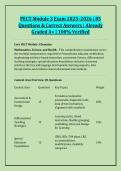
PECT Module 3 Exam 2025–2026 | 85
Questions & Correct Answers | Already
Graded A+ | 100% Verified
Core PECT Module 3 Domains
Mathematics, Science, and Health – This comprehensive examination covers
the essential competencies required for Pennsylvania educator certification,
emphasizing evidence-based instruction, assessment literacy, differentiated
teaching strategies, special education foundations, inclusive classroom
practices, literacy and language development, learning supports, data
interpretation, and evidence-based educational interventions.
Content Area Overview: 85 Questions
Content Area Questions Key Topics Weight
Formative/summative
Assessment &
assessment, diagnostic tools,
Instructional 15 18%
data-driven instruction,
Design
alignment with standards
Learning styles, tiered
Differentiated
instruction, flexible grouping,
Teaching 12 14%
scaffolding, Universal Design
Strategies
for Learning
IDEA, IEPs, 504 plans, LRE,
Special
accommodations,
Education 12 14%
modifications, disability
Foundations
categories
,Content Area Questions Key Topics Weight
Co-teaching, classroom
Inclusive
management, positive
Classroom 12 14%
behavior supports, cultural
Practices
responsiveness
Phonemic awareness, phonics,
Literacy &
fluency, vocabulary,
Language 12 14%
comprehension, ELL
Development
strategies
Learning RTI/MTSS, progress
Supports & 12 monitoring, evidence-based 14%
Interventions interventions, remediation
Analyzing student data,
Data graphing, interpreting
10 12%
Interpretation assessment results,
instructional decision-making
1. A teacher gives a pre-test on fractions before designing a unit. The
primary purpose is to:
• A. Assign grades
• B. Compare classes
• C. Identify students' readiness and misconceptions
• D. Satisfy district requirements
Correct Answer: C. Identify students' readiness and misconceptions
,Rationale: Diagnostic data guide differentiated instruction and pacing
decisions. A pre-test reveals what students already know and where gaps
exist, allowing the teacher to tailor instruction to meet specific student needs
rather than proceeding with a one-size-fits-all approach.
Why Wrong: A is incorrect (pre-tests are not for grading); B is incorrect
(comparing classes is not the primary purpose); D is incorrect (compliance is
secondary to instructional planning).
2. Which item is most critical when aligning assessments with
Pennsylvania Core Standards?
• A. Length of test
• B. Font size
• C. Cognitive complexity matches standard verbs (e.g., analyze,
evaluate)
• D. Multiple-choice format
Correct Answer: C. Cognitive complexity matches standard verbs (e.g.,
analyze, evaluate)
Rationale: Verb level determines required thinking depth; alignment ensures
validity. If a standard uses "analyze," the assessment must require analysis,
not just recall. This ensures the assessment accurately measures whether
students have met the standard.
Why Wrong: A is incorrect (length does not ensure alignment); B is incorrect
(font size is an accessibility consideration, not alignment); D is incorrect
(format alone does not ensure cognitive alignment).
3. A student scores 45% on a criterion-referenced test. The most
appropriate next step is to:
• A. Retain student in grade
• B. Label student as failing
, • C. Provide targeted remediation and reassess
• D. Move on to next unit
Correct Answer: C. Provide targeted remediation and reassess
Rationale: Criterion-referenced data indicate mastery gaps, not normative
failure. A score of 45% shows the student has not yet mastered the content,
and the appropriate instructional response is targeted intervention followed
by reassessment to measure growth.
Why Wrong: A is incorrect (retention is not the first response); B is incorrect
(labeling is not instructional); D is incorrect (moving on without addressing
gaps will compound difficulties).
4. Which assessment type best measures higher-order thinking?
• A. True/false quiz
• B. Fill-in-the-blank
• C. Performance task requiring analysis and synthesis
• D. Matching worksheet
Correct Answer: C. Performance task requiring analysis and synthesis
Rationale: Performance tasks require application of knowledge in authentic
contexts. They demand that students analyze, synthesize, and evaluate—
higher-order thinking skills that cannot be measured through simple recall
items like true/false or matching.
Why Wrong: A, B, and D are incorrect because they primarily measure recall
and recognition rather than higher-order thinking.
5. A teacher wants to determine if students have mastered the learning
objectives for a unit. Which type of assessment should be used?
• A. Diagnostic assessment
• B. Summative assessment
Questions & Correct Answers | Already
Graded A+ | 100% Verified
Core PECT Module 3 Domains
Mathematics, Science, and Health – This comprehensive examination covers
the essential competencies required for Pennsylvania educator certification,
emphasizing evidence-based instruction, assessment literacy, differentiated
teaching strategies, special education foundations, inclusive classroom
practices, literacy and language development, learning supports, data
interpretation, and evidence-based educational interventions.
Content Area Overview: 85 Questions
Content Area Questions Key Topics Weight
Formative/summative
Assessment &
assessment, diagnostic tools,
Instructional 15 18%
data-driven instruction,
Design
alignment with standards
Learning styles, tiered
Differentiated
instruction, flexible grouping,
Teaching 12 14%
scaffolding, Universal Design
Strategies
for Learning
IDEA, IEPs, 504 plans, LRE,
Special
accommodations,
Education 12 14%
modifications, disability
Foundations
categories
,Content Area Questions Key Topics Weight
Co-teaching, classroom
Inclusive
management, positive
Classroom 12 14%
behavior supports, cultural
Practices
responsiveness
Phonemic awareness, phonics,
Literacy &
fluency, vocabulary,
Language 12 14%
comprehension, ELL
Development
strategies
Learning RTI/MTSS, progress
Supports & 12 monitoring, evidence-based 14%
Interventions interventions, remediation
Analyzing student data,
Data graphing, interpreting
10 12%
Interpretation assessment results,
instructional decision-making
1. A teacher gives a pre-test on fractions before designing a unit. The
primary purpose is to:
• A. Assign grades
• B. Compare classes
• C. Identify students' readiness and misconceptions
• D. Satisfy district requirements
Correct Answer: C. Identify students' readiness and misconceptions
,Rationale: Diagnostic data guide differentiated instruction and pacing
decisions. A pre-test reveals what students already know and where gaps
exist, allowing the teacher to tailor instruction to meet specific student needs
rather than proceeding with a one-size-fits-all approach.
Why Wrong: A is incorrect (pre-tests are not for grading); B is incorrect
(comparing classes is not the primary purpose); D is incorrect (compliance is
secondary to instructional planning).
2. Which item is most critical when aligning assessments with
Pennsylvania Core Standards?
• A. Length of test
• B. Font size
• C. Cognitive complexity matches standard verbs (e.g., analyze,
evaluate)
• D. Multiple-choice format
Correct Answer: C. Cognitive complexity matches standard verbs (e.g.,
analyze, evaluate)
Rationale: Verb level determines required thinking depth; alignment ensures
validity. If a standard uses "analyze," the assessment must require analysis,
not just recall. This ensures the assessment accurately measures whether
students have met the standard.
Why Wrong: A is incorrect (length does not ensure alignment); B is incorrect
(font size is an accessibility consideration, not alignment); D is incorrect
(format alone does not ensure cognitive alignment).
3. A student scores 45% on a criterion-referenced test. The most
appropriate next step is to:
• A. Retain student in grade
• B. Label student as failing
, • C. Provide targeted remediation and reassess
• D. Move on to next unit
Correct Answer: C. Provide targeted remediation and reassess
Rationale: Criterion-referenced data indicate mastery gaps, not normative
failure. A score of 45% shows the student has not yet mastered the content,
and the appropriate instructional response is targeted intervention followed
by reassessment to measure growth.
Why Wrong: A is incorrect (retention is not the first response); B is incorrect
(labeling is not instructional); D is incorrect (moving on without addressing
gaps will compound difficulties).
4. Which assessment type best measures higher-order thinking?
• A. True/false quiz
• B. Fill-in-the-blank
• C. Performance task requiring analysis and synthesis
• D. Matching worksheet
Correct Answer: C. Performance task requiring analysis and synthesis
Rationale: Performance tasks require application of knowledge in authentic
contexts. They demand that students analyze, synthesize, and evaluate—
higher-order thinking skills that cannot be measured through simple recall
items like true/false or matching.
Why Wrong: A, B, and D are incorrect because they primarily measure recall
and recognition rather than higher-order thinking.
5. A teacher wants to determine if students have mastered the learning
objectives for a unit. Which type of assessment should be used?
• A. Diagnostic assessment
• B. Summative assessment


