

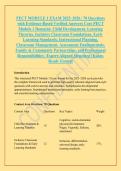
PECT MODULE 1 EXAM 2025–2026 | 70 Questions
with Evidence-Based Verified Answers Core PECT
Module 1 Domains: Child Development, Learning
Theories, Inclusive Classroom Foundations, Early
Learning Standards, Instructional Planning,
Classroom Management, Assessment Fundamentals,
Family & Community Partnerships, and Professional
Responsibilities | Expert-Aligned Structure | Exam-
Ready Format
Introduction
This structured PECT Module 1 Exam format for the 2025–2026 cycle provides
the complete framework used to generate high-quality educator-aligned exam-style
questions with correct answers and rationales. It emphasizes developmental
appropriateness, foundational instructional principles, early learning best practices,
and essential teaching competencies.
Content Area Overview: 70 Questions
Content Area Questions Key Topics Weight
Cognitive, social-emotional,
Child Development & physical development;
14 20%
Learning Theories Piaget, Vygotsky, Erikson,
attachment
Inclusive Classroom Inclusion, differentiation,
Foundations & Early 12 universal design, early 17%
Learning Standards learning standards,
,Content Area Questions Key Topics Weight
developmentally appropriate
practice
Lesson planning, objectives,
Instructional Planning scope and sequence,
12 17%
& Curriculum Design thematic units, curriculum
alignment
Classroom Behavior management,
Management & positive guidance, trauma-
10 14%
Positive Behavior informed practices, routines,
Support transitions
Formative, summative,
Assessment diagnostic assessment;
8 11%
Fundamentals authentic assessment;
progress monitoring
Home-school collaboration,
Family & Community community resources,
8 11%
Partnerships cultural responsiveness,
family engagement
Teacher ethics,
Professional
confidentiality, professional
Responsibilities & 6 9%
development, legal
Ethics
responsibilities, advocacy
Answer Format
, All correct answers appear in bold, followed by concise, evidence-informed
rationales explaining educational reasoning, student-support priorities, and why
alternate options are less effective.
CHILD DEVELOPMENT & LEARNING THEORIES (Questions 1–14)
1. A four-year-old who counts to 30 but cannot yet conserve quantity is
demonstrating:
a) Accelerated giftedness
b) Typical asynchronous development
c) Learning disability
d) Over-reliance on rote memory
Correct Answer: b) Typical asynchronous development
Rationale: Pre-operational children often show advanced rote skills while lacking
underlying logical operations such as conservation, which is developmentally
appropriate for this age.
2. According to Vygotsky, the most effective way to help a struggling
kindergartener blend phonemes is to:
a) Repeat the task independently until mastery
b) Provide mediated scaffolding within the child's ZPD
c) Delay instruction until Grade 1
d) Offer extrinsic rewards for speed
Correct Answer: b) Provide mediated scaffolding within the child's ZPD
Rationale: Targeted support in the Zone of Proximal Development accelerates
skill internalization through guided assistance from a more knowledgeable adult or
peer.
3. A toddler repeatedly drops food from a high-chair to watch it fall. This best
illustrates:
with Evidence-Based Verified Answers Core PECT
Module 1 Domains: Child Development, Learning
Theories, Inclusive Classroom Foundations, Early
Learning Standards, Instructional Planning,
Classroom Management, Assessment Fundamentals,
Family & Community Partnerships, and Professional
Responsibilities | Expert-Aligned Structure | Exam-
Ready Format
Introduction
This structured PECT Module 1 Exam format for the 2025–2026 cycle provides
the complete framework used to generate high-quality educator-aligned exam-style
questions with correct answers and rationales. It emphasizes developmental
appropriateness, foundational instructional principles, early learning best practices,
and essential teaching competencies.
Content Area Overview: 70 Questions
Content Area Questions Key Topics Weight
Cognitive, social-emotional,
Child Development & physical development;
14 20%
Learning Theories Piaget, Vygotsky, Erikson,
attachment
Inclusive Classroom Inclusion, differentiation,
Foundations & Early 12 universal design, early 17%
Learning Standards learning standards,
,Content Area Questions Key Topics Weight
developmentally appropriate
practice
Lesson planning, objectives,
Instructional Planning scope and sequence,
12 17%
& Curriculum Design thematic units, curriculum
alignment
Classroom Behavior management,
Management & positive guidance, trauma-
10 14%
Positive Behavior informed practices, routines,
Support transitions
Formative, summative,
Assessment diagnostic assessment;
8 11%
Fundamentals authentic assessment;
progress monitoring
Home-school collaboration,
Family & Community community resources,
8 11%
Partnerships cultural responsiveness,
family engagement
Teacher ethics,
Professional
confidentiality, professional
Responsibilities & 6 9%
development, legal
Ethics
responsibilities, advocacy
Answer Format
, All correct answers appear in bold, followed by concise, evidence-informed
rationales explaining educational reasoning, student-support priorities, and why
alternate options are less effective.
CHILD DEVELOPMENT & LEARNING THEORIES (Questions 1–14)
1. A four-year-old who counts to 30 but cannot yet conserve quantity is
demonstrating:
a) Accelerated giftedness
b) Typical asynchronous development
c) Learning disability
d) Over-reliance on rote memory
Correct Answer: b) Typical asynchronous development
Rationale: Pre-operational children often show advanced rote skills while lacking
underlying logical operations such as conservation, which is developmentally
appropriate for this age.
2. According to Vygotsky, the most effective way to help a struggling
kindergartener blend phonemes is to:
a) Repeat the task independently until mastery
b) Provide mediated scaffolding within the child's ZPD
c) Delay instruction until Grade 1
d) Offer extrinsic rewards for speed
Correct Answer: b) Provide mediated scaffolding within the child's ZPD
Rationale: Targeted support in the Zone of Proximal Development accelerates
skill internalization through guided assistance from a more knowledgeable adult or
peer.
3. A toddler repeatedly drops food from a high-chair to watch it fall. This best
illustrates:


