
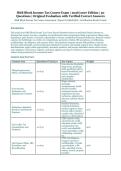
H&R Block Income Tax Course Exam | 2026/2027 Edition | 50
Questions | Original Evaluation with Verified Correct Answers
H&R Block Income Tax Course Assessment | Expert-Verified Q&A | Certification-Ready Format
Introduction
This 2026/2027 H&R Block Income Tax Course Exam Evaluation focuses on individual federal income tax
domains that support accurate, compliant, and professional return preparation: filing requirements, filing status,
dependents, gross income, exclusions, adjustments to income, standard and itemized deductions, business-related
expenses for individuals, tax credits, tax computations, payments, refunds, IRS procedures, recordkeeping,
confidentiality, due diligence, and preparer ethics. The questions integrate current IRS guidelines, Internal
Revenue Code principles, and tax preparation standards so learners can identify taxpayer facts, classify income
and deductions, apply credits appropriately, document positions, and prepare individual returns with accuracy
and compliance. Each item is original, curriculum-aligned, and expert-verified for accurate Evaluation readiness
without using proprietary live assessment items.
Content Area Overview
Content Area Questions (Total 50) Key Topics Weight
Gross income thresholds,
filing status, qualifying
child, qualifying relative,
Filing Requirements,
10 of 50 head of household, joint 20%
Status, and Dependents
returns, dependency
tests, taxpayer
identification
Wages, interest,
dividends,
unemployment, Social
Gross Income, Security benefits,
Exclusions, and 10 of 50 retirement income, self- 20%
Adjustments to Income employment income,
exclusions, adjustments,
educator and IRA-related
items
Standard deduction,
itemized deductions,
Deductions: Standard,
medical expenses, taxes,
Itemized, and Business 10 of 50 20%
interest, gifts to charity,
Expenses
casualty rules, Schedule C
expenses, substantiation
Child-related credits,
earned income credit,
education credits, child
Tax Credits, Tax
and dependent care
Computations, and 10 of 50 20%
credit, nonrefundable
Payments
versus refundable credits,
withholding, estimated
tax
PTIN, due diligence,
taxpayer interviews,
Tax Preparer Ethics, IRS confidentiality, Circular
Procedures, and 10 of 50 230 principles, e-file 20%
Recordkeeping rules, amended returns,
notices, records, preparer
penalties
, Examination Questions
Domain: Filing Requirements, Status, and Dependents
1. Which factor is most important when determining whether an individual must file a federal
income tax return?
A. Filing status, age, gross income, and dependency status
B. Favorite bank and preferred refund method only
C. State of birth only
D. Whether the taxpayer received a paper form in the mail
Correct Answer: A
Rationale: Federal filing requirements depend on filing status, age, gross income, and whether another
taxpayer can claim the individual as a dependent. A taxpayer may also need to file for other reasons, such as
self-employment tax or advance credit reconciliation.
2. A married couple is legally married on the last day of the tax year and wants to file one return
reporting combined income. Which filing status generally applies?
A. Single
B. Married filing jointly
C. Head of household automatically
D. Qualifying surviving spouse automatically
Correct Answer: B
Rationale: Marital status is generally determined on the last day of the tax year. A legally married couple
may generally file a joint return if both spouses agree and meet the requirements.
3. Which filing status is generally available to an unmarried taxpayer who pays more than half the
cost of keeping up a home for a qualifying person?
A. Married filing separately
B. Head of household
C. Single only
D. Dependent filer only
Correct Answer: B
Rationale: Head of household status generally requires the taxpayer to be unmarried or considered
unmarried, pay more than half the household cost, and have a qualifying person under IRS rules.
4. Which test is required for a qualifying child dependent?
A. Relationship test
B. Investor test
C. Home ownership test
D. Itemized deduction test
Correct Answer: A
Rationale: A qualifying child must meet relationship, age, residency, support, joint return, and taxpayer
identification requirements. The relationship test is one of the core dependency requirements.
5. A qualifying relative dependent must generally meet which requirement?
A. The taxpayer must provide more than half of the person's total support
B. The person must always live with the taxpayer regardless of relationship
C. The person must be under age five
D. The person must have wages greater than the taxpayer
Correct Answer: A
Rationale: For a qualifying relative, the taxpayer generally must provide more than half of the person's total
support, and the person must meet relationship or household, gross income, citizenship or residency, and joint
return rules.
6. Which statement is correct about a dependent filing a return?
A. A dependent may still have a filing requirement depending on income type and amount
B. A dependent is never allowed to file a return
C. A dependent always uses head of household status
D. A dependent can never receive a refund
Correct Answer: A
Rationale: Dependents may need to file if earned income, unearned income, gross income, or self-employment
income meets filing thresholds. Filing may also be useful to claim a refund of withholding.
Questions | Original Evaluation with Verified Correct Answers
H&R Block Income Tax Course Assessment | Expert-Verified Q&A | Certification-Ready Format
Introduction
This 2026/2027 H&R Block Income Tax Course Exam Evaluation focuses on individual federal income tax
domains that support accurate, compliant, and professional return preparation: filing requirements, filing status,
dependents, gross income, exclusions, adjustments to income, standard and itemized deductions, business-related
expenses for individuals, tax credits, tax computations, payments, refunds, IRS procedures, recordkeeping,
confidentiality, due diligence, and preparer ethics. The questions integrate current IRS guidelines, Internal
Revenue Code principles, and tax preparation standards so learners can identify taxpayer facts, classify income
and deductions, apply credits appropriately, document positions, and prepare individual returns with accuracy
and compliance. Each item is original, curriculum-aligned, and expert-verified for accurate Evaluation readiness
without using proprietary live assessment items.
Content Area Overview
Content Area Questions (Total 50) Key Topics Weight
Gross income thresholds,
filing status, qualifying
child, qualifying relative,
Filing Requirements,
10 of 50 head of household, joint 20%
Status, and Dependents
returns, dependency
tests, taxpayer
identification
Wages, interest,
dividends,
unemployment, Social
Gross Income, Security benefits,
Exclusions, and 10 of 50 retirement income, self- 20%
Adjustments to Income employment income,
exclusions, adjustments,
educator and IRA-related
items
Standard deduction,
itemized deductions,
Deductions: Standard,
medical expenses, taxes,
Itemized, and Business 10 of 50 20%
interest, gifts to charity,
Expenses
casualty rules, Schedule C
expenses, substantiation
Child-related credits,
earned income credit,
education credits, child
Tax Credits, Tax
and dependent care
Computations, and 10 of 50 20%
credit, nonrefundable
Payments
versus refundable credits,
withholding, estimated
tax
PTIN, due diligence,
taxpayer interviews,
Tax Preparer Ethics, IRS confidentiality, Circular
Procedures, and 10 of 50 230 principles, e-file 20%
Recordkeeping rules, amended returns,
notices, records, preparer
penalties
, Examination Questions
Domain: Filing Requirements, Status, and Dependents
1. Which factor is most important when determining whether an individual must file a federal
income tax return?
A. Filing status, age, gross income, and dependency status
B. Favorite bank and preferred refund method only
C. State of birth only
D. Whether the taxpayer received a paper form in the mail
Correct Answer: A
Rationale: Federal filing requirements depend on filing status, age, gross income, and whether another
taxpayer can claim the individual as a dependent. A taxpayer may also need to file for other reasons, such as
self-employment tax or advance credit reconciliation.
2. A married couple is legally married on the last day of the tax year and wants to file one return
reporting combined income. Which filing status generally applies?
A. Single
B. Married filing jointly
C. Head of household automatically
D. Qualifying surviving spouse automatically
Correct Answer: B
Rationale: Marital status is generally determined on the last day of the tax year. A legally married couple
may generally file a joint return if both spouses agree and meet the requirements.
3. Which filing status is generally available to an unmarried taxpayer who pays more than half the
cost of keeping up a home for a qualifying person?
A. Married filing separately
B. Head of household
C. Single only
D. Dependent filer only
Correct Answer: B
Rationale: Head of household status generally requires the taxpayer to be unmarried or considered
unmarried, pay more than half the household cost, and have a qualifying person under IRS rules.
4. Which test is required for a qualifying child dependent?
A. Relationship test
B. Investor test
C. Home ownership test
D. Itemized deduction test
Correct Answer: A
Rationale: A qualifying child must meet relationship, age, residency, support, joint return, and taxpayer
identification requirements. The relationship test is one of the core dependency requirements.
5. A qualifying relative dependent must generally meet which requirement?
A. The taxpayer must provide more than half of the person's total support
B. The person must always live with the taxpayer regardless of relationship
C. The person must be under age five
D. The person must have wages greater than the taxpayer
Correct Answer: A
Rationale: For a qualifying relative, the taxpayer generally must provide more than half of the person's total
support, and the person must meet relationship or household, gross income, citizenship or residency, and joint
return rules.
6. Which statement is correct about a dependent filing a return?
A. A dependent may still have a filing requirement depending on income type and amount
B. A dependent is never allowed to file a return
C. A dependent always uses head of household status
D. A dependent can never receive a refund
Correct Answer: A
Rationale: Dependents may need to file if earned income, unearned income, gross income, or self-employment
income meets filing thresholds. Filing may also be useful to claim a refund of withholding.


