

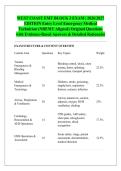
WEST COAST EMT BLOCK 3 EXAM | 2026/2027
EDITION Entry Level Emergency Medical
Technician (NREMT Aligned) Original Questions
with Evidence-Based Answers & Detailed Rationales
EXAM STRUCTURE & CONTENT OVERVIEW
Content Area Questions Key Topics Weight
Trauma
Bleeding control, shock, chest
Emergencies &
18 trauma, burns, splinting, 22.5%
Bleeding
evisceration, transport priority
Management
Medical Diabetes, stroke, poisoning,
Emergencies & 18 anaphylaxis, respiratory 22.5%
Toxicology distress, seizures, infection
Airway maneuvers, suction,
Airway, Respiration
20 adjuncts, oxygen, BVM 25%
& Ventilation
ventilation, choking
CPR quality, AED safety,
Cardiology,
chest pain, nitroglycerin
Resuscitation & 14 17.5%
precautions, shock
AED Operations
recognition
Scene safety, triage, patient
EMS Operations &
10 assessment, documentation, 12.5%
Assessment
medical direction
,DOMAIN 1: TRAUMA EMERGENCIES & BLEEDING MANAGEMENT
Questions 1–18
Q1. A 28-year-old construction worker has bright red spurting blood from a
forearm wound. What should the EMT do first after ensuring scene safety
and standard precautions?
• A) Apply a cervical collar before touching the wound
• B) Apply direct pressure with a gloved hand and dressing
• C) Give oral fluids to replace blood loss
• D) Begin a detailed secondary assessment before controlling bleeding
Rationale: Life-threatening external bleeding requires immediate control; direct
pressure is the first rapid intervention for most accessible wounds. Bright red
spurting blood indicates arterial bleeding, which is life-threatening and must be
controlled immediately.
Why Wrong: A, C, D are incorrect because they delay life threats or select an
intervention unrelated to the patient's immediate problem.
Q2. Direct pressure fails to control severe bleeding from a mangled lower leg.
Which action is most appropriate?
• A) Loosen the dressing to check circulation every minute
• B) Place ice directly inside the wound
• C) Delay transport until bleeding stops spontaneously
• D) Apply a commercial tourniquet proximal to the wound
Rationale: Uncontrolled severe extremity bleeding requires a tourniquet placed 2-
3 inches above the injury and tightened until bleeding stops. Tourniquets are
indicated when direct pressure fails or is not possible.
Why Wrong: A, B, C are incorrect because they delay definitive care or use
ineffective interventions.
,Q3. A patient with a knife wound to the chest has a sucking chest wound.
What is the priority intervention?
• A) Apply direct pressure over the wound
• B) Apply an occlusive dressing taped on three sides
• C) Insert a chest tube
• D) Place the patient in Trendelenburg position
Rationale: A three-sided occlusive dressing allows air to escape but prevents air
from entering the pleural space, preventing tension pneumothorax. The fourth side
remains untaped to act as a flutter valve.
Why Wrong: A is insufficient; C is beyond EMT scope; D does not address the
wound.
Q4. Which of the following is a sign of compensated shock?
• A) Bradycardia and hypotension
• B) Tachycardia with normal blood pressure
• C) Hypotension with altered mental status
• D) Absent peripheral pulses
Rationale: In compensated shock, the body maintains blood pressure through
tachycardia and peripheral vasoconstriction. Hypotension, altered mental status,
and absent peripheral pulses indicate decompensated shock.
Why Wrong: A, C, D are signs of decompensated shock.
Q5. A patient with a femur fracture has a deformed, shortened leg. What is
the best method to immobilize this injury?
• A) Apply a traction splint
• B) Apply an air splint
• C) Use pillows and blanket rolls
• D) Transport without immobilization
, Rationale: Traction splints are specifically designed for mid-shaft femur fractures
to reduce pain, decrease bleeding, and prevent further neurovascular injury by
applying gentle traction.
Why Wrong: B is for extremity fractures; C is a general immobilization
technique; D is inappropriate.
Q6. A patient with a closed head injury presents with one pupil dilated and
non-reactive. This finding is most consistent with:
• A) Hypoglycemia
• B) Increased intracranial pressure with herniation
• C) Stroke
• D) Seizure activity
Rationale: A dilated, non-reactive pupil (blown pupil) indicates uncal herniation
from increased intracranial pressure, a life-threatening emergency requiring rapid
transport.
Why Wrong: A, C, D do not typically cause unilateral pupillary changes.
Q7. What is the proper sequence for the primary assessment of a trauma
patient?
• A) Circulation, Airway, Breathing, Disability, Exposure
• B) Airway, Breathing, Circulation, Disability, Exposure (ABCDE)
• C) Disability, Airway, Breathing, Circulation, Exposure
• D) Exposure, Disability, Airway, Breathing, Circulation
Rationale: The ABCDE approach ensures life threats are addressed in order of
priority: Airway with cervical spine protection, Breathing, Circulation, Disability,
and Exposure.
Why Wrong: A, C, D represent incorrect sequencing of the primary assessment.
Q8. A patient with a pelvic fracture and hypotension should be managed with:
EDITION Entry Level Emergency Medical
Technician (NREMT Aligned) Original Questions
with Evidence-Based Answers & Detailed Rationales
EXAM STRUCTURE & CONTENT OVERVIEW
Content Area Questions Key Topics Weight
Trauma
Bleeding control, shock, chest
Emergencies &
18 trauma, burns, splinting, 22.5%
Bleeding
evisceration, transport priority
Management
Medical Diabetes, stroke, poisoning,
Emergencies & 18 anaphylaxis, respiratory 22.5%
Toxicology distress, seizures, infection
Airway maneuvers, suction,
Airway, Respiration
20 adjuncts, oxygen, BVM 25%
& Ventilation
ventilation, choking
CPR quality, AED safety,
Cardiology,
chest pain, nitroglycerin
Resuscitation & 14 17.5%
precautions, shock
AED Operations
recognition
Scene safety, triage, patient
EMS Operations &
10 assessment, documentation, 12.5%
Assessment
medical direction
,DOMAIN 1: TRAUMA EMERGENCIES & BLEEDING MANAGEMENT
Questions 1–18
Q1. A 28-year-old construction worker has bright red spurting blood from a
forearm wound. What should the EMT do first after ensuring scene safety
and standard precautions?
• A) Apply a cervical collar before touching the wound
• B) Apply direct pressure with a gloved hand and dressing
• C) Give oral fluids to replace blood loss
• D) Begin a detailed secondary assessment before controlling bleeding
Rationale: Life-threatening external bleeding requires immediate control; direct
pressure is the first rapid intervention for most accessible wounds. Bright red
spurting blood indicates arterial bleeding, which is life-threatening and must be
controlled immediately.
Why Wrong: A, C, D are incorrect because they delay life threats or select an
intervention unrelated to the patient's immediate problem.
Q2. Direct pressure fails to control severe bleeding from a mangled lower leg.
Which action is most appropriate?
• A) Loosen the dressing to check circulation every minute
• B) Place ice directly inside the wound
• C) Delay transport until bleeding stops spontaneously
• D) Apply a commercial tourniquet proximal to the wound
Rationale: Uncontrolled severe extremity bleeding requires a tourniquet placed 2-
3 inches above the injury and tightened until bleeding stops. Tourniquets are
indicated when direct pressure fails or is not possible.
Why Wrong: A, B, C are incorrect because they delay definitive care or use
ineffective interventions.
,Q3. A patient with a knife wound to the chest has a sucking chest wound.
What is the priority intervention?
• A) Apply direct pressure over the wound
• B) Apply an occlusive dressing taped on three sides
• C) Insert a chest tube
• D) Place the patient in Trendelenburg position
Rationale: A three-sided occlusive dressing allows air to escape but prevents air
from entering the pleural space, preventing tension pneumothorax. The fourth side
remains untaped to act as a flutter valve.
Why Wrong: A is insufficient; C is beyond EMT scope; D does not address the
wound.
Q4. Which of the following is a sign of compensated shock?
• A) Bradycardia and hypotension
• B) Tachycardia with normal blood pressure
• C) Hypotension with altered mental status
• D) Absent peripheral pulses
Rationale: In compensated shock, the body maintains blood pressure through
tachycardia and peripheral vasoconstriction. Hypotension, altered mental status,
and absent peripheral pulses indicate decompensated shock.
Why Wrong: A, C, D are signs of decompensated shock.
Q5. A patient with a femur fracture has a deformed, shortened leg. What is
the best method to immobilize this injury?
• A) Apply a traction splint
• B) Apply an air splint
• C) Use pillows and blanket rolls
• D) Transport without immobilization
, Rationale: Traction splints are specifically designed for mid-shaft femur fractures
to reduce pain, decrease bleeding, and prevent further neurovascular injury by
applying gentle traction.
Why Wrong: B is for extremity fractures; C is a general immobilization
technique; D is inappropriate.
Q6. A patient with a closed head injury presents with one pupil dilated and
non-reactive. This finding is most consistent with:
• A) Hypoglycemia
• B) Increased intracranial pressure with herniation
• C) Stroke
• D) Seizure activity
Rationale: A dilated, non-reactive pupil (blown pupil) indicates uncal herniation
from increased intracranial pressure, a life-threatening emergency requiring rapid
transport.
Why Wrong: A, C, D do not typically cause unilateral pupillary changes.
Q7. What is the proper sequence for the primary assessment of a trauma
patient?
• A) Circulation, Airway, Breathing, Disability, Exposure
• B) Airway, Breathing, Circulation, Disability, Exposure (ABCDE)
• C) Disability, Airway, Breathing, Circulation, Exposure
• D) Exposure, Disability, Airway, Breathing, Circulation
Rationale: The ABCDE approach ensures life threats are addressed in order of
priority: Airway with cervical spine protection, Breathing, Circulation, Disability,
and Exposure.
Why Wrong: A, C, D represent incorrect sequencing of the primary assessment.
Q8. A patient with a pelvic fracture and hypotension should be managed with:


