

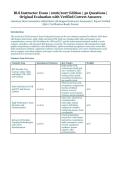
BLS Instructor Exam | 2026/2027 Edition | 50 Questions |
Original Evaluation with Verified Correct Answers
American Heart Association (AHA) Basic Life Support Instructor Assessment | Expert-Verified
Q&A | Certification-Ready Format
Introduction
This 2026/2027 BLS Instructor Exam Evaluation focuses on the core domains required for effective AHA Basic
Life Support instruction: adult, child, and infant CPR; AED use; choking relief; high-performance team
communication; current AHA Guidelines for CPR and ECC; and the instructional standards needed to teach,
evaluate, remediate, and document BLS learners accurately. The questions integrate AHA standards for high-
quality compressions, ventilation, early defibrillation, opioid-associated emergencies, team roles, course flow,
skills assessment, feedback, equipment readiness, instructor professionalism, and course administration. Each
item is original, curriculum-aligned, and expert-verified for accurate Evaluation readiness without using
proprietary live assessment items.
Content Area Overview
Content Area Questions (Total 50) Key Topics Weight
High-quality CPR,
compression depth and
BLS Provider Core
rate, ventilation, AED
Content: Adult, Child,
15 of 50 sequence, pulse checks, 30%
and Infant CPR, AED,
choking relief, opioid-
and Choking
associated emergencies,
age-specific ratios
Chain of survival, early
recognition, compression
AHA Guidelines for CPR
fraction, feedback
and ECC and Science 10 of 50 20%
devices, recovery
Updates
position, team response,
evidence-based standards
Clear roles, closed-loop
communication,
High-Performance Team leadership, mutual
Dynamics and 10 of 50 respect, debriefing, 20%
Communication compressor rotation,
minimizing pauses, team
coordination
Course preparation,
lesson flow, video-based
Instructor Principles, instruction, remediation,
Teaching Methodologies skills assessment, course
15 of 50 30%
and Course records, equipment
Administration readiness, learner
support, AHA
professionalism
, Examination Questions
Domain: BLS Provider Core Content: Adult, Child, and Infant CPR, AED, and Choking
1. Which adult chest compression rate should a BLS instructor reinforce as consistent with AHA
standards?
A. 60 to 80/min
B. 80 to 90/min
C. 100 to 120/min
D. 140 to 160/min
Correct Answer: C
Rationale: High-quality adult CPR includes compressions at a rate of 100 to 120/min. Rates that are too slow
reduce circulation, while excessive rates can reduce compression depth and recoil.
2. Which adult chest compression depth should be taught for high-quality CPR?
A. About 1 inch
B. At least 2 inches while avoiding excessive depth
C. At least 4 inches
D. Any depth if the rate is correct
Correct Answer: B
Rationale: Adult compressions should be at least 2 inches deep while avoiding excessive depth. Adequate
depth improves blood flow during cardiac arrest.
3. During adult CPR without an advanced airway, what compression-to-ventilation ratio is used by
a single rescuer?
A. 5:1
B. 15:1
C. 30:2
D. 50:5
Correct Answer: C
Rationale: For an adult without an advanced airway, the standard ratio is 30 compressions to 2 breaths. This
balances circulation with ventilation while limiting interruptions.
4. For two-rescuer CPR on a child without an advanced airway, which compression-to-ventilation
ratio is correct?
A. 30:2
B. 15:2
C. 5:1
D. 3:1
Correct Answer: B
Rationale: For children and infants with two rescuers and no advanced airway, the ratio is 15:2. This reflects
the importance of ventilation in many pediatric arrests.
5. What is the maximum time a rescuer should take to check for breathing and a pulse?
A. 5 seconds exactly
B. No more than 10 seconds
C. 20 seconds
D. 30 seconds
Correct Answer: B
Rationale: Pulse and breathing checks should take no more than 10 seconds. Delayed recognition delays
compressions and defibrillation.
6. Which action is correct when an AED arrives for an unresponsive adult with no normal
breathing and no pulse?
A. Continue CPR and ignore the AED until paramedics arrive
B. Turn on the AED, attach pads, and follow prompts while minimizing interruptions
C. Deliver 5 rescue breaths before applying pads every time
D. Place pads over medication patches without removing them if safe removal is possible
Correct Answer: B
Rationale: Early defibrillation is a critical BLS action. The AED should be powered on, pads applied correctly,
prompts followed, and CPR interruptions minimized.
Original Evaluation with Verified Correct Answers
American Heart Association (AHA) Basic Life Support Instructor Assessment | Expert-Verified
Q&A | Certification-Ready Format
Introduction
This 2026/2027 BLS Instructor Exam Evaluation focuses on the core domains required for effective AHA Basic
Life Support instruction: adult, child, and infant CPR; AED use; choking relief; high-performance team
communication; current AHA Guidelines for CPR and ECC; and the instructional standards needed to teach,
evaluate, remediate, and document BLS learners accurately. The questions integrate AHA standards for high-
quality compressions, ventilation, early defibrillation, opioid-associated emergencies, team roles, course flow,
skills assessment, feedback, equipment readiness, instructor professionalism, and course administration. Each
item is original, curriculum-aligned, and expert-verified for accurate Evaluation readiness without using
proprietary live assessment items.
Content Area Overview
Content Area Questions (Total 50) Key Topics Weight
High-quality CPR,
compression depth and
BLS Provider Core
rate, ventilation, AED
Content: Adult, Child,
15 of 50 sequence, pulse checks, 30%
and Infant CPR, AED,
choking relief, opioid-
and Choking
associated emergencies,
age-specific ratios
Chain of survival, early
recognition, compression
AHA Guidelines for CPR
fraction, feedback
and ECC and Science 10 of 50 20%
devices, recovery
Updates
position, team response,
evidence-based standards
Clear roles, closed-loop
communication,
High-Performance Team leadership, mutual
Dynamics and 10 of 50 respect, debriefing, 20%
Communication compressor rotation,
minimizing pauses, team
coordination
Course preparation,
lesson flow, video-based
Instructor Principles, instruction, remediation,
Teaching Methodologies skills assessment, course
15 of 50 30%
and Course records, equipment
Administration readiness, learner
support, AHA
professionalism
, Examination Questions
Domain: BLS Provider Core Content: Adult, Child, and Infant CPR, AED, and Choking
1. Which adult chest compression rate should a BLS instructor reinforce as consistent with AHA
standards?
A. 60 to 80/min
B. 80 to 90/min
C. 100 to 120/min
D. 140 to 160/min
Correct Answer: C
Rationale: High-quality adult CPR includes compressions at a rate of 100 to 120/min. Rates that are too slow
reduce circulation, while excessive rates can reduce compression depth and recoil.
2. Which adult chest compression depth should be taught for high-quality CPR?
A. About 1 inch
B. At least 2 inches while avoiding excessive depth
C. At least 4 inches
D. Any depth if the rate is correct
Correct Answer: B
Rationale: Adult compressions should be at least 2 inches deep while avoiding excessive depth. Adequate
depth improves blood flow during cardiac arrest.
3. During adult CPR without an advanced airway, what compression-to-ventilation ratio is used by
a single rescuer?
A. 5:1
B. 15:1
C. 30:2
D. 50:5
Correct Answer: C
Rationale: For an adult without an advanced airway, the standard ratio is 30 compressions to 2 breaths. This
balances circulation with ventilation while limiting interruptions.
4. For two-rescuer CPR on a child without an advanced airway, which compression-to-ventilation
ratio is correct?
A. 30:2
B. 15:2
C. 5:1
D. 3:1
Correct Answer: B
Rationale: For children and infants with two rescuers and no advanced airway, the ratio is 15:2. This reflects
the importance of ventilation in many pediatric arrests.
5. What is the maximum time a rescuer should take to check for breathing and a pulse?
A. 5 seconds exactly
B. No more than 10 seconds
C. 20 seconds
D. 30 seconds
Correct Answer: B
Rationale: Pulse and breathing checks should take no more than 10 seconds. Delayed recognition delays
compressions and defibrillation.
6. Which action is correct when an AED arrives for an unresponsive adult with no normal
breathing and no pulse?
A. Continue CPR and ignore the AED until paramedics arrive
B. Turn on the AED, attach pads, and follow prompts while minimizing interruptions
C. Deliver 5 rescue breaths before applying pads every time
D. Place pads over medication patches without removing them if safe removal is possible
Correct Answer: B
Rationale: Early defibrillation is a critical BLS action. The AED should be powered on, pads applied correctly,
prompts followed, and CPR interruptions minimized.


