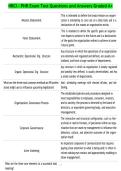
HRCI - PHR Exam Test Questions and Answers Graded A+
This is intended to define the broad mission an organi-
Mission Statement zation is attempting to carry out on a daily basis and is a
declaration of the reason an organization exists.
This is intended to define the specific goals an organiza-
tion hopes to achieve in the future and is a declaration
Vision Statement
of the goals the organization wishes to achieve at some
future point.
Any structure in which the operations of an organization
Mechanistic Operational Org. Structure are extremely well regulated and defined, are usually cen-
tralized, and have a large number of departments.
Any structure in which an organization is loosely regulated
Organic Operational Org. Structure and possibly less defined, is usually decentralized, and has
a small number of departments.
What are the three most common methods an HR profes- Mail, scheduling meetings with elected oflcials, and lob-
sional might use to influence upcoming legislation? bying.
The established policies and procedures designed to
meet responsibilities to employees, consumers, investors,
Organization's Governance Process and to society; the process is directed by the board of
directors, or equivalent governing body, and executive
management.
The interactive and structural configuration, such as hier-
archical or matrix formats, of personnel within an orga-
Corporate Governance nization that are used my management to influence the
behaviors, culture, and objective outcomes of the organi-
zation itself.
An important component of communication that requires
paying close attention to what is being said; it often in-
Active Listening
volves making eye contact and appropriately nodding to
show engagement.
What are the three core elements to a successful statt
meeting?
,1) Invite all attendees to share a little. 2) Focus on the
group and any outcomes that might need adjustment
or improvement. 3) Allow time for feedback in the deci-
sion-making process.
e.g. Phone, Videoconferencing, Face-to-Face Meetings
Information-rich Communication Channels
and Presentations
Information-lean Communication Channels e.g. Email, Fliers, Newsletters, Reports
e.g. Delegating Authority, Employee Survey, Suggestion
Involvement Strategies
Program, Committee, Task Force
e.g. Brown-Bag Lunch Program, Department Meeting,
Communication Strategies Town Hall Meetings, Open-Door Policy, Management by
Walking Around (MBWA)
Occurs when someone with a responsibility to act in the
Conflict of Interest best interest of the company may also be in the position
to derive personal benefit at the expense of the company.
Software systems that contain employee profiles, work-
force features, and reporting tools. Modules of this in-
Human Resources Information Systems (HRIS)
clude applicant tracking, time and attendance, payroll,
benefits administration, and performance management.
Integrate features that might include document manage-
ment, ways to provide policies or benefits summaries
Human Capital Management (HCM) Systems access, budgeting and forecasting, application tracking,
succession planning, and engagement and retention
tools.
Estimates or predicts the unknown values of one variable
Regression Analysis (dependent variable, Y) from the known or fixed value of
another variable (independent variable, X).
A type of regression analysis that is used when there is
Linear Regression
only one independent variable to consider.
, A type of regression analysis that is used when there are
Multiple Regression
multiple independent variables to consider.
Change would not occur without a feeling of loss or pain
Gene Dalton's Theory of Lasting Change to motivate it and that people will continue old patterns of
behavior unless they feel a need for change.
Gene Dalton developed these four to support change
areas: 1) Generalized goals -> 2) Specific objectives, for-
Gene Dalton's Change Focus Areas mal social ties -> 3) New relationships, self-doubt -> 4)
Heightened self-esteem, and external motives for change
-> 5) Internal motive for change
1. Unfreezing - Values, attitudes, and behaviors are chal-
lenged, and people understand the need for change.
2. Changing - Occurs during the action phase, whereby
Lewin's Change Management Model the situation is examined, and a new equilibrium is creat-
ed.
3. Refreezing - Changes is stabilized and new patterns are
solidified.
1) Strategy
2) Structure
3) Systems
McKinsey 7-S Model 4) Shared Values
5) Style
6) Statt
7) Skills
1) Create a sense of urgency.
2) Build a guiding coalition.
3) Develop a shared vision and strategy.
John Kotter's 8-Step Change Model
4) Communicate the change vision.
5) Empower action.
6) Generate short-term wins.
This is intended to define the broad mission an organi-
Mission Statement zation is attempting to carry out on a daily basis and is a
declaration of the reason an organization exists.
This is intended to define the specific goals an organiza-
tion hopes to achieve in the future and is a declaration
Vision Statement
of the goals the organization wishes to achieve at some
future point.
Any structure in which the operations of an organization
Mechanistic Operational Org. Structure are extremely well regulated and defined, are usually cen-
tralized, and have a large number of departments.
Any structure in which an organization is loosely regulated
Organic Operational Org. Structure and possibly less defined, is usually decentralized, and has
a small number of departments.
What are the three most common methods an HR profes- Mail, scheduling meetings with elected oflcials, and lob-
sional might use to influence upcoming legislation? bying.
The established policies and procedures designed to
meet responsibilities to employees, consumers, investors,
Organization's Governance Process and to society; the process is directed by the board of
directors, or equivalent governing body, and executive
management.
The interactive and structural configuration, such as hier-
archical or matrix formats, of personnel within an orga-
Corporate Governance nization that are used my management to influence the
behaviors, culture, and objective outcomes of the organi-
zation itself.
An important component of communication that requires
paying close attention to what is being said; it often in-
Active Listening
volves making eye contact and appropriately nodding to
show engagement.
What are the three core elements to a successful statt
meeting?
,1) Invite all attendees to share a little. 2) Focus on the
group and any outcomes that might need adjustment
or improvement. 3) Allow time for feedback in the deci-
sion-making process.
e.g. Phone, Videoconferencing, Face-to-Face Meetings
Information-rich Communication Channels
and Presentations
Information-lean Communication Channels e.g. Email, Fliers, Newsletters, Reports
e.g. Delegating Authority, Employee Survey, Suggestion
Involvement Strategies
Program, Committee, Task Force
e.g. Brown-Bag Lunch Program, Department Meeting,
Communication Strategies Town Hall Meetings, Open-Door Policy, Management by
Walking Around (MBWA)
Occurs when someone with a responsibility to act in the
Conflict of Interest best interest of the company may also be in the position
to derive personal benefit at the expense of the company.
Software systems that contain employee profiles, work-
force features, and reporting tools. Modules of this in-
Human Resources Information Systems (HRIS)
clude applicant tracking, time and attendance, payroll,
benefits administration, and performance management.
Integrate features that might include document manage-
ment, ways to provide policies or benefits summaries
Human Capital Management (HCM) Systems access, budgeting and forecasting, application tracking,
succession planning, and engagement and retention
tools.
Estimates or predicts the unknown values of one variable
Regression Analysis (dependent variable, Y) from the known or fixed value of
another variable (independent variable, X).
A type of regression analysis that is used when there is
Linear Regression
only one independent variable to consider.
, A type of regression analysis that is used when there are
Multiple Regression
multiple independent variables to consider.
Change would not occur without a feeling of loss or pain
Gene Dalton's Theory of Lasting Change to motivate it and that people will continue old patterns of
behavior unless they feel a need for change.
Gene Dalton developed these four to support change
areas: 1) Generalized goals -> 2) Specific objectives, for-
Gene Dalton's Change Focus Areas mal social ties -> 3) New relationships, self-doubt -> 4)
Heightened self-esteem, and external motives for change
-> 5) Internal motive for change
1. Unfreezing - Values, attitudes, and behaviors are chal-
lenged, and people understand the need for change.
2. Changing - Occurs during the action phase, whereby
Lewin's Change Management Model the situation is examined, and a new equilibrium is creat-
ed.
3. Refreezing - Changes is stabilized and new patterns are
solidified.
1) Strategy
2) Structure
3) Systems
McKinsey 7-S Model 4) Shared Values
5) Style
6) Statt
7) Skills
1) Create a sense of urgency.
2) Build a guiding coalition.
3) Develop a shared vision and strategy.
John Kotter's 8-Step Change Model
4) Communicate the change vision.
5) Empower action.
6) Generate short-term wins.