

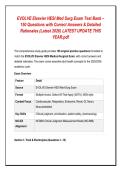
EVOLVE Elsevier HESI Med Surg Exam Test Bank –
150 Questions with Correct Answers & Detailed
Rationales (Latest 2026) LATEST UPDATE THIS
YEAR.pdf
This comprehensive study guide provides 150 original practice questions formatted to
match the EVOLVE Elsevier HESI Medical-Surgical Exam, with correct answers and
detailed rationales. The exam covers essential adult health concepts for the 2025/2026
academic cycle .
Exam Overview
Feature Detail
Source EVOLVE Elsevier HESI Med-Surg Exam
Format Multiple-choice, Select-All-That-Apply (SATA), NGN-style
Content Focus Cardiovascular, Respiratory, Endocrine, Renal, GI, Neuro,
Musculoskeletal
Key Skills Clinical judgment, prioritization, patient safety, pharmacology
NCLEX NCSBN Clinical Judgment Measurement Model (NCJMM)
Alignment
Section 1: Fluid & Electrolytes (Questions 1–15)
,1. The nurse notes that the handgrip of a client with hypokalemia has diminished
since the previous assessment one hour ago. Which intervention by the nurse is the
priority?
A) Document findings and monitor the client
B) Measure the client's pulse and blood pressure
C) Assess the client's respiratory rate, rhythm, and depth
D) Call the healthcare provider
Answer: C
Rationale: In a client with hypokalemia, progressive skeletal muscle weakness is
associated with increasing severity. The most life-threatening complication of hypokalemia
is respiratory insufficiency. The nurse must perform a respiratory assessment first to ensure
the client is not in immediate jeopardy .
2. The physician orders Lasix (furosemide) 60 mg PO daily. On hand you have Lasix
40 mg tablets. How many tablets will you give?
A) 0.5 tablet
B) 1 tablet
C) 1.5 tablets
D) 2 tablets
Answer: C
Rationale: 60 mg ÷ 40 mg = 1.5 tablets. This dosage calculation requires basic math:
desired dose divided by available dose .
,3. The nurse is teaching a client about furosemide (Lasix). Which food should the
nurse encourage the client to increase in the diet?
A) Cheese
B) Bananas
C) White rice
D) Applesauce
Answer: B
Rationale: Furosemide is a loop diuretic that causes potassium loss. Bananas are rich in
potassium and help prevent hypokalemia. Other potassium-rich foods include oranges,
potatoes, and spinach .
4. A client is being treated for dehydration. Which statement made by the client
indicates understanding of this condition?
A) "I will use a salt substitute when making and eating my meals."
B) "I must drink a quart of water or other liquid each day."
C) "I will not drink liquids after 6 PM so I won't have to get up at night."
D) "I will weigh myself each morning before I eat or drink."
Answer: D
Rationale: Because 1 L of water weighs 1 kg, change in body weight is a good measure
of excess fluid loss or fluid retention. Weight loss greater than 0.5 lb daily indicates
excessive fluid loss .
, 5. A client with heart failure has an ejection fraction of 25%. The nurse understands
this indicates:
A) Normal cardiac function
B) Mildly reduced function
C) Severely reduced systolic function
D) Preserved ejection fraction heart failure
Answer: C
Rationale: Normal ejection fraction is 55-70%. An EF of 25% indicates severely
impaired systolic function. The heart is pumping less than half the normal amount of blood
with each contraction .
6. A client receiving doxorubicin (Adriamycin) intravenously complains of pain at the
insertion site. The nurse notes edema at the site. Which intervention is most
important for the nurse to implement?
A) Assess for erythema
B) Administer the antidote
C) Apply warm compresses
D) Discontinue the IV infusion
Answer: D
Rationale: Pain and edema at the IV site indicate extravasation of the vesicant
chemotherapeutic agent. The infusion must be discontinued immediately to prevent tissue
necrosis .
150 Questions with Correct Answers & Detailed
Rationales (Latest 2026) LATEST UPDATE THIS
YEAR.pdf
This comprehensive study guide provides 150 original practice questions formatted to
match the EVOLVE Elsevier HESI Medical-Surgical Exam, with correct answers and
detailed rationales. The exam covers essential adult health concepts for the 2025/2026
academic cycle .
Exam Overview
Feature Detail
Source EVOLVE Elsevier HESI Med-Surg Exam
Format Multiple-choice, Select-All-That-Apply (SATA), NGN-style
Content Focus Cardiovascular, Respiratory, Endocrine, Renal, GI, Neuro,
Musculoskeletal
Key Skills Clinical judgment, prioritization, patient safety, pharmacology
NCLEX NCSBN Clinical Judgment Measurement Model (NCJMM)
Alignment
Section 1: Fluid & Electrolytes (Questions 1–15)
,1. The nurse notes that the handgrip of a client with hypokalemia has diminished
since the previous assessment one hour ago. Which intervention by the nurse is the
priority?
A) Document findings and monitor the client
B) Measure the client's pulse and blood pressure
C) Assess the client's respiratory rate, rhythm, and depth
D) Call the healthcare provider
Answer: C
Rationale: In a client with hypokalemia, progressive skeletal muscle weakness is
associated with increasing severity. The most life-threatening complication of hypokalemia
is respiratory insufficiency. The nurse must perform a respiratory assessment first to ensure
the client is not in immediate jeopardy .
2. The physician orders Lasix (furosemide) 60 mg PO daily. On hand you have Lasix
40 mg tablets. How many tablets will you give?
A) 0.5 tablet
B) 1 tablet
C) 1.5 tablets
D) 2 tablets
Answer: C
Rationale: 60 mg ÷ 40 mg = 1.5 tablets. This dosage calculation requires basic math:
desired dose divided by available dose .
,3. The nurse is teaching a client about furosemide (Lasix). Which food should the
nurse encourage the client to increase in the diet?
A) Cheese
B) Bananas
C) White rice
D) Applesauce
Answer: B
Rationale: Furosemide is a loop diuretic that causes potassium loss. Bananas are rich in
potassium and help prevent hypokalemia. Other potassium-rich foods include oranges,
potatoes, and spinach .
4. A client is being treated for dehydration. Which statement made by the client
indicates understanding of this condition?
A) "I will use a salt substitute when making and eating my meals."
B) "I must drink a quart of water or other liquid each day."
C) "I will not drink liquids after 6 PM so I won't have to get up at night."
D) "I will weigh myself each morning before I eat or drink."
Answer: D
Rationale: Because 1 L of water weighs 1 kg, change in body weight is a good measure
of excess fluid loss or fluid retention. Weight loss greater than 0.5 lb daily indicates
excessive fluid loss .
, 5. A client with heart failure has an ejection fraction of 25%. The nurse understands
this indicates:
A) Normal cardiac function
B) Mildly reduced function
C) Severely reduced systolic function
D) Preserved ejection fraction heart failure
Answer: C
Rationale: Normal ejection fraction is 55-70%. An EF of 25% indicates severely
impaired systolic function. The heart is pumping less than half the normal amount of blood
with each contraction .
6. A client receiving doxorubicin (Adriamycin) intravenously complains of pain at the
insertion site. The nurse notes edema at the site. Which intervention is most
important for the nurse to implement?
A) Assess for erythema
B) Administer the antidote
C) Apply warm compresses
D) Discontinue the IV infusion
Answer: D
Rationale: Pain and edema at the IV site indicate extravasation of the vesicant
chemotherapeutic agent. The infusion must be discontinued immediately to prevent tissue
necrosis .


