
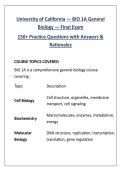
University of California — BIO 1A General
Biology — Final Exam
150+ Practice Questions with Answers &
Rationales
COURSE TOPICS COVERED
BIO 1A is a comprehensive general biology course
covering:
Topic Description
Cell structure, organelles, membrane
Cell Biology
transport, cell signaling
Macromolecules, enzymes, metabolism,
Biochemistry
energy
Molecular DNA structure, replication, transcription,
Biology translation, gene regulation
,Topic Description
Mendelian genetics, chromosomal inheritanc
Genetics
mutations
Natural selection, population genetics,
Evolution
speciation
Plant and animal physiology (varies by
Physiology
campus)
PART I: CELL BIOLOGY — STRUCTURE & FUNCTION
(Questions 1-30)
1. A cell lacking which of the following structures is
most likely to be a prokaryote?
• A) Nucleus
• B) Cell Membrane
• C) Ribosome
, • D) Mitochondria
• E) Cytoplasm
Answer: A
Rationale: Prokaryotes lack a membrane-bound
nucleus. They do have cell membranes, ribosomes,
and cytoplasm, but mitochondria are absent in
prokaryotes. However, the nucleus is the defining
feature that distinguishes eukaryotes from
prokaryotes.
2. Which of the following structures is abundant in
liver cells and primarily responsible for detoxification
processes?
• A) Rough ER
• B) Smooth ER
• C) Nucleus
• D) Golgi apparatus
• E) Lysosomes
, Answer: B
Rationale: The smooth endoplasmic reticulum (SER) is
abundant in liver cells and is responsible for
detoxification of drugs and poisons, as well as lipid
synthesis and calcium storage.
3. Which of the following correctly ranks the
components of the endomembrane system in order of
protein flow from synthesis to secretion?
• A) Rough ER → Golgi → vesicle → plasma
membrane
• B) Golgi → Rough ER → vesicle → plasma
membrane
• C) Rough ER → vesicle → Golgi → plasma
membrane
• D) Smooth ER → Golgi → Rough ER → plasma
membrane
• E) Nucleus → Rough ER → Golgi → plasma
membrane
Biology — Final Exam
150+ Practice Questions with Answers &
Rationales
COURSE TOPICS COVERED
BIO 1A is a comprehensive general biology course
covering:
Topic Description
Cell structure, organelles, membrane
Cell Biology
transport, cell signaling
Macromolecules, enzymes, metabolism,
Biochemistry
energy
Molecular DNA structure, replication, transcription,
Biology translation, gene regulation
,Topic Description
Mendelian genetics, chromosomal inheritanc
Genetics
mutations
Natural selection, population genetics,
Evolution
speciation
Plant and animal physiology (varies by
Physiology
campus)
PART I: CELL BIOLOGY — STRUCTURE & FUNCTION
(Questions 1-30)
1. A cell lacking which of the following structures is
most likely to be a prokaryote?
• A) Nucleus
• B) Cell Membrane
• C) Ribosome
, • D) Mitochondria
• E) Cytoplasm
Answer: A
Rationale: Prokaryotes lack a membrane-bound
nucleus. They do have cell membranes, ribosomes,
and cytoplasm, but mitochondria are absent in
prokaryotes. However, the nucleus is the defining
feature that distinguishes eukaryotes from
prokaryotes.
2. Which of the following structures is abundant in
liver cells and primarily responsible for detoxification
processes?
• A) Rough ER
• B) Smooth ER
• C) Nucleus
• D) Golgi apparatus
• E) Lysosomes
, Answer: B
Rationale: The smooth endoplasmic reticulum (SER) is
abundant in liver cells and is responsible for
detoxification of drugs and poisons, as well as lipid
synthesis and calcium storage.
3. Which of the following correctly ranks the
components of the endomembrane system in order of
protein flow from synthesis to secretion?
• A) Rough ER → Golgi → vesicle → plasma
membrane
• B) Golgi → Rough ER → vesicle → plasma
membrane
• C) Rough ER → vesicle → Golgi → plasma
membrane
• D) Smooth ER → Golgi → Rough ER → plasma
membrane
• E) Nucleus → Rough ER → Golgi → plasma
membrane


