

Written by students who passed Immediately available after payment Read online or as PDF Wrong document? Swap it for free 4.6 TrustPilot
logo-home
Exam (elaborations)

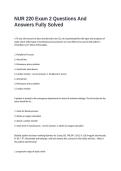
NUR 220 Exam 2 Questions And Answers Fully Solved

Rating
-
Sold
-
Pages
11
Grade
A+
Uploaded on
02-07-2026
Written in
2025/2026

A 70 year old woman has been transferred to the ICU, dx of pyelonephritis with signs and symptoms of septic shock. What types of monitoring and assessment are most likely to be used in this patient's immediate care? Select all that apply. 1. Peripheral IV access 2. Arterial line 3. Pulmonary artery catheter 4. Ventricular assist device 5. Cardiac monitor - correct answers 1. Peripheral IV access 2. Arterial line 3. Pulmonary artery catheter 5. Cardiac monitor A patient is treated in the emergency department for shock of unknown etiology. The first action by the nurse should be to... 1. check for blood pressure 2. obtain an oxygen saturation 3. attach a cardiac monitor 4. check level of consiousness - correct answers 2. obtain an oxygen saturation Diabetic patient has been vomiting/diarrhea for 3 days; BS: 748; BP: 72/62; P: 128 irregular and thready; R: 38; T: 97; disoriented and lethargic; cold and clammy skin; cyanosis in the hands and feet... What is the patient experiencing? 1. progressive stage of septic shock 2. compensatory stage of diabetic shock 3. refractory stage of cardiogenic shock 4. progressive stage of hypovolemic shock - correct answers 4. progressive stage of hypovolemic shock A patient in septic shock has not responded to fluid resuscitation, as evidenced by a decreasing BP and decreasing cardiac output. The nurse anticipates the administration of which medication? 1. nitroglycerine 2. dobutamine 3. norepinephrine 4. sodium nitroprusside - correct answers 3. norepinephrine The client has all the following clinical manifestations. Which assessment findings alerts the nurse to the probability of septic shock? 1. hypotension 2. pale and clammy skin 3. anxiety and confusion 4. oozing of blood at the IV site - correct answers 4. oozing of blood at the IV site The nurse recognizes which client as being at highest risk for septic shock? 1. 12 year old with open fracture of the left femur and 2 peripheral IV's 2. 35 year old with HIV receiving enteral feedings via PEG tube 3. 65 year old with pneumonia receiving IV fluids and broad-spectrum oral antibiotics 4. 82 year old with leukemia receiving broad spectrum IV antibiotics via triple lumen central line - correct answers 4. 82 year old with leukemia receiving broad spectrum IV antibiotics via triple lumen central line The nurse notes that the patient's serum lactic acid level is trending upward. What interpretation should the nurse draw from this assessment finding? 1. The patient is experiencing increased intracranial pressure. 2. Intracellular contents are being released into the patient's vascular space. 3. The patient has developed a systemic infection. 4. The patient is experiencing a deficit in oxygen supply. - correct answers 4. The patient is experiencing a deficit in oxygen supply. A nurse in the intensive care unit receives report from the nurse in the emergency department about a new patient being admitted. The ED nurse reports that his blood pressure is 85/54, heart rate is 53 beats per minute, and his skin is warm and dry. What does the ICU nurse recognize that the patient is probably experiencing? 1. anaphylactic shock 2. neurogenic shock 3. septic shock 4. hypovolemic shock - correct answers 2. neurogenic shock The nursing instructor is talking with a group of senior nursing students about shock. When caring for a patient at risk for shock, what assessment finding would the nurse consider a potential sign of shock? 1. elevated systolic blood pressure 2. elevated mean arterial pressure 3. shallow and rapid respirations 4. bradycardia - correct answers 3. shallow and rapid respirations The intensive care nurse is contributing to the care of patient who has just been admitted with a presentation that is characteristic of shock. The nurse is providing constant assessment of numerous parameters but should know that a priority indicator of the patient's current status is: 1. core body temperature 2. lung sounds 3. mean arterial pressure 4. cognitive status - correct answers 3. mean arterial pressure An infusion of nitroglycerine has been ordered by the critical care health care provider in the treatment of a patient who has been admitted to the intensive care unit in a state of shock. The nurse should anticipate that this patient is likely experiencing what type of shock? 1. neurogenic shock 2. septic shock 3. anaphylactic shock 4. cardiogenic shock - correct answers 4. cardiogenic shock A 24 year old man has suffered extensive head and neck injuries in a motorcycle accident and has been admitted to the intensive care unit in apparent neurogenic shock. Which of the following are characteristics of this patient's diagnosis? 1. The patient has adequate blood volume but is profoundly vasodilated. 2. The patient is experiencing an exaggerated and pathological immune response. 3. The patient is at risk of extreme tachycardia due to sympathetic stimulation. 4. The patient is in hypertensive crisis as a result of baroreceptor dysfunction. - correct answers 1. The patient has adequate blood volume but is profoundly vasodilated. A nursing priority in any care situation is the establishment and maintenance of a patent airway. Which of the following patients would likely require immediate medical and nursing interventions to protect the airway? 1. A patient who has developed septic shock during treatment for severe lower extremity burns. 2. A patient who has gone into anaphylactic shock after inadvertently eating shellfish. 3. A patient whose myocardial infarction has resulted in cardiogenic shock. 4. A patient who has gone into hypovolemic shock as a result of injury to the femoral artery. - correct answers 2. A patient who has gone into anaphylactic shock after inadvertently eating shellfish. A medical-surgical nurse is aware that pulmonary embolism and tension pneumothorax are medical diagnoses that have the potential to result in shock. What commonality between these two health problems creates the potential for shock? 1. Both health problems involve an obstruction of normal blood flow. 2. Both problems precipitate massive vasodilation and fluid displacement into the interstitial space. 3. Both health problems involve a profound disruption in the normal process of hemostasis. 4. Both health problems result in hypovolemia. - correct answers 1. Both health problems involve an obstruction of normal blood flow. Phenytoin 200mg IV push is ordered for your patient with status epilepticus. You have 100mg/2mL, not to exceed 50mg/min. How much will you draw for injection? How many minutes will it take to administer the dose? How many mL per minute will you give? - correct answers 4 mL 4 minutes 1 mL/min Order: heparin 1,875 units/hr Have: heparin 25,000 units/500mL D5W Set the pump at how many mL/hr? Per aPTT: heparin to be increased by 1,200 u/hr (previously at 1,875 u/hr; have 25,000 units/500mL) New rate for the pump is how many mL/hr? - correct answers 37.5 mL/hr 61.5 mL/hr When a patient experiences a generalized tonic/clonic seizure in the ED all of the following orders are received. Which one will the ED nurse implement first? 1. send to radiology for CT scan 2. administer diazepam 3. check capillary blood glucose 4. monitor level of consciousness - correct answers 2. administer diazepam When preparing to admit a patient who has been treated for status epilepticus in the emergency department, which equipment should the nurse have available in the room? Select all that apply. 1. suction tubing 2. oxygen mask 3. nasogastric tube 4. siderail pads 5. tongue blade - correct answers 1. suction tubing 2. oxygen mask 4. siderail pads The nurse is caring for a client with a complete T5 spinal cord injury. Upon assessment, the nurse notes flushed skin, diaphoresis about T5, and a blood pressure of 162/96 mmHg. The client reports a severe, pounding headache. Which nursing interventions would be appropriate for this client? Select all that apply. 1. elevating the head of the bed 90 degrees 2. loosening constrictive clothing 3. assessing for bladder distention and bowel impaction 4. administering antihypertension medication 5. placing the client in a supine position with legs elevated - correct answers 1. elevating the head of the bed 90 degrees 2. loosening constrictive clothing 3. assessing for bladder distention and bowel impaction 4. administering antihypertension medication The nurse cares for a client diagnosed with a right sided cerebrovascular accident with dysphagia. While the patient is eating, which of the following actions by the nurse reflects appropriate care for the client? Select all that apply. 1. The nurse assesses the client's ability to swallow. 2. The nurse positions the client with the head of the bed elevated. 3. The nurse offers the client scrambled eggs. 4. The nurse instructs the client to place food on the left side of the mouth. 5. The nurse turns off the television. - correct answers 1. The nurse assesses the client's ability to swallow. 2. The nurse positions the client with the head of the bed elevated. 3. The nurse offers the client scrambled eggs. 5. The nurse turns off the television. The nurse is caring for a client after a craniotomy in which a large tumor was removed from the left side. Choose the positions in which the nurse can safely place the client. Select all that apply. 1. with the head in a midline position 2. with the neck flexed 3. with the head of the bed elevated 4. on the left side 5. in a semi-fowler's position - correct answers 1. with the head in a midline position 3. with the head of the bed elevated 5. in a semi-fowler's position The nurse is assessing a client diagnosed with bacterial meningitis. Which of the following signs and symptoms of meningeal infection is the nurse likely to observe? Select all that apply. 1. nuchal rigidity 2. positive Babinski sign 3. positive Kernig's sign 4. negative Babinski reflex - correct answers 1. nuchal rigidity 2. positive Babinski sign 3. positive Kernig's sign In which order will the nurse perform the following actions when caring for a patient with possible cervical spine cord trauma who is admitted to the emergency department? 1. administer O2 using a non-rebreathing mask 2. monitor cardiac rhythm and blood pressure 3. immobilize the patient's head, neck, and spine 4. transfer the patient to radiology for spinal CT - correct answers 3. immobilize the patient's head, neck, and spine 1. administer O2 using a non-rebreathing mask 2. monitor cardiac rhythm and blood pressure 4. transfer the patient to radiology for spinal CT A 78-year-old patient who has had a stroke has become increasingly confused over the past 2 days. Multiple laboratory tests are prescribed. Which findings would cause the nurse to contact the healthcare provider? Select all that apply. 1. heart rate of 86 beats per minute 2. blood glucose level of 96 mg/dL 3. urinalysis positive for nitrates 4. potassium of 3.8 mEq/L 5. temperature of 101.3 degrees Fahrenheit (38.5 degrees Celsius) 6. white blood cell count of 18,000/mm3 - correct answers 3. urinalysis positive for nitrates 5. temperature of 101.3 degrees Fahrenheit (38.5 degrees Celsius) 6. white blood cell count of 18,000/mm3 The emergency department nurse admits the client reporting a severe headache. The nurse notes right-sided weakness and the client is hypertensive. Which nursing actions must the nurse implement in the first hour of care? Select all the apply. 1. offer the client a semi-soft diet 2. contact physical therapy for consultation 3. draw labs for complete blood count, including platelets 4. complete the order for a computed tomography (CT) scan 5. establish IV access - correct answers 3. draw labs for complete blood count, including platelets 4. complete the order for a computed tomography (CT) scan 5. establish IV access A nurse develops a plan of care for a client following a lumbar puncture. Which interventions should be included in the plan? Select all that apply. 1. restrict fluid intake for 8 hours 2. monitor the client's ability to void 3. inspect the puncture site for swelling, redness, and drainage 4. maintain the client on a nothing-by-mouth status for 24 hours 5. monitor the client's ability to move the extremities 6. maintain the client in a flat position - correct answers 2. monitor the client's ability to void 3. inspect the puncture site for swelling, redness, and drainage 5. monitor the client's ability to move the extremities 6. maintain the client in a flat position Which of the following instructions or precautions should the nurse teach a client who is scheduled for a position emission tomography of the brain? 1. avoid caffeine for 12 hours before the test 2. drink at least 3L of fluid during the 24 hours before the test 3. avoid bathing and washing your hair for 24 hours before the test 4. remove your dentures before the test begins - correct answers 1. avoid caffeine for 12 hours before the test In providing discharge teaching to a client after a lumbar laminectomy, the nurse instructs the client to return to the hospital for which potential complication? 1. pain at the incision site 2. decreased appetite 3. slight redness and itching at the incision site 4. clear drainage from the incision site - correct answers 4. clear drainage from the incision site The nurse correlates which clinical manifestation of Guillain-Barre syndrome as the most common? 1. ophthalmoplegia and diplopia 2. progressive weakness without sensory involvement 3. progressive ascending weakness and paresthesia 4. weakness of face/jaw/sternomastoid muscles - correct answers 3. progressive ascending weakness and paresthesia The client with myasthenia gravis in cholinergic crisis has been treated with atropine. Which nursing intervention is a priority for this client? 1. suctioning the client 2. turning and repositioning the client 3. measuring urinary output every 30 minutes 4. administering cholinergic drugs on time - correct answers 1. suctioning the client A client admitted to the intensive care unit with a stroke becomes lethargic and unable to articulate words when speaking. Which is the nurse's best action? 1. document finding and check blood pressure 2. elevate head of bed and call provider 3. place client supine and monitor 4. assess WBC and differential - correct answers 2. elevate head of bed and call provider The client is receiving warfarin therapy after a thrombotic stroke. Which international normalized ratio indicates that anticoagulation is adequate? 1: 0.05-1.0 2: 2.0-3.0 3: 5x control value 4: same as a control - correct answers 2: 2.0-3.0

Show more Read less
Institution
NUR 220
Course
NUR 220

Content preview

NUR 220 Exam 2 Questions And
Answers Fully Solved

A 70 year old woman has been transferred to the ICU, dx of pyelonephritis with signs and symptoms of
septic shock. What types of monitoring and assessment are most likely to be used in this patient's
immediate care? Select all that apply.


1. Peripheral IV access

2. Arterial line

3. Pulmonary artery catheter

4. Ventricular assist device

5. Cardiac monitor - correct answers 1. Peripheral IV access

2. Arterial line

3. Pulmonary artery catheter

5. Cardiac monitor


A patient is treated in the emergency department for shock of unknown etiology. The first action by the
nurse should be to...


1. check for blood pressure

2. obtain an oxygen saturation

3. attach a cardiac monitor

4. check level of consiousness - correct answers 2. obtain an oxygen saturation


Diabetic patient has been vomiting/diarrhea for 3 days; BS: 748; BP: 72/62; P: 128 irregular and thready;
R: 38; T: 97; disoriented and lethargic; cold and clammy skin; cyanosis in the hands and feet... What is
the patient experiencing?


1. progressive stage of septic shock

, 2. compensatory stage of diabetic shock

3. refractory stage of cardiogenic shock

4. progressive stage of hypovolemic shock - correct answers 4. progressive stage of hypovolemic shock


A patient in septic shock has not responded to fluid resuscitation, as evidenced by a decreasing BP and
decreasing cardiac output. The nurse anticipates the administration of which medication?


1. nitroglycerine

2. dobutamine

3. norepinephrine

4. sodium nitroprusside - correct answers 3. norepinephrine


The client has all the following clinical manifestations. Which assessment findings alerts the nurse to the
probability of septic shock?


1. hypotension

2. pale and clammy skin

3. anxiety and confusion

4. oozing of blood at the IV site - correct answers 4. oozing of blood at the IV site


The nurse recognizes which client as being at highest risk for septic shock?


1. 12 year old with open fracture of the left femur and 2 peripheral IV's

2. 35 year old with HIV receiving enteral feedings via PEG tube

3. 65 year old with pneumonia receiving IV fluids and broad-spectrum oral antibiotics

4. 82 year old with leukemia receiving broad spectrum IV antibiotics via triple lumen central line -
correct answers 4. 82 year old with leukemia receiving broad spectrum IV antibiotics via triple lumen
central line


Written for

Institution
NUR 220
Course
NUR 220

Document information

Uploaded on
July 2, 2026
Number of pages
11
Written in
2025/2026
Type
Exam (elaborations)
Contains
Questions & answers

Subjects

$15.59
Get access to the full document:

Wrong document? Swap it for free Within 14 days of purchase and before downloading, you can choose a different document. You can simply spend the amount again.
Written by students who passed
Immediately available after payment
Read online or as PDF


Also available in package deal

Thumbnail
Package deal
package deal of NUR 220 Exam Bundle Correctly Answered.
-
15 2026
$ 101.17 More info

Get to know the seller

Seller avatar
Reputation scores are based on the amount of documents a seller has sold for a fee and the reviews they have received for those documents. There are three levels: Bronze, Silver and Gold. The better the reputation, the more your can rely on the quality of the sellers work.
RealGrades Nursing
View profile
Follow You need to be logged in order to follow users or courses
Sold
192
Member since
2 year
Number of followers
52
Documents
12274
Last sold
1 week ago

4.0

26 reviews

5
12
4
5
3
7
2
1
1
1

Recently viewed by you

Why students choose Stuvia

Created by fellow students, verified by reviews

Quality you can trust: written by students who passed their tests and reviewed by others who've used these notes.

Didn't get what you expected? Choose another document

No worries! You can instantly pick a different document that better fits what you're looking for.

Pay as you like, start learning right away

No subscription, no commitments. Pay the way you're used to via credit card and download your PDF document instantly.

Student with book image

“Bought, downloaded, and aced it. It really can be that simple.”

Alisha Student

Working on your references?

Create accurate citations in APA, MLA and Harvard with our free citation generator.

Working on your references?

Frequently asked questions
