
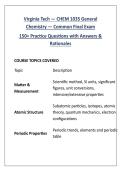
Virginia Tech — CHEM 1035 General
Chemistry — Common Final Exam
150+ Practice Questions with Answers &
Rationales
COURSE TOPICS COVERED
Topic Description
Scientific method, SI units, significant
Matter &
figures, unit conversions,
Measurement
intensive/extensive properties
Subatomic particles, isotopes, atomic
Atomic Structure theory, quantum mechanics, electron
configurations
Periodic trends, elements and periodic
Periodic Properties
table
,Topic Description
Mole calculations, empirical/molecular
Stoichiometry
formulas, limiting reactants, percent yield
Ionic and covalent bonds, Lewis structure
Chemical Bonding
VSEPR theory, molecular geometry
Gas laws, ideal gas equation, partial
Gases
pressures, diffusion/effusion
Energy flow, enthalpy, Hess's Law,
Thermochemistry
calorimetry
Solutions Molarity, dilutions, colligative properties
Acids & Bases pH, pOH, strong/weak acids and bases
Intermolecular Dispersion forces, dipole-dipole, hydroge
Forces bonding, ion-dipole
,Topic Description
Kinetics & Reaction rates, equilibrium constants, Le
Equilibrium Châtelier's principle
PART I: MATTER, MEASUREMENT & SIGNIFICANT
FIGURES (Questions 1-25)
1. In the scientific method, a hypothesis is all of the
following EXCEPT:
• A) A proposal to explain observations
• B) Always correct
• C) Testable
• D) Based on prior knowledge
• E) Subject to revision
Answer: B
Rationale: A hypothesis is a testable proposal to
, explain observations. It is not always correct — it may
be proven wrong through experimentation.
2. Which of the following is an example of a chemical
change?
• A) Water boiling
• B) Sugar dissolving in water
• C) Iron slowly forming reddish-brown rust
• D) A magnet separating iron shavings from sand
• E) Ice melting
Answer: C
Rationale: Rusting is a chemical change because new
substances (iron oxides) are formed. Boiling,
dissolving, and melting are physical changes.
3. A liquid is defined as:
• A) A substance that has fixed volume and fixed
shape
Chemistry — Common Final Exam
150+ Practice Questions with Answers &
Rationales
COURSE TOPICS COVERED
Topic Description
Scientific method, SI units, significant
Matter &
figures, unit conversions,
Measurement
intensive/extensive properties
Subatomic particles, isotopes, atomic
Atomic Structure theory, quantum mechanics, electron
configurations
Periodic trends, elements and periodic
Periodic Properties
table
,Topic Description
Mole calculations, empirical/molecular
Stoichiometry
formulas, limiting reactants, percent yield
Ionic and covalent bonds, Lewis structure
Chemical Bonding
VSEPR theory, molecular geometry
Gas laws, ideal gas equation, partial
Gases
pressures, diffusion/effusion
Energy flow, enthalpy, Hess's Law,
Thermochemistry
calorimetry
Solutions Molarity, dilutions, colligative properties
Acids & Bases pH, pOH, strong/weak acids and bases
Intermolecular Dispersion forces, dipole-dipole, hydroge
Forces bonding, ion-dipole
,Topic Description
Kinetics & Reaction rates, equilibrium constants, Le
Equilibrium Châtelier's principle
PART I: MATTER, MEASUREMENT & SIGNIFICANT
FIGURES (Questions 1-25)
1. In the scientific method, a hypothesis is all of the
following EXCEPT:
• A) A proposal to explain observations
• B) Always correct
• C) Testable
• D) Based on prior knowledge
• E) Subject to revision
Answer: B
Rationale: A hypothesis is a testable proposal to
, explain observations. It is not always correct — it may
be proven wrong through experimentation.
2. Which of the following is an example of a chemical
change?
• A) Water boiling
• B) Sugar dissolving in water
• C) Iron slowly forming reddish-brown rust
• D) A magnet separating iron shavings from sand
• E) Ice melting
Answer: C
Rationale: Rusting is a chemical change because new
substances (iron oxides) are formed. Boiling,
dissolving, and melting are physical changes.
3. A liquid is defined as:
• A) A substance that has fixed volume and fixed
shape


