

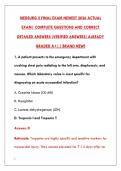
MEDSURG 2 FINAL EXAM NEWEST 2026 ACTUAL
EXAM| COMPLETE QUESTIONS AND CORRECT
DETAILED ANSWERS (VERIFIED ANSWERS) ALREADY
GRADED A+|| BRAND NEW!!
1. A patient presents to the emergency department with
crushing chest pain radiating to the left arm, diaphoresis, and
nausea. Which laboratory value is most specific for
diagnosing an acute myocardial infarction?
A. Creatine kinase (CK-MB)
B. Myoglobin
C. Lactate dehydrogenase (LDH)
D. Troponin I and Troponin T
Answer: D
Rationale: Troponins are highly specific and sensitive markers for
myocardial injury. They remain elevated for 7-14 days after an
1
,MI, making them the preferred biomarker for diagnosis. CK-MB
rises and falls more quickly (within 48-72 hours). Myoglobin is
less specific, and LDH is no longer routinely used for MI
diagnosis. Early troponin elevation (within 3-4 hours) allows for
rapid diagnosis and treatment.
2. A 62-year-old male with a history of hypertension and
hyperlipidemia reports chest pain that occurs with exertion
and is relieved by rest. This presentation is most consistent
with:
A. Unstable angina
B. Stable angina
C. Myocardial infarction
D. Pericarditis
Answer: B
2
,Rationale: Stable angina is characterized by predictable chest
pain that occurs with exertion or emotional stress and is relieved
by rest or nitroglycerin. Unstable angina occurs at rest or with
minimal exertion and is a medical emergency. Myocardial
infarction causes prolonged pain not relieved by rest. Pericarditis
pain is typically sharp and worsens with lying flat.
3. A patient is diagnosed with ST-segment elevation
myocardial infarction (STEMI). What is the priority intervention
within the first 90 minutes of arrival?
A. Administer aspirin
B. Administer morphine
C. Percutaneous coronary intervention (PCI)
D. Administer oxygen
Answer: C
3
, Rationale: For STEMI patients, the goal is to achieve reperfusion
within 90 minutes of arrival at a PCI-capable facility. PCI is the
preferred method of reperfusion. Aspirin, morphine, and oxygen
are important but should not delay PCI. If PCI is not available
within 120 minutes, fibrinolytic therapy should be considered.
4. A patient with heart failure presents with dyspnea, crackles
in the lung bases, and peripheral edema. Which medication
should the nurse anticipate administering first?
A. Digoxin
B. Furosemide
C. Metoprolol
D. Lisinopril
Answer: B
Rationale: Furosemide is a loop diuretic that reduces fluid
overload by promoting excretion of excess fluid, relieving
4
EXAM| COMPLETE QUESTIONS AND CORRECT
DETAILED ANSWERS (VERIFIED ANSWERS) ALREADY
GRADED A+|| BRAND NEW!!
1. A patient presents to the emergency department with
crushing chest pain radiating to the left arm, diaphoresis, and
nausea. Which laboratory value is most specific for
diagnosing an acute myocardial infarction?
A. Creatine kinase (CK-MB)
B. Myoglobin
C. Lactate dehydrogenase (LDH)
D. Troponin I and Troponin T
Answer: D
Rationale: Troponins are highly specific and sensitive markers for
myocardial injury. They remain elevated for 7-14 days after an
1
,MI, making them the preferred biomarker for diagnosis. CK-MB
rises and falls more quickly (within 48-72 hours). Myoglobin is
less specific, and LDH is no longer routinely used for MI
diagnosis. Early troponin elevation (within 3-4 hours) allows for
rapid diagnosis and treatment.
2. A 62-year-old male with a history of hypertension and
hyperlipidemia reports chest pain that occurs with exertion
and is relieved by rest. This presentation is most consistent
with:
A. Unstable angina
B. Stable angina
C. Myocardial infarction
D. Pericarditis
Answer: B
2
,Rationale: Stable angina is characterized by predictable chest
pain that occurs with exertion or emotional stress and is relieved
by rest or nitroglycerin. Unstable angina occurs at rest or with
minimal exertion and is a medical emergency. Myocardial
infarction causes prolonged pain not relieved by rest. Pericarditis
pain is typically sharp and worsens with lying flat.
3. A patient is diagnosed with ST-segment elevation
myocardial infarction (STEMI). What is the priority intervention
within the first 90 minutes of arrival?
A. Administer aspirin
B. Administer morphine
C. Percutaneous coronary intervention (PCI)
D. Administer oxygen
Answer: C
3
, Rationale: For STEMI patients, the goal is to achieve reperfusion
within 90 minutes of arrival at a PCI-capable facility. PCI is the
preferred method of reperfusion. Aspirin, morphine, and oxygen
are important but should not delay PCI. If PCI is not available
within 120 minutes, fibrinolytic therapy should be considered.
4. A patient with heart failure presents with dyspnea, crackles
in the lung bases, and peripheral edema. Which medication
should the nurse anticipate administering first?
A. Digoxin
B. Furosemide
C. Metoprolol
D. Lisinopril
Answer: B
Rationale: Furosemide is a loop diuretic that reduces fluid
overload by promoting excretion of excess fluid, relieving
4


