

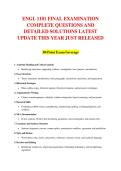
ENGL 1101 FINAL EXAMINATION
COMPLETE QUESTIONS AND
DETAILED SOLUTIONS LATEST
UPDATE THIS YEAR JUST RELEASED
10-Point Exam Coverage
1. Academic Reading and Critical Analysis
Identifying main ideas, supporting evidence, assumptions, tone, purpose, and audience.
2. Essay Structure
Thesis statements, introductions, body paragraphs, conclusions, transitions, and organization.
3. Rhetorical Strategies
Ethos, pathos, logos, rhetorical appeals, rhetorical situations, and persuasive techniques.
4. Argumentative Writing
Claims, counterarguments, rebuttals, evidence integration, logical reasoning, and persuasion.
5. Research Skills
Evaluating credible sources, paraphrasing, summarizing, quoting, avoiding plagiarism, and
synthesis.
6. MLA Documentation
In-text citations, Works Cited formatting, quotations, source integration, and citation rules.
7. Grammar and Sentence Structure
Sentence fragments, run-ons, comma splices, punctuation, modifiers, agreement, and parallelism.
8. Style and Diction
Word choice, tone, clarity, conciseness, coherence, sentence variety, and academic language.
9. Revision and Editing
Identifying weaknesses, improving organization, eliminating redundancy, and strengthening
arguments.
,10. Reading Comprehension and Literary Analysis
Interpreting passages, recognizing themes, figurative language, symbolism, and author's purpose .
1. While revising an argumentative essay, which thesis
statement most effectively presents a focused, debatable claim
that can be fully supported with academic evidence?
A. College education is interesting for many students.
B. College students have different experiences every semester.
C. Colleges should require financial literacy courses because
they improve budgeting, reduce debt, and prepare students
for independent adulthood.
D. Many students enjoy learning new subjects.
Answer: C
Rationale: A strong thesis is specific, arguable, and previews
supporting reasons.
2. During peer review, a classmate notices that every paragraph
discusses unrelated ideas without logical progression. Which
writing principle requires the greatest improvement?
A. Unity and organization
B. Capitalization
C. MLA spacing
D. Pronunciation
,Answer: A
Rationale: Effective essays organize ideas logically while
maintaining paragraph unity.
3. Which sentence best demonstrates appropriate integration of
evidence into an academic paragraph without creating an
awkward interruption to the writer's own analysis?
A. Quote.
B. "Education matters."
C. According to recent educational research, consistent
reading habits improve vocabulary development, supporting
the argument that daily reading enhances academic success.
D. Books exist.
Answer: C
Rationale: Evidence should be smoothly introduced and
connected to analysis.
4. An author attempts to persuade readers by presenting
verified statistics from government reports instead of emotional
stories. Which rhetorical appeal is primarily being used?
A. Pathos
B. Logos
C. Ethos
D. Irony
, Answer: B
Rationale: Logos relies upon facts, statistics, and logical
reasoning.
5. Which revision most effectively eliminates wordiness while
preserving the sentence's original meaning and improving
overall clarity?
A. Due to the fact that students studied, they passed.
B. Because students studied, they passed.
C. Students studied because of the reason.
D. Students passed due to the studying that occurred.
Answer: B
Rationale: Concise writing improves readability and clarity.
6. Which statement best explains the purpose of a topic
sentence within a well-developed academic body paragraph?
A. It summarizes the conclusion.
B. It introduces the paragraph's controlling idea.
C. It lists every source.
D. It provides MLA citations.
Answer: B
Rationale: Topic sentences establish the paragraph's main
point.
COMPLETE QUESTIONS AND
DETAILED SOLUTIONS LATEST
UPDATE THIS YEAR JUST RELEASED
10-Point Exam Coverage
1. Academic Reading and Critical Analysis
Identifying main ideas, supporting evidence, assumptions, tone, purpose, and audience.
2. Essay Structure
Thesis statements, introductions, body paragraphs, conclusions, transitions, and organization.
3. Rhetorical Strategies
Ethos, pathos, logos, rhetorical appeals, rhetorical situations, and persuasive techniques.
4. Argumentative Writing
Claims, counterarguments, rebuttals, evidence integration, logical reasoning, and persuasion.
5. Research Skills
Evaluating credible sources, paraphrasing, summarizing, quoting, avoiding plagiarism, and
synthesis.
6. MLA Documentation
In-text citations, Works Cited formatting, quotations, source integration, and citation rules.
7. Grammar and Sentence Structure
Sentence fragments, run-ons, comma splices, punctuation, modifiers, agreement, and parallelism.
8. Style and Diction
Word choice, tone, clarity, conciseness, coherence, sentence variety, and academic language.
9. Revision and Editing
Identifying weaknesses, improving organization, eliminating redundancy, and strengthening
arguments.
,10. Reading Comprehension and Literary Analysis
Interpreting passages, recognizing themes, figurative language, symbolism, and author's purpose .
1. While revising an argumentative essay, which thesis
statement most effectively presents a focused, debatable claim
that can be fully supported with academic evidence?
A. College education is interesting for many students.
B. College students have different experiences every semester.
C. Colleges should require financial literacy courses because
they improve budgeting, reduce debt, and prepare students
for independent adulthood.
D. Many students enjoy learning new subjects.
Answer: C
Rationale: A strong thesis is specific, arguable, and previews
supporting reasons.
2. During peer review, a classmate notices that every paragraph
discusses unrelated ideas without logical progression. Which
writing principle requires the greatest improvement?
A. Unity and organization
B. Capitalization
C. MLA spacing
D. Pronunciation
,Answer: A
Rationale: Effective essays organize ideas logically while
maintaining paragraph unity.
3. Which sentence best demonstrates appropriate integration of
evidence into an academic paragraph without creating an
awkward interruption to the writer's own analysis?
A. Quote.
B. "Education matters."
C. According to recent educational research, consistent
reading habits improve vocabulary development, supporting
the argument that daily reading enhances academic success.
D. Books exist.
Answer: C
Rationale: Evidence should be smoothly introduced and
connected to analysis.
4. An author attempts to persuade readers by presenting
verified statistics from government reports instead of emotional
stories. Which rhetorical appeal is primarily being used?
A. Pathos
B. Logos
C. Ethos
D. Irony
, Answer: B
Rationale: Logos relies upon facts, statistics, and logical
reasoning.
5. Which revision most effectively eliminates wordiness while
preserving the sentence's original meaning and improving
overall clarity?
A. Due to the fact that students studied, they passed.
B. Because students studied, they passed.
C. Students studied because of the reason.
D. Students passed due to the studying that occurred.
Answer: B
Rationale: Concise writing improves readability and clarity.
6. Which statement best explains the purpose of a topic
sentence within a well-developed academic body paragraph?
A. It summarizes the conclusion.
B. It introduces the paragraph's controlling idea.
C. It lists every source.
D. It provides MLA citations.
Answer: B
Rationale: Topic sentences establish the paragraph's main
point.


