
MED-SURG EXAM
1. A nurse is planning to irrigate and dress a clean, granulation wound for a client who has a pressure injury. Which
of the following actions should the nurse take?
a. Apply a wet-to-dry gauze dressing
b. Irrigate with hydrogen peroxide solution
c. Use a 30-ml syringe
d. Attach a 24-gauge angiocatheter to the syringe.
2.
a. Apply a wet-to-dry gauze dressing.: The nurse should not apply wet-to-dry dressings
to clean, granulating wounds as they interrupt viable, healing tissues when they are
removed. Appropriate dressings for a wound that is developing granulation tissue
include a hydrocolloid dressing and a transparent film dressing.
b. Irrigate with hydrogen peroxide solution: the nurse should use hydrogen peroxide to
clean contaminated surfaces. Hydrogen peroxide should not be used on a pressure
injury wound because it destroys newly granulated tissue. Instead, the nurse should
use solutions specifically designed as wound cleansers or 0.9% sodium chloride
irrigation to irrigate the wound.
c. Use a 30-mL syringe: NSWERThe nurse should use a 30-mL to 60-mL syringe with
an 18- or 19-gauge catheter to deliver the ideal pressure of 8 pounds per square
inch (psi) when irrigating a wound. To maintain healthy granulation tissue, the
wound irrigation should be delivered at between 4 and 15 psi.
d. Attach a 24-gauge angiocatheter to the syringe:the nurse should use an 18- or 19-
gauge catheter that will apply the appropriate irrigation pressure. A 24-gauge
angiocatheter delivers solutions at a higher pressure than necessary for irrigation
and a can potentially damage the developing granulation tissues.
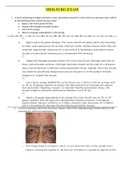
1. a nurse Is assessing a client who has Graves’ disease. Thich of the collowing images should undicate to the
nurse that the client has exophthalmos:
o
o This image depicts entropion, which occurs when the skin of the eyelids turns
inward, causing the eyelids to rub the eye. Entropion is caused by spasms of the
, eyelid muscle or trauma and occurs most often in older adult clients due to the
loss of supportive tissue.
o
o This image depicts ectropion, which occurs when the skin of the eyelids turns
outward, causing sagging of the lower lids due to muscle weakness. Ectropion
occurs with aging and can cause drying of the cornea and ulceration.
o
o This image depicts ptosis, which occurs when excess skin of the upper eyelid
drops down over the eye. Ptosis can occur due to aging or at any age due to
diabetes, myasthenia gravis, or stroke.
o
o MY ANSWER
, o The nurse should identify an outward protrusion of the eyes as exophthalmos, a
common finding of Graves' disease. An overproduction of the thyroid hormone
causes edema of the extraocular muscle and increases fatty tissue behind the
eye, which results in the eyes protruding outward. Exophthalmos can cause the
client to experience problems with vision, including focusing on objects, as well
as pressure on the optic nerve.
5. the nurse is providing teaching to a female client who has a history of UTI’s. which of the following information
should the nurse include in the teaching?
a. Avoid foods that are high in ascorbic acid
b. Add oatmeal to the water when taking a tub bath
c. Urinate every 6 hours
d. Take daily cranberry supplements?
6. A nurse is providing teaching to a client who has esophageal cancer and is to undergo radiation therapy. Which
off the following statements should the nurse identify as an indication that the client understands the teaching?
a. “ I will wash the ink markings off the radiation area after each treatment.”
b. “I will use my hands rather than a washcloth to clean the radiation area.”
c. “I will be able to be out in the sun 1 month after my radiation treatments are over.”
d. “I will use a heating pad on my neck it if becomes sore during the radiation therapy.”
i.
"I will wash the ink markings off the radiation area after each treatment."
ii. The ink markings designate the exact radiation area. The client should not
remove these markings until they complete the entire radiation treatment.
iii. "I will use my hands rather than a washcloth to clean the radiation area."
iv. MY ANSWER
v. The client should gently wash the radiation area with their hands using warm
water and mild soap to protect the skin from further irritation.
vi. "I will be able to be out in the sun 1 month after my radiation treatments are over."
vii. Radiation therapy causes skin to become sensitive to the effects of sun
exposure and increases the risk for developing skin cancer. The client should
avoid direct sunlight during the radiation treatments and for at least 1 year
following the conclusion of the therapy.
viii. "I will use a heating pad on my neck if it becomes sore during the radiation therapy."
ix. The client should avoid exposing the treatment area to heat as this can cause
further irritation to the skin.
7. A nurse is caring for a client 1 hr following a cardiac catheterization. The nurse notes the formation of a
hematoma at the insertion site and a decreased pulse rate in the affected extremity. Which of the following
interventions is the nurse’s priority?
a. Initiate oxygen at 2 L via nasal cannula
b. Apply firm pressure to the insertion site
c. Take the client’s vital signs
d. Obtain a stat order for an aPTT
, i. Initiate oxygen at 2 L/min via nasal cannula.: The nurse can apply oxygen to
promote adequate tissue oxygenation. However, another intervention is the
priority.
ii. Apply firm pressure to the insertion site.: MY ANSWERThe greatest risk to the
client is bleeding. Therefore, the priority intervention is for the nurse to apply
firm pressure to the hematoma to stop the bleeding.
iii. Take the client's vital signs.: The nurse should take the client's vital signs to
further determine the client's status. However, another intervention is the
priority.
iv. Obtain a stat order for an aPTT.: The nurse can request laboratory data to
provide information about the client's coagulation status. However, another
intervention is the priority.
8. A nurse is caring for a client who has emphysema and is receiving mechanical ventilation. The client appears
anxious and restless, and the high-pressure alarm is sounding. Which of the following actions should the nurse
take first?
9. A nurse is caring for a client who has a closed head injury and has an intraventricular catheter placed. Which of
the following findings indicates that the client is experiencing increased ICP?
a. Flat jugular veins
b. GCS score of 15
c. Sleepiness exhibited by the client
d. Widening pulse pressure
e. Decerebrate posturing
f. Flat jugular veins is incorrect. With increased ICP, the jugular veins are typically distended.
A Glasgow Coma Scale score of 15 is incorrect. A Glasgow Coma Scale score of 15
indicates neurological functioning within the expected reference range for eye opening, motor,
and verbal response.
Sleepiness exhibited by the client is correct. Sleepiness or difficulty arousing the client from
sleep is an indication of increased ICP.
Widening pulse pressure is correct. A widening pulse pressure (increase in systolic with
concurrent decrease in diastolic blood pressure) is an indication of increased ICP.
Decerebrate posturing is correct. Both decerebrate and decorticate posturing indicate
increased ICP.
10. A nurse is preparing a client who has supraventricular tachycardia for elective cardioversion. Which of the
following prescribed medications should the nurse instruct the clients to withhold for 48hr prior to
cardioversion?
a. Enoxaparin
b. Metformin
c. Diazepam
d. Digoxin
1. A nurse is planning to irrigate and dress a clean, granulation wound for a client who has a pressure injury. Which
of the following actions should the nurse take?
a. Apply a wet-to-dry gauze dressing
b. Irrigate with hydrogen peroxide solution
c. Use a 30-ml syringe
d. Attach a 24-gauge angiocatheter to the syringe.
2.
a. Apply a wet-to-dry gauze dressing.: The nurse should not apply wet-to-dry dressings
to clean, granulating wounds as they interrupt viable, healing tissues when they are
removed. Appropriate dressings for a wound that is developing granulation tissue
include a hydrocolloid dressing and a transparent film dressing.
b. Irrigate with hydrogen peroxide solution: the nurse should use hydrogen peroxide to
clean contaminated surfaces. Hydrogen peroxide should not be used on a pressure
injury wound because it destroys newly granulated tissue. Instead, the nurse should
use solutions specifically designed as wound cleansers or 0.9% sodium chloride
irrigation to irrigate the wound.
c. Use a 30-mL syringe: NSWERThe nurse should use a 30-mL to 60-mL syringe with
an 18- or 19-gauge catheter to deliver the ideal pressure of 8 pounds per square
inch (psi) when irrigating a wound. To maintain healthy granulation tissue, the
wound irrigation should be delivered at between 4 and 15 psi.
d. Attach a 24-gauge angiocatheter to the syringe:the nurse should use an 18- or 19-
gauge catheter that will apply the appropriate irrigation pressure. A 24-gauge
angiocatheter delivers solutions at a higher pressure than necessary for irrigation
and a can potentially damage the developing granulation tissues.
1. a nurse Is assessing a client who has Graves’ disease. Thich of the collowing images should undicate to the
nurse that the client has exophthalmos:
o
o This image depicts entropion, which occurs when the skin of the eyelids turns
inward, causing the eyelids to rub the eye. Entropion is caused by spasms of the
, eyelid muscle or trauma and occurs most often in older adult clients due to the
loss of supportive tissue.
o
o This image depicts ectropion, which occurs when the skin of the eyelids turns
outward, causing sagging of the lower lids due to muscle weakness. Ectropion
occurs with aging and can cause drying of the cornea and ulceration.
o
o This image depicts ptosis, which occurs when excess skin of the upper eyelid
drops down over the eye. Ptosis can occur due to aging or at any age due to
diabetes, myasthenia gravis, or stroke.
o
o MY ANSWER
, o The nurse should identify an outward protrusion of the eyes as exophthalmos, a
common finding of Graves' disease. An overproduction of the thyroid hormone
causes edema of the extraocular muscle and increases fatty tissue behind the
eye, which results in the eyes protruding outward. Exophthalmos can cause the
client to experience problems with vision, including focusing on objects, as well
as pressure on the optic nerve.
5. the nurse is providing teaching to a female client who has a history of UTI’s. which of the following information
should the nurse include in the teaching?
a. Avoid foods that are high in ascorbic acid
b. Add oatmeal to the water when taking a tub bath
c. Urinate every 6 hours
d. Take daily cranberry supplements?
6. A nurse is providing teaching to a client who has esophageal cancer and is to undergo radiation therapy. Which
off the following statements should the nurse identify as an indication that the client understands the teaching?
a. “ I will wash the ink markings off the radiation area after each treatment.”
b. “I will use my hands rather than a washcloth to clean the radiation area.”
c. “I will be able to be out in the sun 1 month after my radiation treatments are over.”
d. “I will use a heating pad on my neck it if becomes sore during the radiation therapy.”
i.
"I will wash the ink markings off the radiation area after each treatment."
ii. The ink markings designate the exact radiation area. The client should not
remove these markings until they complete the entire radiation treatment.
iii. "I will use my hands rather than a washcloth to clean the radiation area."
iv. MY ANSWER
v. The client should gently wash the radiation area with their hands using warm
water and mild soap to protect the skin from further irritation.
vi. "I will be able to be out in the sun 1 month after my radiation treatments are over."
vii. Radiation therapy causes skin to become sensitive to the effects of sun
exposure and increases the risk for developing skin cancer. The client should
avoid direct sunlight during the radiation treatments and for at least 1 year
following the conclusion of the therapy.
viii. "I will use a heating pad on my neck if it becomes sore during the radiation therapy."
ix. The client should avoid exposing the treatment area to heat as this can cause
further irritation to the skin.
7. A nurse is caring for a client 1 hr following a cardiac catheterization. The nurse notes the formation of a
hematoma at the insertion site and a decreased pulse rate in the affected extremity. Which of the following
interventions is the nurse’s priority?
a. Initiate oxygen at 2 L via nasal cannula
b. Apply firm pressure to the insertion site
c. Take the client’s vital signs
d. Obtain a stat order for an aPTT
, i. Initiate oxygen at 2 L/min via nasal cannula.: The nurse can apply oxygen to
promote adequate tissue oxygenation. However, another intervention is the
priority.
ii. Apply firm pressure to the insertion site.: MY ANSWERThe greatest risk to the
client is bleeding. Therefore, the priority intervention is for the nurse to apply
firm pressure to the hematoma to stop the bleeding.
iii. Take the client's vital signs.: The nurse should take the client's vital signs to
further determine the client's status. However, another intervention is the
priority.
iv. Obtain a stat order for an aPTT.: The nurse can request laboratory data to
provide information about the client's coagulation status. However, another
intervention is the priority.
8. A nurse is caring for a client who has emphysema and is receiving mechanical ventilation. The client appears
anxious and restless, and the high-pressure alarm is sounding. Which of the following actions should the nurse
take first?
9. A nurse is caring for a client who has a closed head injury and has an intraventricular catheter placed. Which of
the following findings indicates that the client is experiencing increased ICP?
a. Flat jugular veins
b. GCS score of 15
c. Sleepiness exhibited by the client
d. Widening pulse pressure
e. Decerebrate posturing
f. Flat jugular veins is incorrect. With increased ICP, the jugular veins are typically distended.
A Glasgow Coma Scale score of 15 is incorrect. A Glasgow Coma Scale score of 15
indicates neurological functioning within the expected reference range for eye opening, motor,
and verbal response.
Sleepiness exhibited by the client is correct. Sleepiness or difficulty arousing the client from
sleep is an indication of increased ICP.
Widening pulse pressure is correct. A widening pulse pressure (increase in systolic with
concurrent decrease in diastolic blood pressure) is an indication of increased ICP.
Decerebrate posturing is correct. Both decerebrate and decorticate posturing indicate
increased ICP.
10. A nurse is preparing a client who has supraventricular tachycardia for elective cardioversion. Which of the
following prescribed medications should the nurse instruct the clients to withhold for 48hr prior to
cardioversion?
a. Enoxaparin
b. Metformin
c. Diazepam
d. Digoxin


