

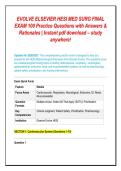
EVOLVE ELSEVIER HESI MED SURG FINAL
EXAM 100 Practice Questions with Answers &
Rationales | Instant pdf download – study
anywhere!
Updated for 2026/2027. This comprehensive practice exam is designed to help you
prepare for the HESI Medical-Surgical final exam from Elsevier Evolve. The questions cover
key medical-surgical nursing topics including cardiovascular, respiratory, neurological,
gastrointestinal, endocrine, renal, and musculoskeletal systems, as well as pharmacology,
patient safety, prioritization, and nursing interventions .
Exam Quick Facts
Feature Details
Focus Areas Cardiovascular, Respiratory, Neurological, Endocrine, GI, Renal,
Musculoskeletal
Question Multiple-choice, Select-All-That-Apply (SATA), Prioritization
Formats
Key Clinical Judgment, Patient Safety, Prioritization, Pharmacology
Competencies
Institution Elsevier Evolve HESI
SECTION 1: Cardiovascular System (Questions 1-15)
Question 1
,An adult client who is hospitalized after surgery reports sudden onset of chest pain and
dyspnea. The client appears anxious, restless, and mildly cyanotic. The nurse should further
assess the client for which condition?
A) Myocardial infarction
B) Pneumothorax
C) Pulmonary embolism
D) Pericarditis
Answer: C. Pulmonary embolism
The sudden onset of chest pain, dyspnea, anxiety, and cyanosis in a postoperative client is
classic for pulmonary embolism. Postoperative patients are at increased risk for venous
thromboembolism due to immobility and hypercoagulability .
Question 2
A 68-year-old male with a history of hypertension presents with dyspnea on exertion,
orthopnea, and peripheral edema. On auscultation, you note an S3 gallop. Which of the
following is the most likely diagnosis?
A) Right-sided heart failure
B) Left-sided heart failure
C) Pericarditis
D) Myocarditis
Answer: B. Left-sided heart failure
Left-sided heart failure presents with dyspnea on exertion, orthopnea, and an S3 gallop.
The S3 heart sound is a hallmark of decreased left ventricular compliance. Right-sided heart
failure presents with peripheral edema, JVD, and hepatomegaly .
Question 3
A client with heart failure is prescribed furosemide 40 mg IV push. Which assessment
finding requires immediate action?
A) Weight increase of 1 lb in 24 hours
B) Serum potassium 3.2 mEq/L
,C) Urine output 30 mL/hr
D) Blood pressure 130/80 mmHg
Answer: B. Serum potassium 3.2 mEq/L
Furosemide is a loop diuretic that causes potassium wasting. Hypokalemia (normal 3.5–
5.0) increases risk of digoxin toxicity and cardiac dysrhythmias. This finding requires
immediate intervention .
Question 4
A client with unstable angina is started on IV heparin. The aPTT level 6 hours later is 110
seconds. What should the nurse do first?
A) Continue infusion as ordered
B) Stop the heparin infusion
C) Give protamine sulfate
D) Increase infusion rate
Answer: B. Stop the heparin infusion
Therapeutic aPTT for heparin is 1.5–2.5 times control (approx 60–80 sec). 110 seconds
indicates excessive anticoagulation and bleeding risk. Stop infusion and notify provider .
Question 5
A male client with heart failure (HF) calls the clinic and reports that he cannot put his shoes
on because they are too tight. Which additional information should the nurse obtain?
A) What time did he take his last medications?
B) Has his weight changed in the last several days?
C) Is he still able to tighten his belt buckle?
D) How many hours did he sleep last night?
Answer: B. Has his weight changed in the last several days?
Weight gain is a key indicator of fluid retention in heart failure patients. A 2–3 lb weight gain
over 24 hours or 5 lb over a week warrants notification of the provider .
Question 6
, A client post-MI develops crackles in both lung bases, S3 gallop, and BP 90/60 mmHg.
Which condition does the nurse suspect?
A) Pericarditis
B) Cardiogenic shock
C) Acute heart failure
D) Pulmonary embolism
Answer: C. Acute heart failure
Crackles, S3 gallop, and hypotension post-MI indicate acute left-sided heart failure due to
decreased contractility. This requires prompt intervention with diuretics, inotropes, and
afterload reduction .
Question 7
A 65-year-old male with a history of coronary artery disease presents with crushing
substernal chest pain radiating to the left arm. He is diaphoretic and nauseated. ECG shows
ST-segment elevation in leads V1–V4. Which coronary artery is most likely occluded?
A) Right coronary artery (RCA)
B) Left anterior descending (LAD) artery
C) Left circumflex (LCX) artery
D) Left main coronary artery
Answer: B. Left anterior descending (LAD) artery
ST-segment elevation in leads V1–V4 indicates an anterior wall myocardial infarction,
which is most commonly caused by occlusion of the LAD artery. The LAD supplies the
anterior wall of the left ventricle and the interventricular septum .
Question 8
A client presents with chronic venous insufficiency. Which assessment finding should the
nurse anticipate?
A) Bilateral lower leg stasis dermatitis
B) Pallor on leg elevation
C) Decreased hair growth on the lower legs
D) Intermittent claudication
EXAM 100 Practice Questions with Answers &
Rationales | Instant pdf download – study
anywhere!
Updated for 2026/2027. This comprehensive practice exam is designed to help you
prepare for the HESI Medical-Surgical final exam from Elsevier Evolve. The questions cover
key medical-surgical nursing topics including cardiovascular, respiratory, neurological,
gastrointestinal, endocrine, renal, and musculoskeletal systems, as well as pharmacology,
patient safety, prioritization, and nursing interventions .
Exam Quick Facts
Feature Details
Focus Areas Cardiovascular, Respiratory, Neurological, Endocrine, GI, Renal,
Musculoskeletal
Question Multiple-choice, Select-All-That-Apply (SATA), Prioritization
Formats
Key Clinical Judgment, Patient Safety, Prioritization, Pharmacology
Competencies
Institution Elsevier Evolve HESI
SECTION 1: Cardiovascular System (Questions 1-15)
Question 1
,An adult client who is hospitalized after surgery reports sudden onset of chest pain and
dyspnea. The client appears anxious, restless, and mildly cyanotic. The nurse should further
assess the client for which condition?
A) Myocardial infarction
B) Pneumothorax
C) Pulmonary embolism
D) Pericarditis
Answer: C. Pulmonary embolism
The sudden onset of chest pain, dyspnea, anxiety, and cyanosis in a postoperative client is
classic for pulmonary embolism. Postoperative patients are at increased risk for venous
thromboembolism due to immobility and hypercoagulability .
Question 2
A 68-year-old male with a history of hypertension presents with dyspnea on exertion,
orthopnea, and peripheral edema. On auscultation, you note an S3 gallop. Which of the
following is the most likely diagnosis?
A) Right-sided heart failure
B) Left-sided heart failure
C) Pericarditis
D) Myocarditis
Answer: B. Left-sided heart failure
Left-sided heart failure presents with dyspnea on exertion, orthopnea, and an S3 gallop.
The S3 heart sound is a hallmark of decreased left ventricular compliance. Right-sided heart
failure presents with peripheral edema, JVD, and hepatomegaly .
Question 3
A client with heart failure is prescribed furosemide 40 mg IV push. Which assessment
finding requires immediate action?
A) Weight increase of 1 lb in 24 hours
B) Serum potassium 3.2 mEq/L
,C) Urine output 30 mL/hr
D) Blood pressure 130/80 mmHg
Answer: B. Serum potassium 3.2 mEq/L
Furosemide is a loop diuretic that causes potassium wasting. Hypokalemia (normal 3.5–
5.0) increases risk of digoxin toxicity and cardiac dysrhythmias. This finding requires
immediate intervention .
Question 4
A client with unstable angina is started on IV heparin. The aPTT level 6 hours later is 110
seconds. What should the nurse do first?
A) Continue infusion as ordered
B) Stop the heparin infusion
C) Give protamine sulfate
D) Increase infusion rate
Answer: B. Stop the heparin infusion
Therapeutic aPTT for heparin is 1.5–2.5 times control (approx 60–80 sec). 110 seconds
indicates excessive anticoagulation and bleeding risk. Stop infusion and notify provider .
Question 5
A male client with heart failure (HF) calls the clinic and reports that he cannot put his shoes
on because they are too tight. Which additional information should the nurse obtain?
A) What time did he take his last medications?
B) Has his weight changed in the last several days?
C) Is he still able to tighten his belt buckle?
D) How many hours did he sleep last night?
Answer: B. Has his weight changed in the last several days?
Weight gain is a key indicator of fluid retention in heart failure patients. A 2–3 lb weight gain
over 24 hours or 5 lb over a week warrants notification of the provider .
Question 6
, A client post-MI develops crackles in both lung bases, S3 gallop, and BP 90/60 mmHg.
Which condition does the nurse suspect?
A) Pericarditis
B) Cardiogenic shock
C) Acute heart failure
D) Pulmonary embolism
Answer: C. Acute heart failure
Crackles, S3 gallop, and hypotension post-MI indicate acute left-sided heart failure due to
decreased contractility. This requires prompt intervention with diuretics, inotropes, and
afterload reduction .
Question 7
A 65-year-old male with a history of coronary artery disease presents with crushing
substernal chest pain radiating to the left arm. He is diaphoretic and nauseated. ECG shows
ST-segment elevation in leads V1–V4. Which coronary artery is most likely occluded?
A) Right coronary artery (RCA)
B) Left anterior descending (LAD) artery
C) Left circumflex (LCX) artery
D) Left main coronary artery
Answer: B. Left anterior descending (LAD) artery
ST-segment elevation in leads V1–V4 indicates an anterior wall myocardial infarction,
which is most commonly caused by occlusion of the LAD artery. The LAD supplies the
anterior wall of the left ventricle and the interventricular septum .
Question 8
A client presents with chronic venous insufficiency. Which assessment finding should the
nurse anticipate?
A) Bilateral lower leg stasis dermatitis
B) Pallor on leg elevation
C) Decreased hair growth on the lower legs
D) Intermittent claudication


