

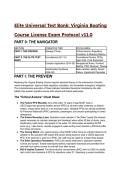
Elite Universal Test Bank: Virginia Boating
Course License Exam Protocol v11.0
PART 0: THE NAVIGATOR
SECTION COGNITIVE TIER FOCUS AREA
PART I: THE PREVIEW Strategic Primer Critical Axioms, Regulatory
Constants, & Statutory Metrics
PART II: THE ELITE TEST Foundational (Q1–15) Foundational Syntax, PFDs,
BANK Age Limits, Core Equipment
Complex Application (Q16–35) Navigational Rules, Accident
Metrics, PWC Nuances, Towing
Grandmaster Synthesis Multi-variable Liability, Kinetic
(Q36–60) Failure, Impairment Cascades
PART I: THE PREVIEW
Mastering the Virginia Boating Course requires absolute fluency in the intersection of kinetic
vessel management, rigorous state regulatory mandates, and immediate emergency mitigation.
The comprehensive execution of these statutes translates theoretical compliance into elite,
liability-free aquatic operation across both inland and federal waterways.
The "Critical Axioms" Cheat Sheet
● The Federal PFD Mandate: Any child under 13 years of age MUST wear a
USCG-approved personal flotation device (PFD) at all times while underway on federal
waters, unless below deck or in an enclosed cabin. Inflatable PFDs are strictly prohibited
for Personal Watercraft (PWC) operators, passengers, and anyone participating in towed
watersports.
● The Kinetic Boundary Laws: Operators must maintain a "No Wake" speed (the slowest
speed necessary to maintain steerage and headway) when within 50 feet of docks, piers,
boathouses, boat ramps, and people in the water. On inland lakes exceeding 20,000
acres (e.g., Lake Anna), vessels engaged in wake surfing must maintain a 200-foot buffer
from these structures.
● The Towing Matrix: Any vessel towing a skier MUST either have an onboard observer (in
addition to the operator) OR require the person being towed to wear a USCG-approved
PFD. If an observer is used on a PWC, the craft must be rated for at least three people.
● The Solar Operation Parameters: PWCs are strictly restricted to operation between
sunrise and sunset. Towed watersports behind a standard motorboat are permitted from
one-half hour before sunrise to one-half hour after sunset.
● BUI & Implied Consent: The blood alcohol concentration (BAC) limit is 0.08% for adults
and a strict zero-tolerance 0.02% for operators under 21. Operating a vessel constitutes
, implied consent to chemical testing.
Metric Virginia Statutory Requirement
PWC Minimum Age 14 years old (with mandatory education
certificate).
Education Threshold Mandatory for ALL PWC operators and
motorboats \ge 10 HP.
Accident Reporting (Injury/Death) Written report filed within 48 hours.
Accident Reporting (Property) Written report filed within 10 days for damages
> $2,000.
Fire Extinguisher Expiration 12 years from the absolute date of
manufacture.
Throwable PFD (Type IV) Mandatory for all vessels 16 feet or greater in
length.
PART II: THE ELITE TEST BANK
Q1: A family is operating a 24-foot motorboat on a federal waterway in Virginia. The vessel is
underway, and a 12-year-old passenger is sitting on the open bow. Based on the principles of
Virginia and Federal equipment regulations, which action is MANDATORY? A) The child must
be seated behind the windshield to prevent ejection. B) The child must wear a USCG-approved
Type IV throwable device. C) The child must wear a properly fitted USCG-approved wearable
life jacket. D) The child is exempt from wearing a life jacket because the vessel exceeds 16 feet.
● The Answer: C (The child must wear a properly fitted USCG-approved wearable life
jacket.)
● Distractor Analysis:
○ A is incorrect: While bow riding is dangerous, seating placement does not
supersede the strict federal PFD requirement for minors.
○ B is incorrect: Type IV devices are throwable cushions/rings, not wearable PFDs,
and do not satisfy the minor wear requirement.
○ D is incorrect: Vessel length dictates throwable device requirements, but the
under-13 PFD rule applies to recreational vessels of all lengths on federal waters.
The Mentor's Analysis: The primary defensive mechanism for minors on open water is the
continuous utilization of a wearable PFD. When navigating federal waters, all children under 13
must wear an approved life jacket while underway unless inside an enclosed cabin. By utilizing
USCG-Approved Wearable PFDs, the operator bypasses the common trap of assuming vessel
length negates passenger safety mandates. Professional/Academic Intuition: Age 12 and
under equals a mandatory wearable PFD while underway.
Q2: A 15-year-old individual wishes to independently operate a Personal Watercraft (PWC) on
Smith Mountain Lake. Based on the Virginia Boating Safety Education parameters, which
conclusion is the MOST ACCURATE? A) The individual may operate the PWC if supervised by
an adult from the shoreline. B) The individual may not operate the PWC because the absolute
minimum age is 16. C) The individual may operate the PWC provided they have passed an
approved boating safety course and carry proof onboard. D) The individual may operate the
PWC only if towing a skier with an observer.
● The Answer: C (The individual may operate the PWC provided they have passed an
approved boating safety course and carry proof onboard.)
● Distractor Analysis:
○ A is incorrect: Shoreline supervision does not satisfy operational age and
, certification laws.
○ B is incorrect: While 16 is a standard threshold for unsupervised operation without
exemptions, Virginia law specifically allows 14 and 15-year-olds to operate a PWC if
they hold and carry an approved education certificate.
○ D is incorrect: Towing parameters do not grant operational age exemptions.
The Mentor's Analysis: Virginia explicitly delineates the minimum age for kinetic watercraft
operation to prevent high-speed juvenile fatalities. 14 and 15-year-olds are legally granted
operational privileges strictly conditional upon certified education. By utilizing
NASBLA-Approved Certification, young operators bypass the common trap of illegal underage
operation. Professional/Academic Intuition: 14 is the hard-deck minimum age for PWC
operation, requiring proof of education on board.
Q3: An operator is outfitting a 20-foot motorized vessel for a weekend excursion. The motor
generates 50 horsepower. Based on the Virginia Department of Wildlife Resources (DWR)
education framework, which operator MUST carry a boating safety education certificate? A)
Only operators born after January 1, 1988. B) Any operator of the vessel, regardless of their
age. C) Only operators under the age of 21. D) No operator is required to have a certificate if
the vessel is rented.
● The Answer: B (Any operator of the vessel, regardless of their age.)
● Distractor Analysis:
○ A is incorrect: The 1988 birth year threshold applies to neighboring North Carolina,
not Virginia's universal phase-in.
○ C is incorrect: The phase-in period for age brackets concluded in 2016; all ages are
now bound by the requirement.
○ D is incorrect: Rented vessels do not grant blanket exemptions from educational
mandates.
The Mentor's Analysis: Engine propulsion capacity dictates the educational threshold in
Virginia. Any motorboat producing 10 horsepower or more transitions the vessel from a manual
craft to a high-kinetic liability, demanding certified proficiency. By utilizing Universal Certification,
the operator bypasses the common trap of relying on outdated, phased-in age exemptions.
Professional/Academic Intuition: 10 horsepower or greater triggers mandatory universal
education, irrespective of operator age.
Q4: A vessel collision occurs, resulting in a passenger suffering a severe laceration that
requires immediate transport to a hospital for stitches. The vessel sustains $500 in damage.
Based on Virginia accident reporting regulations, when is the LATEST the operator can file a
formal written report? A) 24 hours B) 48 hours C) 5 days D) 10 days
● The Answer: B (48 hours)
● Distractor Analysis:
○ A is incorrect: 24 hours is the mortality window that triggers the 48-hour reporting
deadline, not the deadline itself.
○ C is incorrect: 5 days is a fictitious administrative window in this jurisdiction.
○ D is incorrect: 10 days is strictly reserved for property-damage-only incidents
exceeding the monetary threshold of $2,000.
The Mentor's Analysis: Biological trauma dictates immediate administrative tracking. Any
injury surpassing the threshold of basic first aid accelerates the reporting timeline to ensure
rapid investigation of maritime hazards. By utilizing the 48-Hour Medical Threshold, the operator
bypasses the common trap of waiting for the 10-day property damage window.
Professional/Academic Intuition: Blood or death equals 48 hours; fiberglass damage
equals 10 days.
Course License Exam Protocol v11.0
PART 0: THE NAVIGATOR
SECTION COGNITIVE TIER FOCUS AREA
PART I: THE PREVIEW Strategic Primer Critical Axioms, Regulatory
Constants, & Statutory Metrics
PART II: THE ELITE TEST Foundational (Q1–15) Foundational Syntax, PFDs,
BANK Age Limits, Core Equipment
Complex Application (Q16–35) Navigational Rules, Accident
Metrics, PWC Nuances, Towing
Grandmaster Synthesis Multi-variable Liability, Kinetic
(Q36–60) Failure, Impairment Cascades
PART I: THE PREVIEW
Mastering the Virginia Boating Course requires absolute fluency in the intersection of kinetic
vessel management, rigorous state regulatory mandates, and immediate emergency mitigation.
The comprehensive execution of these statutes translates theoretical compliance into elite,
liability-free aquatic operation across both inland and federal waterways.
The "Critical Axioms" Cheat Sheet
● The Federal PFD Mandate: Any child under 13 years of age MUST wear a
USCG-approved personal flotation device (PFD) at all times while underway on federal
waters, unless below deck or in an enclosed cabin. Inflatable PFDs are strictly prohibited
for Personal Watercraft (PWC) operators, passengers, and anyone participating in towed
watersports.
● The Kinetic Boundary Laws: Operators must maintain a "No Wake" speed (the slowest
speed necessary to maintain steerage and headway) when within 50 feet of docks, piers,
boathouses, boat ramps, and people in the water. On inland lakes exceeding 20,000
acres (e.g., Lake Anna), vessels engaged in wake surfing must maintain a 200-foot buffer
from these structures.
● The Towing Matrix: Any vessel towing a skier MUST either have an onboard observer (in
addition to the operator) OR require the person being towed to wear a USCG-approved
PFD. If an observer is used on a PWC, the craft must be rated for at least three people.
● The Solar Operation Parameters: PWCs are strictly restricted to operation between
sunrise and sunset. Towed watersports behind a standard motorboat are permitted from
one-half hour before sunrise to one-half hour after sunset.
● BUI & Implied Consent: The blood alcohol concentration (BAC) limit is 0.08% for adults
and a strict zero-tolerance 0.02% for operators under 21. Operating a vessel constitutes
, implied consent to chemical testing.
Metric Virginia Statutory Requirement
PWC Minimum Age 14 years old (with mandatory education
certificate).
Education Threshold Mandatory for ALL PWC operators and
motorboats \ge 10 HP.
Accident Reporting (Injury/Death) Written report filed within 48 hours.
Accident Reporting (Property) Written report filed within 10 days for damages
> $2,000.
Fire Extinguisher Expiration 12 years from the absolute date of
manufacture.
Throwable PFD (Type IV) Mandatory for all vessels 16 feet or greater in
length.
PART II: THE ELITE TEST BANK
Q1: A family is operating a 24-foot motorboat on a federal waterway in Virginia. The vessel is
underway, and a 12-year-old passenger is sitting on the open bow. Based on the principles of
Virginia and Federal equipment regulations, which action is MANDATORY? A) The child must
be seated behind the windshield to prevent ejection. B) The child must wear a USCG-approved
Type IV throwable device. C) The child must wear a properly fitted USCG-approved wearable
life jacket. D) The child is exempt from wearing a life jacket because the vessel exceeds 16 feet.
● The Answer: C (The child must wear a properly fitted USCG-approved wearable life
jacket.)
● Distractor Analysis:
○ A is incorrect: While bow riding is dangerous, seating placement does not
supersede the strict federal PFD requirement for minors.
○ B is incorrect: Type IV devices are throwable cushions/rings, not wearable PFDs,
and do not satisfy the minor wear requirement.
○ D is incorrect: Vessel length dictates throwable device requirements, but the
under-13 PFD rule applies to recreational vessels of all lengths on federal waters.
The Mentor's Analysis: The primary defensive mechanism for minors on open water is the
continuous utilization of a wearable PFD. When navigating federal waters, all children under 13
must wear an approved life jacket while underway unless inside an enclosed cabin. By utilizing
USCG-Approved Wearable PFDs, the operator bypasses the common trap of assuming vessel
length negates passenger safety mandates. Professional/Academic Intuition: Age 12 and
under equals a mandatory wearable PFD while underway.
Q2: A 15-year-old individual wishes to independently operate a Personal Watercraft (PWC) on
Smith Mountain Lake. Based on the Virginia Boating Safety Education parameters, which
conclusion is the MOST ACCURATE? A) The individual may operate the PWC if supervised by
an adult from the shoreline. B) The individual may not operate the PWC because the absolute
minimum age is 16. C) The individual may operate the PWC provided they have passed an
approved boating safety course and carry proof onboard. D) The individual may operate the
PWC only if towing a skier with an observer.
● The Answer: C (The individual may operate the PWC provided they have passed an
approved boating safety course and carry proof onboard.)
● Distractor Analysis:
○ A is incorrect: Shoreline supervision does not satisfy operational age and
, certification laws.
○ B is incorrect: While 16 is a standard threshold for unsupervised operation without
exemptions, Virginia law specifically allows 14 and 15-year-olds to operate a PWC if
they hold and carry an approved education certificate.
○ D is incorrect: Towing parameters do not grant operational age exemptions.
The Mentor's Analysis: Virginia explicitly delineates the minimum age for kinetic watercraft
operation to prevent high-speed juvenile fatalities. 14 and 15-year-olds are legally granted
operational privileges strictly conditional upon certified education. By utilizing
NASBLA-Approved Certification, young operators bypass the common trap of illegal underage
operation. Professional/Academic Intuition: 14 is the hard-deck minimum age for PWC
operation, requiring proof of education on board.
Q3: An operator is outfitting a 20-foot motorized vessel for a weekend excursion. The motor
generates 50 horsepower. Based on the Virginia Department of Wildlife Resources (DWR)
education framework, which operator MUST carry a boating safety education certificate? A)
Only operators born after January 1, 1988. B) Any operator of the vessel, regardless of their
age. C) Only operators under the age of 21. D) No operator is required to have a certificate if
the vessel is rented.
● The Answer: B (Any operator of the vessel, regardless of their age.)
● Distractor Analysis:
○ A is incorrect: The 1988 birth year threshold applies to neighboring North Carolina,
not Virginia's universal phase-in.
○ C is incorrect: The phase-in period for age brackets concluded in 2016; all ages are
now bound by the requirement.
○ D is incorrect: Rented vessels do not grant blanket exemptions from educational
mandates.
The Mentor's Analysis: Engine propulsion capacity dictates the educational threshold in
Virginia. Any motorboat producing 10 horsepower or more transitions the vessel from a manual
craft to a high-kinetic liability, demanding certified proficiency. By utilizing Universal Certification,
the operator bypasses the common trap of relying on outdated, phased-in age exemptions.
Professional/Academic Intuition: 10 horsepower or greater triggers mandatory universal
education, irrespective of operator age.
Q4: A vessel collision occurs, resulting in a passenger suffering a severe laceration that
requires immediate transport to a hospital for stitches. The vessel sustains $500 in damage.
Based on Virginia accident reporting regulations, when is the LATEST the operator can file a
formal written report? A) 24 hours B) 48 hours C) 5 days D) 10 days
● The Answer: B (48 hours)
● Distractor Analysis:
○ A is incorrect: 24 hours is the mortality window that triggers the 48-hour reporting
deadline, not the deadline itself.
○ C is incorrect: 5 days is a fictitious administrative window in this jurisdiction.
○ D is incorrect: 10 days is strictly reserved for property-damage-only incidents
exceeding the monetary threshold of $2,000.
The Mentor's Analysis: Biological trauma dictates immediate administrative tracking. Any
injury surpassing the threshold of basic first aid accelerates the reporting timeline to ensure
rapid investigation of maritime hazards. By utilizing the 48-Hour Medical Threshold, the operator
bypasses the common trap of waiting for the 10-day property damage window.
Professional/Academic Intuition: Blood or death equals 48 hours; fiberglass damage
equals 10 days.


