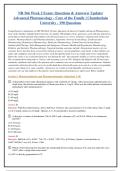
NR 566 Week 3 Exam: Questions & Answers( Update)
Advanced Pharmacology - Care of the Family | Chamberlain
University - 189 Questions
This exam assesses advanced understanding of pharmacokinetics and pharmacodynamics principles applied to
family care. Questions require integration of drug absorption, distribution, metabolism, elimination, receptor
theory, dose-response relationships, and clinical implications across diverse patient populations. Emphasis on
mechanistic reasoning and evidence-based application. It contains 189 multiple-choice questions, each with four
distractors and a fully worked rationale that explains why the keyed answer is correct. Content is organized into
10 focused sections: Pharmacokinetics and Pharmacodynamics, Autonomic Nervous System Drugs,
Cardiovascular Pharmacology, Respiratory Pharmacology, Endocrine Pharmacology, Neurological and
Psychiatric Pharmacology, Antimicrobial Therapy, Pain Management and Analgesics, Women's Health and
Reproductive Pharmacology, Pediatric and Geriatric Pharmacology Considerations. Targeted learning outcomes
include: Analyze pharmacokinetic parameters to predict drug behavior and adjust dosing regimens.; Evaluate
pharmacodynamic principles, including receptor interactions and dose-response relationships.; Apply
pharmacokinetic/pharmacodynamic concepts to optimize drug therapy in complex clinical scenarios.. Every item
has been reviewed for clinical accuracy, current guidelines, and clarity so that students can study with confidence
and self-correct as they work through the bank. Use it as a high-yield review immediately before the exam, or as a
structured practice tool during the unit - the rationales double as concise teaching notes. The recommended
Section 1: Pharmacokinetics and Pharmacodynamics (Questions 1-10)
1 A patient with severe hepatic cirrhosis is prescribed a drug that undergoes extensive first-pass metabolism.
Which of the following pharmacokinetic changes is most likely to result in increased systemic exposure to the
drug?
A) Increased volume of distribution due to reduced plasma protein binding
B) Decreased clearance due to reduced hepatic enzyme activity
C) Increased bioavailability due to reduced first-pass effect
D) Decreased half-life due to altered hepatic blood flow
Answer: C
Rationale: In severe hepatic cirrhosis, portosystemic shunting and reduced hepatocyte function decrease first-pass
metabolism, leading to higher oral bioavailability. Reduced clearance (B) also occurs but does not directly explain
increased systemic exposure after oral dosing; bioavailability is the primary determinant. Increased volume of
distribution (A) may occur but does not increase systemic exposure. Half-life (D) is prolonged, not decreased.
2 A drug follows a two-compartment model with rapid distribution and slow elimination. After a single
intravenous bolus dose, the plasma concentration-time curve shows a biexponential decline. Which parameter
best describes the initial rapid decline?
A) Elimination half-life
B) Distribution half-life
C) Volume of distribution at steady state
D) Area under the curve
Answer: B
Rationale: In a two-compartment model, the initial rapid decline reflects distribution from central to peripheral
compartment, characterized by distribution half-life (alpha phase). Elimination half-life (A) describes the terminal
slow phase. Volume of distribution (C) and AUC (D) are derived from the entire curve, not specific to the initial
,decline.
3 A patient is receiving a continuous intravenous infusion of a drug that exhibits Michaelis-Menten elimination
kinetics. The infusion rate is increased from 10 mg/h to 20 mg/h. Which of the following best describes the
change in steady-state concentration (Css)?
A) Css doubles proportionally
B) Css increases more than twofold
C) Css increases less than twofold
D) Css remains unchanged
Answer: B
Rationale: For drugs with Michaelis-Menten elimination, clearance decreases as concentration increases due to
enzyme saturation. Doubling the infusion rate leads to a greater than proportional increase in Css because clearance
is lower at higher concentrations. Option A would occur with linear kinetics. Options C and D are incorrect.
4 Which of the following best explains why a drug with a high extraction ratio (E > 0.7) exhibits clearance that is
primarily dependent on hepatic blood flow?
A) The drug is highly bound to plasma proteins, limiting free fraction
B) The drug's intrinsic clearance is low relative to blood flow
C) The drug's intrinsic clearance is high, so hepatic enzymes are saturated
D) The drug is extensively metabolized in the gut wall
Answer: C
Rationale: For high extraction ratio drugs, intrinsic clearance is much greater than hepatic blood flow, so clearance
is blood flow-limited. Intrinsic clearance is high, not low (B). Protein binding (A) has minimal effect because
extraction is efficient. Gut wall metabolism (D) is a separate first-pass effect.
5 A patient with chronic kidney disease (GFR 25 mL/min) is started on a drug that is primarily eliminated renally
with a narrow therapeutic index. The drug's half-life in normal renal function is 8 hours. Which adjustment is
most appropriate?
A) Maintain same dose but increase dosing interval
B) Reduce dose by 50% and maintain same interval
C) Reduce dose by 75% and increase interval
D) No adjustment needed because half-life is unchanged
Answer: A
Rationale: With reduced GFR, clearance decreases and half-life prolongs. Maintaining the same dose but extending
the dosing interval allows similar peak concentrations while avoiding accumulation. Reducing dose (B, C) may
lead to subtherapeutic peaks. Half-life is increased, not unchanged (D).
6 Receptor binding studies show that Drug X has a Kd of 0.5 nM and an Emax of 100%. Drug Y has a Kd of 2
nM and an Emax of 80%. Which statement is correct?
A) Drug X is more potent and more efficacious than Drug Y
B) Drug Y is more potent but less efficacious than Drug X
C) Drug X is less potent but more efficacious than Drug Y
D) Drug Y is less potent and less efficacious than Drug X
Answer: A
Rationale: Potency is inversely related to Kd: lower Kd means higher affinity and potency. Drug X has lower Kd
(0.5 vs 2 nM), so it is more potent. Efficacy is determined by Emax: Drug X has higher Emax (100% vs 80%), so it
is more efficacious. Thus, Drug X is both more potent and more efficacious.
,7 A drug that is a weak acid (pKa 4.5) is administered orally. In the stomach (pH 2), what is the predominant form
of the drug, and how does this affect absorption?
A) Ionized form; absorption is favored because ionized drugs are more water-soluble
B) Non-ionized form; absorption is favored because non-ionized drugs cross membranes readily
C) Ionized form; absorption is reduced because ionized drugs are trapped in the stomach
D) Non-ionized form; absorption is reduced because non-ionized drugs precipitate
Answer: B
Rationale: According to the Henderson-Hasselbalch equation, for a weak acid with pKa 4.5 at pH 2, the ratio
[HA]/[A-] = 10^(4.5-2) 316, so the non-ionized form predominates. Non-ionized drugs are lipophilic and can cross
cell membranes, favoring absorption. Ionized forms (A, C) are less absorbable. Non-ionized drugs do not
precipitate (D).
8 A patient is taking a drug that is a substrate of CYP3A4 and P-glycoprotein. Concomitant administration of a
potent CYP3A4 inhibitor and P-gp inhibitor is expected to cause which change in oral bioavailability?
A) Decrease due to reduced metabolism and increased efflux
B) Increase due to reduced metabolism and reduced efflux
C) Increase due to increased metabolism and reduced efflux
D) No change because CYP3A4 and P-gp have opposing effects
Answer: B
Rationale: CYP3A4 inhibition reduces first-pass metabolism, increasing bioavailability. P-gp inhibition reduces
efflux from enterocytes, further increasing absorption. Both effects increase bioavailability. Option A is opposite.
Option C is incorrect because metabolism is reduced, not increased. Option D ignores additive effects.
9 Which of the following best describes the clinical significance of a drug with a very large volume of distribution
(e.g., > 1000 L)?
A) The drug is highly concentrated in plasma and requires low loading doses
B) The drug is extensively distributed into tissues, and a loading dose must be higher to achieve therapeutic
plasma concentrations
C) The drug has a short half-life due to rapid elimination from tissues
D) The drug is likely to cause toxicity because it accumulates in fat
Answer: B
Rationale: A large Vd indicates extensive tissue distribution, meaning a larger loading dose is needed to achieve a
target plasma concentration. Option A is incorrect; a large Vd means low plasma concentration relative to total
body amount. Half-life depends on clearance and Vd; large Vd often prolongs half-life (C). Toxicity (D) is not
directly implied.
10 A drug shows linear pharmacokinetics over a dose range of 10-100 mg. If the area under the curve (AUC) after
a 50 mg oral dose is 100 mg-h/L, what is the predicted AUC after a 75 mg oral dose?
A) 100 mg-h/L
B) 150 mg-h/L
C) 200 mg-h/L
D) 75 mg-h/L
Answer: B
Rationale: In linear pharmacokinetics, AUC is proportional to dose. Dose increased from 50 to 75 mg (1.5-fold), so
AUC should increase proportionally: 100 × 1.5 = 150 mg-h/L. Option A is unchanged, C is double, D is less than
proportional.
, Section 2: Autonomic Nervous System Drugs (Questions 11-30)
11 A patient with a history of poorly controlled hypertension and benign prostatic hyperplasia is prescribed
tamsulosin. Which of the following best explains the potential benefit of tamsulosin on blood pressure in this
patient?
A) Selective 1A antagonism reduces peripheral vascular resistance without significant reflex tachycardia.
B) 1B antagonism causes venodilation and reduces preload, lowering blood pressure.
C) 2 antagonism in the central nervous system reduces sympathetic outflow.
D) 1 blockade reduces cardiac output and renin release.
Answer: A
Rationale: Tamsulosin is selective for ±1A receptors, which are primarily in the prostate, but at higher doses can
also block 1B receptors in vasculature, causing vasodilation. However, its selectivity for 1A reduces the degree of
vasodilation compared to non-selective 1 blockers, and reflex tachycardia is minimal. Option B is incorrect because
1B antagonism is not selective for venodilation. Option C describes 2 agonists like clonidine. Option D describes
beta blockers.
12 A researcher is studying a novel compound that selectively activates M2 muscarinic receptors. Which of the
following physiological effects would most likely be observed in an animal model?
A) Increased heart rate and contractility.
B) Bronchodilation and decreased secretions.
C) Bradycardia and decreased atrial contractility.
D) Mydriasis and cycloplegia.
Answer: C
Rationale: M2 receptors are the predominant muscarinic subtype in the heart, and their activation leads to decreased
heart rate (negative chronotropy) and reduced atrial contractility (negative inotropy). Option A is mediated by 1
adrenergic receptors. Option B is mediated by 2 receptors. Option D is mediated by M3 receptors in the iris and
ciliary muscle.
13 A patient receiving long-term treatment for glaucoma develops bronchospasm after using a new eye drop.
Which of the following drug classes is most likely responsible?
A) 1-selective adrenergic antagonists.
B) Non-selective -adrenergic antagonists (e.g., timolol).
C) 2-adrenergic agonists (e.g., brimonidine).
D) Prostaglandin analogs (e.g., latanoprost).
Answer: B
Rationale: Non-selective ²-blockers like timolol can cause bronchospasm in susceptible individuals due to blockade
of 2 receptors in the lungs. 1-selective antagonists are less likely to cause bronchospasm but are not completely
risk-free. 2 agonists and prostaglandin analogs do not typically cause bronchospasm.
14 A 45-year-old patient with no significant medical history presents with acute hypertension (BP 220/130 mm
Hg) and severe headache. Which of the following agents would be most appropriate for immediate blood
pressure reduction?
A) Oral propranolol.
B) Intravenous nitroprusside.
C) Intravenous esmolol.
D) Intravenous phentolamine.
Answer: B
Advanced Pharmacology - Care of the Family | Chamberlain
University - 189 Questions
This exam assesses advanced understanding of pharmacokinetics and pharmacodynamics principles applied to
family care. Questions require integration of drug absorption, distribution, metabolism, elimination, receptor
theory, dose-response relationships, and clinical implications across diverse patient populations. Emphasis on
mechanistic reasoning and evidence-based application. It contains 189 multiple-choice questions, each with four
distractors and a fully worked rationale that explains why the keyed answer is correct. Content is organized into
10 focused sections: Pharmacokinetics and Pharmacodynamics, Autonomic Nervous System Drugs,
Cardiovascular Pharmacology, Respiratory Pharmacology, Endocrine Pharmacology, Neurological and
Psychiatric Pharmacology, Antimicrobial Therapy, Pain Management and Analgesics, Women's Health and
Reproductive Pharmacology, Pediatric and Geriatric Pharmacology Considerations. Targeted learning outcomes
include: Analyze pharmacokinetic parameters to predict drug behavior and adjust dosing regimens.; Evaluate
pharmacodynamic principles, including receptor interactions and dose-response relationships.; Apply
pharmacokinetic/pharmacodynamic concepts to optimize drug therapy in complex clinical scenarios.. Every item
has been reviewed for clinical accuracy, current guidelines, and clarity so that students can study with confidence
and self-correct as they work through the bank. Use it as a high-yield review immediately before the exam, or as a
structured practice tool during the unit - the rationales double as concise teaching notes. The recommended
Section 1: Pharmacokinetics and Pharmacodynamics (Questions 1-10)
1 A patient with severe hepatic cirrhosis is prescribed a drug that undergoes extensive first-pass metabolism.
Which of the following pharmacokinetic changes is most likely to result in increased systemic exposure to the
drug?
A) Increased volume of distribution due to reduced plasma protein binding
B) Decreased clearance due to reduced hepatic enzyme activity
C) Increased bioavailability due to reduced first-pass effect
D) Decreased half-life due to altered hepatic blood flow
Answer: C
Rationale: In severe hepatic cirrhosis, portosystemic shunting and reduced hepatocyte function decrease first-pass
metabolism, leading to higher oral bioavailability. Reduced clearance (B) also occurs but does not directly explain
increased systemic exposure after oral dosing; bioavailability is the primary determinant. Increased volume of
distribution (A) may occur but does not increase systemic exposure. Half-life (D) is prolonged, not decreased.
2 A drug follows a two-compartment model with rapid distribution and slow elimination. After a single
intravenous bolus dose, the plasma concentration-time curve shows a biexponential decline. Which parameter
best describes the initial rapid decline?
A) Elimination half-life
B) Distribution half-life
C) Volume of distribution at steady state
D) Area under the curve
Answer: B
Rationale: In a two-compartment model, the initial rapid decline reflects distribution from central to peripheral
compartment, characterized by distribution half-life (alpha phase). Elimination half-life (A) describes the terminal
slow phase. Volume of distribution (C) and AUC (D) are derived from the entire curve, not specific to the initial
,decline.
3 A patient is receiving a continuous intravenous infusion of a drug that exhibits Michaelis-Menten elimination
kinetics. The infusion rate is increased from 10 mg/h to 20 mg/h. Which of the following best describes the
change in steady-state concentration (Css)?
A) Css doubles proportionally
B) Css increases more than twofold
C) Css increases less than twofold
D) Css remains unchanged
Answer: B
Rationale: For drugs with Michaelis-Menten elimination, clearance decreases as concentration increases due to
enzyme saturation. Doubling the infusion rate leads to a greater than proportional increase in Css because clearance
is lower at higher concentrations. Option A would occur with linear kinetics. Options C and D are incorrect.
4 Which of the following best explains why a drug with a high extraction ratio (E > 0.7) exhibits clearance that is
primarily dependent on hepatic blood flow?
A) The drug is highly bound to plasma proteins, limiting free fraction
B) The drug's intrinsic clearance is low relative to blood flow
C) The drug's intrinsic clearance is high, so hepatic enzymes are saturated
D) The drug is extensively metabolized in the gut wall
Answer: C
Rationale: For high extraction ratio drugs, intrinsic clearance is much greater than hepatic blood flow, so clearance
is blood flow-limited. Intrinsic clearance is high, not low (B). Protein binding (A) has minimal effect because
extraction is efficient. Gut wall metabolism (D) is a separate first-pass effect.
5 A patient with chronic kidney disease (GFR 25 mL/min) is started on a drug that is primarily eliminated renally
with a narrow therapeutic index. The drug's half-life in normal renal function is 8 hours. Which adjustment is
most appropriate?
A) Maintain same dose but increase dosing interval
B) Reduce dose by 50% and maintain same interval
C) Reduce dose by 75% and increase interval
D) No adjustment needed because half-life is unchanged
Answer: A
Rationale: With reduced GFR, clearance decreases and half-life prolongs. Maintaining the same dose but extending
the dosing interval allows similar peak concentrations while avoiding accumulation. Reducing dose (B, C) may
lead to subtherapeutic peaks. Half-life is increased, not unchanged (D).
6 Receptor binding studies show that Drug X has a Kd of 0.5 nM and an Emax of 100%. Drug Y has a Kd of 2
nM and an Emax of 80%. Which statement is correct?
A) Drug X is more potent and more efficacious than Drug Y
B) Drug Y is more potent but less efficacious than Drug X
C) Drug X is less potent but more efficacious than Drug Y
D) Drug Y is less potent and less efficacious than Drug X
Answer: A
Rationale: Potency is inversely related to Kd: lower Kd means higher affinity and potency. Drug X has lower Kd
(0.5 vs 2 nM), so it is more potent. Efficacy is determined by Emax: Drug X has higher Emax (100% vs 80%), so it
is more efficacious. Thus, Drug X is both more potent and more efficacious.
,7 A drug that is a weak acid (pKa 4.5) is administered orally. In the stomach (pH 2), what is the predominant form
of the drug, and how does this affect absorption?
A) Ionized form; absorption is favored because ionized drugs are more water-soluble
B) Non-ionized form; absorption is favored because non-ionized drugs cross membranes readily
C) Ionized form; absorption is reduced because ionized drugs are trapped in the stomach
D) Non-ionized form; absorption is reduced because non-ionized drugs precipitate
Answer: B
Rationale: According to the Henderson-Hasselbalch equation, for a weak acid with pKa 4.5 at pH 2, the ratio
[HA]/[A-] = 10^(4.5-2) 316, so the non-ionized form predominates. Non-ionized drugs are lipophilic and can cross
cell membranes, favoring absorption. Ionized forms (A, C) are less absorbable. Non-ionized drugs do not
precipitate (D).
8 A patient is taking a drug that is a substrate of CYP3A4 and P-glycoprotein. Concomitant administration of a
potent CYP3A4 inhibitor and P-gp inhibitor is expected to cause which change in oral bioavailability?
A) Decrease due to reduced metabolism and increased efflux
B) Increase due to reduced metabolism and reduced efflux
C) Increase due to increased metabolism and reduced efflux
D) No change because CYP3A4 and P-gp have opposing effects
Answer: B
Rationale: CYP3A4 inhibition reduces first-pass metabolism, increasing bioavailability. P-gp inhibition reduces
efflux from enterocytes, further increasing absorption. Both effects increase bioavailability. Option A is opposite.
Option C is incorrect because metabolism is reduced, not increased. Option D ignores additive effects.
9 Which of the following best describes the clinical significance of a drug with a very large volume of distribution
(e.g., > 1000 L)?
A) The drug is highly concentrated in plasma and requires low loading doses
B) The drug is extensively distributed into tissues, and a loading dose must be higher to achieve therapeutic
plasma concentrations
C) The drug has a short half-life due to rapid elimination from tissues
D) The drug is likely to cause toxicity because it accumulates in fat
Answer: B
Rationale: A large Vd indicates extensive tissue distribution, meaning a larger loading dose is needed to achieve a
target plasma concentration. Option A is incorrect; a large Vd means low plasma concentration relative to total
body amount. Half-life depends on clearance and Vd; large Vd often prolongs half-life (C). Toxicity (D) is not
directly implied.
10 A drug shows linear pharmacokinetics over a dose range of 10-100 mg. If the area under the curve (AUC) after
a 50 mg oral dose is 100 mg-h/L, what is the predicted AUC after a 75 mg oral dose?
A) 100 mg-h/L
B) 150 mg-h/L
C) 200 mg-h/L
D) 75 mg-h/L
Answer: B
Rationale: In linear pharmacokinetics, AUC is proportional to dose. Dose increased from 50 to 75 mg (1.5-fold), so
AUC should increase proportionally: 100 × 1.5 = 150 mg-h/L. Option A is unchanged, C is double, D is less than
proportional.
, Section 2: Autonomic Nervous System Drugs (Questions 11-30)
11 A patient with a history of poorly controlled hypertension and benign prostatic hyperplasia is prescribed
tamsulosin. Which of the following best explains the potential benefit of tamsulosin on blood pressure in this
patient?
A) Selective 1A antagonism reduces peripheral vascular resistance without significant reflex tachycardia.
B) 1B antagonism causes venodilation and reduces preload, lowering blood pressure.
C) 2 antagonism in the central nervous system reduces sympathetic outflow.
D) 1 blockade reduces cardiac output and renin release.
Answer: A
Rationale: Tamsulosin is selective for ±1A receptors, which are primarily in the prostate, but at higher doses can
also block 1B receptors in vasculature, causing vasodilation. However, its selectivity for 1A reduces the degree of
vasodilation compared to non-selective 1 blockers, and reflex tachycardia is minimal. Option B is incorrect because
1B antagonism is not selective for venodilation. Option C describes 2 agonists like clonidine. Option D describes
beta blockers.
12 A researcher is studying a novel compound that selectively activates M2 muscarinic receptors. Which of the
following physiological effects would most likely be observed in an animal model?
A) Increased heart rate and contractility.
B) Bronchodilation and decreased secretions.
C) Bradycardia and decreased atrial contractility.
D) Mydriasis and cycloplegia.
Answer: C
Rationale: M2 receptors are the predominant muscarinic subtype in the heart, and their activation leads to decreased
heart rate (negative chronotropy) and reduced atrial contractility (negative inotropy). Option A is mediated by 1
adrenergic receptors. Option B is mediated by 2 receptors. Option D is mediated by M3 receptors in the iris and
ciliary muscle.
13 A patient receiving long-term treatment for glaucoma develops bronchospasm after using a new eye drop.
Which of the following drug classes is most likely responsible?
A) 1-selective adrenergic antagonists.
B) Non-selective -adrenergic antagonists (e.g., timolol).
C) 2-adrenergic agonists (e.g., brimonidine).
D) Prostaglandin analogs (e.g., latanoprost).
Answer: B
Rationale: Non-selective ²-blockers like timolol can cause bronchospasm in susceptible individuals due to blockade
of 2 receptors in the lungs. 1-selective antagonists are less likely to cause bronchospasm but are not completely
risk-free. 2 agonists and prostaglandin analogs do not typically cause bronchospasm.
14 A 45-year-old patient with no significant medical history presents with acute hypertension (BP 220/130 mm
Hg) and severe headache. Which of the following agents would be most appropriate for immediate blood
pressure reduction?
A) Oral propranolol.
B) Intravenous nitroprusside.
C) Intravenous esmolol.
D) Intravenous phentolamine.
Answer: B