9/26/202 : Quiz Submissions - Midterm Exam - EDMG220 D002 Spring 2020
0 - APEI
Quiz Submissions - Midterm Exam
Christopher Benner (username: 5692288)
Attempt 1
Written: Jun 27, 2020 10:37 AM - Jun 27, 2020 11:43 AM
Submission View
Your quiz has been submitted successfully.
Question 1 points
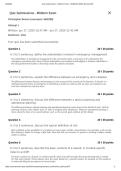
In 3 to 5 sentences, define the stakeholders involved in emergency management.
The stakeholders in emergency management is the community itself, as everyone in it is affected by the
emergency operations plan. Some of these stakeholders are hospitals and firefighters. Another stakeholder is
the local government leaders as they help create the policies and plans.
Question 2 points
In 3 to 5 sentences, explain the difference between an emergency and a disaster.
The difference between disaster and emergency is the amount of the severity of the situation. A disaster is a
widespread event where an emergency is something as small as a multi-car pile up. Also, an emergency can
turn into a disaster but not vice versa.
Question 3 points
In 3 to 5 sentences, discuss the difference between a tactical planning and
operational planning.
The difference between tactical planning and operational planning comes down to the details of each. Tactical
planning involves exact details such as, who is bringing what equipment. Whereas operational planning is
more along the lines of an overall picture such as the overall goals without all the details.
Question 4 points
In 3 to 5 sentences, discuss the typical definition of risk.
Risk is defined as the possibility of a incident can occur given certain circumstances. For example, a risk can be
like climbing a ladder to change a light bulb. Now that risk can increase if a person is climbing a ladder outside
while it’s raining.
Question 5 points
In 3 to 5 sentences, describe the basic contents of a hazard- or incident-specific
index to an EOP.
The basic contents of a hazard- or incident-specific index of an EOP provides the exact planning that is needed
for that exact hazard. These indexes have the exact details for a specific hazard. An example of this would be
an index detailing the procedures for levee breaks.
https://myclassroom.apus.edu/d2l/lms/quizzing/user/quiz_submissions_attempt.d2l? 1/
isprv=&qi=9828&ai=23023&isInPopup=0&cfql=0&ou=16366 2
0 - APEI
Quiz Submissions - Midterm Exam
Christopher Benner (username: 5692288)
Attempt 1
Written: Jun 27, 2020 10:37 AM - Jun 27, 2020 11:43 AM
Submission View
Your quiz has been submitted successfully.
Question 1 points
In 3 to 5 sentences, define the stakeholders involved in emergency management.
The stakeholders in emergency management is the community itself, as everyone in it is affected by the
emergency operations plan. Some of these stakeholders are hospitals and firefighters. Another stakeholder is
the local government leaders as they help create the policies and plans.
Question 2 points
In 3 to 5 sentences, explain the difference between an emergency and a disaster.
The difference between disaster and emergency is the amount of the severity of the situation. A disaster is a
widespread event where an emergency is something as small as a multi-car pile up. Also, an emergency can
turn into a disaster but not vice versa.
Question 3 points
In 3 to 5 sentences, discuss the difference between a tactical planning and
operational planning.
The difference between tactical planning and operational planning comes down to the details of each. Tactical
planning involves exact details such as, who is bringing what equipment. Whereas operational planning is
more along the lines of an overall picture such as the overall goals without all the details.
Question 4 points
In 3 to 5 sentences, discuss the typical definition of risk.
Risk is defined as the possibility of a incident can occur given certain circumstances. For example, a risk can be
like climbing a ladder to change a light bulb. Now that risk can increase if a person is climbing a ladder outside
while it’s raining.
Question 5 points
In 3 to 5 sentences, describe the basic contents of a hazard- or incident-specific
index to an EOP.
The basic contents of a hazard- or incident-specific index of an EOP provides the exact planning that is needed
for that exact hazard. These indexes have the exact details for a specific hazard. An example of this would be
an index detailing the procedures for levee breaks.
https://myclassroom.apus.edu/d2l/lms/quizzing/user/quiz_submissions_attempt.d2l? 1/
isprv=&qi=9828&ai=23023&isInPopup=0&cfql=0&ou=16366 2