
Business law evaluation 2026-2027
1.1 Evaluate what it means to be an HR professional with reference to the CIPDs most current
Profession Map
HR is an ever evolving profession whose practitioners must continually develop and improve to ensure they
possess the necessary knowledge, skills and behaviours to remain relevant leaders in the current
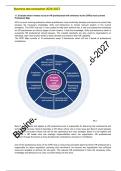
workplace. The CIPD map (pic.1) was created to help them achieve that. It sets out professional standards
for HR practitioners at various stages of their careers. It lists the knowledge, skills and behaviours which a
successful HR professional should possess. The created standards are also used by organisations on
individual, team and function levels to build, develop and improve their HR capability.
The CIPD Map consists of 10 professional areas, 8 behaviours which fall into 4 bands of professional
competence.
Pic.1
Band 1 is the lowest and applies to HR professional who is responsible for delivering the fundamental and
technical HR services. Band 2 describes a HR officer whose role is more issue-led. Band 3 would typically
apply to HR consultant whose role will be less operational but more strategic. Band 4 is the highest and
describes a HR leader who has strategic responsibilities within the organisation. HR professionals
transition through the bands as they develop their competence and grow in confidence.
One of the professional areas of the CIPD map is resourcing and talent planning where HR professional is
responsible for talent acquisition, planning and recruitment, he ensures the organisation has sufficient
resources available to achieve the set goals. This requires HR professional to have the necessary skills,
knowledge and behaviours to carry out tasks falling into this area.
, Business law evaluation 2026-2027
Skills Knowledge Behaviours
research, data collating and the knowledge of employment decisive thinking (recommends
analysis (asses resources law relating to recruitment, resources needed to meet
and talent situation, available redundancy and exit, as well organisation’s future needs)
tools); as data protection;
Learning and development area of the CIPD map is often classified as HR development area as it sets
standards for developing organisation’s strategy which would encourage learning culture and provide
employees with opportunities to learn and further develop themselves, reach their full potential which in
turn would only increase organisation’s capability and support its goals.
Skills Knowledge Behaviours
• research, source and of learning approaches, curiosity (researches new
recommend new learning theories, learning/ training learning and training tools)
opportunities and new needs analysis and learning/
channels appropriate to training delivery channels;
specific needs of the
individuals and their learning
styles;
HR professional who has acquired the above described necessary skills, knowledge and behaviours
will be efficient and effective to collect and accurately analyse resourcing/ learning and development
data such as talent gaps. Furthermore, thanks to their research skills they will be able to recommend
solutions, i.e. learning opportunities, talent/ succession planning, new recruitment methods to
successfully fill the gaps. Their proposed solutions may be innovative and thought provoking but they
will be tailored to the organisation’s needs and in line with its strategy, i.e. inclusion and diversity.
Successful HR professional will be also an effective communicator and influencer when dealing with
staff whilst explaining and encouraging to take up the new training opportunity, candidates when
informing them about recruitment process or managers when gaining approval for a new recruitment
method. HR professional’s competence will improve and drive the organisation’s HR capability.
1.2 Describe the elements of group dynamics and conflict resolution methods.
HR professionals belong to and work with various types of groups, i.e. internal (teams, departments),
external (regulatory bodies, networks, communities), informal (colleagues meeting for lunch), formal
(project teams) etc. Each group is unique and its dynamics can be affected by the group’s
development stage (Tuckman theory, 1975), the roles of group members (Belbin theory,1981), or the
presence of five dysfunctions (Lencioni model, 2002). Tuckman’s theory of group’s formation (pic.2)
proposes five stages of development. In the first stage when group is being formed, the individuals
come together because of the same goal; they don’t trust each other yet, they are only getting to know
each other, their styles of working and the details of the project. The leader should ensure all team
members know and understand the expectations and how they are to be achieved. The storming
stage comes when team members are more comfortable with each other and conflict appears when
the team members start to question the purpose of the project, methods and actions of the other team
members. However with the help from the leader, as well as honest and open communication,
conflicts can be resolved and the team can enter the third stage – norming. In this stage all team
members know each other’s capabilities very well, they know and understand their common goal and
have agreed on the rules and values on which they will operate. They feel responsible for the project
1.1 Evaluate what it means to be an HR professional with reference to the CIPDs most current
Profession Map
HR is an ever evolving profession whose practitioners must continually develop and improve to ensure they
possess the necessary knowledge, skills and behaviours to remain relevant leaders in the current
workplace. The CIPD map (pic.1) was created to help them achieve that. It sets out professional standards
for HR practitioners at various stages of their careers. It lists the knowledge, skills and behaviours which a
successful HR professional should possess. The created standards are also used by organisations on
individual, team and function levels to build, develop and improve their HR capability.
The CIPD Map consists of 10 professional areas, 8 behaviours which fall into 4 bands of professional
competence.
Pic.1
Band 1 is the lowest and applies to HR professional who is responsible for delivering the fundamental and
technical HR services. Band 2 describes a HR officer whose role is more issue-led. Band 3 would typically
apply to HR consultant whose role will be less operational but more strategic. Band 4 is the highest and
describes a HR leader who has strategic responsibilities within the organisation. HR professionals
transition through the bands as they develop their competence and grow in confidence.
One of the professional areas of the CIPD map is resourcing and talent planning where HR professional is
responsible for talent acquisition, planning and recruitment, he ensures the organisation has sufficient
resources available to achieve the set goals. This requires HR professional to have the necessary skills,
knowledge and behaviours to carry out tasks falling into this area.
, Business law evaluation 2026-2027
Skills Knowledge Behaviours
research, data collating and the knowledge of employment decisive thinking (recommends
analysis (asses resources law relating to recruitment, resources needed to meet
and talent situation, available redundancy and exit, as well organisation’s future needs)
tools); as data protection;
Learning and development area of the CIPD map is often classified as HR development area as it sets
standards for developing organisation’s strategy which would encourage learning culture and provide
employees with opportunities to learn and further develop themselves, reach their full potential which in
turn would only increase organisation’s capability and support its goals.
Skills Knowledge Behaviours
• research, source and of learning approaches, curiosity (researches new
recommend new learning theories, learning/ training learning and training tools)
opportunities and new needs analysis and learning/
channels appropriate to training delivery channels;
specific needs of the
individuals and their learning
styles;
HR professional who has acquired the above described necessary skills, knowledge and behaviours
will be efficient and effective to collect and accurately analyse resourcing/ learning and development
data such as talent gaps. Furthermore, thanks to their research skills they will be able to recommend
solutions, i.e. learning opportunities, talent/ succession planning, new recruitment methods to
successfully fill the gaps. Their proposed solutions may be innovative and thought provoking but they
will be tailored to the organisation’s needs and in line with its strategy, i.e. inclusion and diversity.
Successful HR professional will be also an effective communicator and influencer when dealing with
staff whilst explaining and encouraging to take up the new training opportunity, candidates when
informing them about recruitment process or managers when gaining approval for a new recruitment
method. HR professional’s competence will improve and drive the organisation’s HR capability.
1.2 Describe the elements of group dynamics and conflict resolution methods.
HR professionals belong to and work with various types of groups, i.e. internal (teams, departments),
external (regulatory bodies, networks, communities), informal (colleagues meeting for lunch), formal
(project teams) etc. Each group is unique and its dynamics can be affected by the group’s
development stage (Tuckman theory, 1975), the roles of group members (Belbin theory,1981), or the
presence of five dysfunctions (Lencioni model, 2002). Tuckman’s theory of group’s formation (pic.2)
proposes five stages of development. In the first stage when group is being formed, the individuals
come together because of the same goal; they don’t trust each other yet, they are only getting to know
each other, their styles of working and the details of the project. The leader should ensure all team
members know and understand the expectations and how they are to be achieved. The storming
stage comes when team members are more comfortable with each other and conflict appears when
the team members start to question the purpose of the project, methods and actions of the other team
members. However with the help from the leader, as well as honest and open communication,
conflicts can be resolved and the team can enter the third stage – norming. In this stage all team
members know each other’s capabilities very well, they know and understand their common goal and
have agreed on the rules and values on which they will operate. They feel responsible for the project


