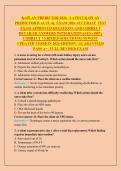
KAPLAN PREDICTOR 2026 / LATEST KAPLAN
PREDICTOR D ACTUAL EXAM 2026 ACCURATE TEST
EXAM APPROVED QUESTIONS AND CORRECT
DETAILED ANSWERS WITH RATIONALES (100%
CORRECT VERIFIED SOLUTIONS) NEWEST
UPDATED VERSION 2026 EDITION | GUARANTEED
PASS A+ | FULL REVISED EXAM
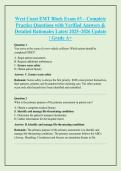
1. A nurse is caring for a client with acute kidney injury and a serum
potassium level of 6.8 mEq/L. Which action should the nurse take first?
A. Administer sodium polystyrene sulfonate
B. Prepare the client for emergency hemodialysis
C. Place the client on a cardiac monitor
D. Administer intravenous insulin and dextrose
Correct answer: C. Place the client on a cardiac monitor.
Rationale:>> Severe hyperkalemia can cause life-threatening dysrhythmias, so
cardiac monitoring is the immediate priority.
2. A client after a stroke has difficulty swallowing. Which action should the
nurse take first?
A. Consult a speech-language pathologist
B. Place the client on NPO status
C. Offer thickened liquids
D. Elevate the head of the bed to 90 degrees
Correct answer: B. Place the client on NPO status.
Rationale:>> Dysphagia creates a major aspiration risk, so airway protection
comes first.
3. A client is postoperative day 1 after a total hip replacement. Which finding
requires immediate intervention?
A. Pain rated 6 out of 10
B. Temperature of 99.8 F
C. Oxygen saturation of 89% on room air
D. Urinary output of 40 mL/hr
,Correct answer: C. Oxygen saturation of 89% on room air.
Rationale:>> Hypoxemia after surgery is urgent and may indicate a serious
complication.
4. A client with cirrhosis has an ammonia level of 120 mcg/dL. Which
assessment finding is most concerning?
A. Asterixis
B. Spider angiomas
C. Palmar erythema
D. Peripheral edema
Correct answer: A. Asterixis.
Rationale:>> Asterixis is a sign of hepatic encephalopathy and neurologic decline.
5. Which task is appropriate to delegate to unlicensed assistive personnel?
A. Assess a postoperative incision
B. Teach inhaler use
C. Measure urine output
D. Change a central line dressing
Correct answer: C. Measure urine output.
Rationale:>> Measuring output is a routine task that can be delegated, while
assessment, teaching, and sterile procedures cannot.
6. A client with preeclampsia is receiving magnesium sulfate. Which finding
indicates toxicity?
A. Blood pressure 140/90 mm Hg
B. Urinary output of 35 mL/hr
C. Deep tendon reflexes 2+
D. Respiratory rate of 10 breaths/min
Correct answer: D. Respiratory rate of 10 breaths/min.
Rationale:>> Magnesium toxicity causes respiratory depression, decreased
reflexes, and reduced urine output.
7. A client with major burns has a nasogastric tube placed. The nurse
understands the primary purpose is to:
A. Prevent aspiration
B. Decrease gastric acid production
C. Prevent Curling’s ulcer
,D. Monitor for gastrointestinal bleeding
Correct answer: C. Prevent Curling’s ulcer.
Rationale:>> Major burns increase the risk of stress ulcers due to decreased GI
perfusion.
8. A client with tuberculosis is prescribed rifampin. Which statement shows
understanding?
A. “My urine and tears may turn orange-red.”
B. “I should take this medication on an empty stomach.”
C. “I will stop the medication once my cough goes away.”
D. “I need to avoid all dairy products.”
Correct answer: A. “My urine and tears may turn orange-red.”
Rationale:>> Rifampin causes harmless orange-red discoloration of body fluids.
9. A client has a chest tube after a pneumothorax. The tube becomes
disconnected from the drainage system. What is the priority action?
A. Clamp the chest tube
B. Submerge the end in sterile water
C. Notify the healthcare provider
D. Apply an occlusive dressing
Correct answer: B. Submerge the end in sterile water.
Rationale:>> This temporarily restores a water seal and prevents air from re-
entering the pleural space.
10. A postpartum client receiving IV oxytocin reports headache and blurred
vision. Which finding requires immediate intervention?
A. Blood pressure 160/110 mm Hg
B. Uterine fundus firm at the umbilicus
C. Moderate lochia rubra
D. Pulse rate 88 beats/min
Correct answer: A. Blood pressure 160/110 mm Hg.
Rationale:>> Severe hypertension with neurologic symptoms suggests
preeclampsia/eclampsia.
11. A client is discharged with enoxaparin. Which statement indicates a need
for further teaching?
A. “I will inject the medication into my abdomen.”
, B. “I will rub the injection site after giving the shot.”
C. “I will not take aspirin while on this medication.”
D. “I will watch for unusual bruising or bleeding.”
Correct answer: B. “I will rub the injection site after giving the shot.”
Rationale:>> Rubbing increases bruising and hematoma formation.
12. A client with diabetic ketoacidosis arrives in the emergency department.
Which fluid is most appropriate initially?
A. 0.9% normal saline
B. 0.45% half-normal saline
C. Dextrose 5% in water
D. Lactated Ringer’s solution
Correct answer: A. 0.9% normal saline.
Rationale:>> Initial DKA treatment starts with isotonic fluid to restore perfusion.
13. A client starts phenelzine for depression. Which food should the nurse
instruct the client to avoid?
A. Roasted chicken
B. Aged cheddar cheese
C. White rice
D. Fresh apples
Correct answer: B. Aged cheddar cheese.
Rationale:>> Aged cheeses contain tyramine and can trigger hypertensive crisis
with MAOIs.
14. A nurse assesses pupillary response after head injury. Which finding
indicates increased intracranial pressure?
A. Pinpoint pupils
B. Bilateral dilated pupils
C. Unequal pupil size
D. Rapidly reactive pupils
Correct answer: C. Unequal pupil size.
Rationale:>> Unequal pupils can indicate worsening intracranial pressure or
herniation.
15. A client with chronic kidney disease has hemoglobin of 8.2 g/dL. Which
medication does the nurse anticipate?
PREDICTOR D ACTUAL EXAM 2026 ACCURATE TEST
EXAM APPROVED QUESTIONS AND CORRECT
DETAILED ANSWERS WITH RATIONALES (100%
CORRECT VERIFIED SOLUTIONS) NEWEST
UPDATED VERSION 2026 EDITION | GUARANTEED
PASS A+ | FULL REVISED EXAM
1. A nurse is caring for a client with acute kidney injury and a serum
potassium level of 6.8 mEq/L. Which action should the nurse take first?
A. Administer sodium polystyrene sulfonate
B. Prepare the client for emergency hemodialysis
C. Place the client on a cardiac monitor
D. Administer intravenous insulin and dextrose
Correct answer: C. Place the client on a cardiac monitor.
Rationale:>> Severe hyperkalemia can cause life-threatening dysrhythmias, so
cardiac monitoring is the immediate priority.
2. A client after a stroke has difficulty swallowing. Which action should the
nurse take first?
A. Consult a speech-language pathologist
B. Place the client on NPO status
C. Offer thickened liquids
D. Elevate the head of the bed to 90 degrees
Correct answer: B. Place the client on NPO status.
Rationale:>> Dysphagia creates a major aspiration risk, so airway protection
comes first.
3. A client is postoperative day 1 after a total hip replacement. Which finding
requires immediate intervention?
A. Pain rated 6 out of 10
B. Temperature of 99.8 F
C. Oxygen saturation of 89% on room air
D. Urinary output of 40 mL/hr
,Correct answer: C. Oxygen saturation of 89% on room air.
Rationale:>> Hypoxemia after surgery is urgent and may indicate a serious
complication.
4. A client with cirrhosis has an ammonia level of 120 mcg/dL. Which
assessment finding is most concerning?
A. Asterixis
B. Spider angiomas
C. Palmar erythema
D. Peripheral edema
Correct answer: A. Asterixis.
Rationale:>> Asterixis is a sign of hepatic encephalopathy and neurologic decline.
5. Which task is appropriate to delegate to unlicensed assistive personnel?
A. Assess a postoperative incision
B. Teach inhaler use
C. Measure urine output
D. Change a central line dressing
Correct answer: C. Measure urine output.
Rationale:>> Measuring output is a routine task that can be delegated, while
assessment, teaching, and sterile procedures cannot.
6. A client with preeclampsia is receiving magnesium sulfate. Which finding
indicates toxicity?
A. Blood pressure 140/90 mm Hg
B. Urinary output of 35 mL/hr
C. Deep tendon reflexes 2+
D. Respiratory rate of 10 breaths/min
Correct answer: D. Respiratory rate of 10 breaths/min.
Rationale:>> Magnesium toxicity causes respiratory depression, decreased
reflexes, and reduced urine output.
7. A client with major burns has a nasogastric tube placed. The nurse
understands the primary purpose is to:
A. Prevent aspiration
B. Decrease gastric acid production
C. Prevent Curling’s ulcer
,D. Monitor for gastrointestinal bleeding
Correct answer: C. Prevent Curling’s ulcer.
Rationale:>> Major burns increase the risk of stress ulcers due to decreased GI
perfusion.
8. A client with tuberculosis is prescribed rifampin. Which statement shows
understanding?
A. “My urine and tears may turn orange-red.”
B. “I should take this medication on an empty stomach.”
C. “I will stop the medication once my cough goes away.”
D. “I need to avoid all dairy products.”
Correct answer: A. “My urine and tears may turn orange-red.”
Rationale:>> Rifampin causes harmless orange-red discoloration of body fluids.
9. A client has a chest tube after a pneumothorax. The tube becomes
disconnected from the drainage system. What is the priority action?
A. Clamp the chest tube
B. Submerge the end in sterile water
C. Notify the healthcare provider
D. Apply an occlusive dressing
Correct answer: B. Submerge the end in sterile water.
Rationale:>> This temporarily restores a water seal and prevents air from re-
entering the pleural space.
10. A postpartum client receiving IV oxytocin reports headache and blurred
vision. Which finding requires immediate intervention?
A. Blood pressure 160/110 mm Hg
B. Uterine fundus firm at the umbilicus
C. Moderate lochia rubra
D. Pulse rate 88 beats/min
Correct answer: A. Blood pressure 160/110 mm Hg.
Rationale:>> Severe hypertension with neurologic symptoms suggests
preeclampsia/eclampsia.
11. A client is discharged with enoxaparin. Which statement indicates a need
for further teaching?
A. “I will inject the medication into my abdomen.”
, B. “I will rub the injection site after giving the shot.”
C. “I will not take aspirin while on this medication.”
D. “I will watch for unusual bruising or bleeding.”
Correct answer: B. “I will rub the injection site after giving the shot.”
Rationale:>> Rubbing increases bruising and hematoma formation.
12. A client with diabetic ketoacidosis arrives in the emergency department.
Which fluid is most appropriate initially?
A. 0.9% normal saline
B. 0.45% half-normal saline
C. Dextrose 5% in water
D. Lactated Ringer’s solution
Correct answer: A. 0.9% normal saline.
Rationale:>> Initial DKA treatment starts with isotonic fluid to restore perfusion.
13. A client starts phenelzine for depression. Which food should the nurse
instruct the client to avoid?
A. Roasted chicken
B. Aged cheddar cheese
C. White rice
D. Fresh apples
Correct answer: B. Aged cheddar cheese.
Rationale:>> Aged cheeses contain tyramine and can trigger hypertensive crisis
with MAOIs.
14. A nurse assesses pupillary response after head injury. Which finding
indicates increased intracranial pressure?
A. Pinpoint pupils
B. Bilateral dilated pupils
C. Unequal pupil size
D. Rapidly reactive pupils
Correct answer: C. Unequal pupil size.
Rationale:>> Unequal pupils can indicate worsening intracranial pressure or
herniation.
15. A client with chronic kidney disease has hemoglobin of 8.2 g/dL. Which
medication does the nurse anticipate?