

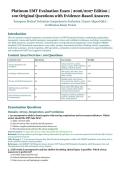
Platinum EMT Evaluation Exam | 2026/2027 Edition |
100 Original Questions with Evidence-Based Answers
Emergency Medical Technician Comprehensive Evaluation | Expert-Aligned Q&A |
Certification-Ready Format
Introduction
This 100-question original competency assessment focuses on EMT Evaluation domains, emphasizing rapid patient
Assessment, trauma and medical emergency management, airway and ventilation techniques, cardiology, resuscitation,
safe EMS operations, transport decisions, communication, and special patient populations. Items integrate NREMT
standards, DOT educational expectations, scene safety, primary Assessment priorities, bleeding control, oxygenation,
medication assistance, shock recognition, AED operations, and patient-centered communication to support stabilization
and readiness for EMT-level cognitive Evaluation.
Content Area Overview: 100 Questions
Content Area Questions Key Topics Weight
Airway maneuvers, suction,
Airway, Respiration, and
20 adjuncts, oxygen, BVM ventilation, 20%
Ventilation
choking, respiratory distress
CPR quality, AED safety, chest
Cardiology and Resuscitation 20 pain, nitroglycerin precautions, 20%
shock, syncope
Bleeding, shock, chest trauma,
Trauma and Medical Emergencies 30 burns, poisoning, diabetes, stroke, 30%
anaphylaxis, environmental illness
Scene safety, PPE, lifting, radio
EMS Operations and Patient
15 reports, refusals, MCI, incident 15%
Transport
command, documentation
Pregnancy, newborns, pediatrics,
Special Patient Populations and
15 geriatrics, disability, behavioral 15%
Communication
crisis, communication
Examination Questions
Domain: Airway, Respiration, and Ventilation
1. An unresponsive adult is found supine with snoring respirations and no trauma indicators. Which
action should the EMT take first?
A. Apply a traction splint
B. Open the airway with a head-tilt chin-lift maneuver
C. Obtain a complete medication history before airway care
D. Place the patient prone and leave the airway unsupported
Correct Answer: B. Open the airway with a head-tilt chin-lift maneuver
Rationale: Snoring indicates partial upper-airway obstruction by soft tissue; in a nontrauma patient, head-tilt chin-lift is the first
airway-opening maneuver.
Why Wrong: A, C, D are incorrect because they delay life-threat management, conflict with NREMT standards, create safety risk, or
do not match the patient’s priority problem.
Reference: 2026 NREMT EMT blueprint airway domain; DOT National EMS Education Standards; AAOS Emergency Care and
Transportation of the Sick and Injured, airway chapters.
2. A fall victim is unresponsive and has shallow breathing. Spinal injury is possible. Which airway
maneuver is preferred?
A. Forcefully hyperextend the neck
B. Perform abdominal thrusts without obstruction
C. Delay airway care until packaging is complete
, D. Use the jaw-thrust maneuver
Correct Answer: D. Use the jaw-thrust maneuver
Rationale: The jaw-thrust opens the airway while limiting cervical spine movement when trauma is suspected.
Why Wrong: A, B, C are incorrect because they delay life-threat management, conflict with NREMT standards, create safety risk, or
do not match the patient’s priority problem.
Reference: 2026 NREMT EMT blueprint airway domain; DOT National EMS Education Standards; AAOS Emergency Care and
Transportation of the Sick and Injured, airway chapters.
3. A patient has gurgling respirations after vomiting. Which intervention is most appropriate?
A. Administer oral glucose
B. Suction the airway until clear while monitoring oxygenation
C. Apply a tourniquet
D. Place AED pads before clearing fluid
Correct Answer: B. Suction the airway until clear while monitoring oxygenation
Rationale: Gurgling indicates fluid in the airway; suctioning is needed to reduce aspiration and improve ventilation.
Why Wrong: A, C, D are incorrect because they delay life-threat management, conflict with NREMT standards, create safety risk, or
do not match the patient’s priority problem.
Reference: 2026 NREMT EMT blueprint airway domain; DOT National EMS Education Standards; AAOS Emergency Care and
Transportation of the Sick and Injured, airway chapters.
4. Which patient is the best candidate for an oropharyngeal airway?
A. An alert patient who can speak normally
B. A conscious patient with intact gag reflex
C. A patient actively refusing airway placement
D. An unresponsive patient without a gag reflex
Correct Answer: D. An unresponsive patient without a gag reflex
Rationale: An OPA helps maintain airway patency in an unresponsive patient who lacks a gag reflex.
Why Wrong: A, B, C are incorrect because they delay life-threat management, conflict with NREMT standards, create safety risk, or
do not match the patient’s priority problem.
Reference: 2026 NREMT EMT blueprint airway domain; DOT National EMS Education Standards; AAOS Emergency Care and
Transportation of the Sick and Injured, airway chapters.
5. Which finding would make a nasopharyngeal airway inappropriate?
A. Semiconscious state with intact gag reflex
B. Severe midface trauma with possible basilar skull fracture
C. Need for airway support with clenched teeth
D. Tolerating nasal placement without resistance
Correct Answer: B. Severe midface trauma with possible basilar skull fracture
Rationale: An NPA is avoided when severe facial trauma or basilar skull fracture is suspected.
Why Wrong: A, C, D are incorrect because they delay life-threat management, conflict with NREMT standards, create safety risk, or
do not match the patient’s priority problem.
Reference: 2026 NREMT EMT blueprint airway domain; DOT National EMS Education Standards; AAOS Emergency Care and
Transportation of the Sick and Injured, airway chapters.
6. A patient is breathing 5 times per minute with poor chest rise. Which device should be used?
A. Nasal cannula at 2 L/min only
B. Nonrebreather mask without assisted ventilations
C. Room air while obtaining history
D. Bag-valve-mask with high-concentration oxygen
Correct Answer: D. Bag-valve-mask with high-concentration oxygen
Rationale: Inadequate rate and tidal volume require positive pressure ventilation with oxygen.
Why Wrong: A, B, C are incorrect because they delay life-threat management, conflict with NREMT standards, create safety risk, or
do not match the patient’s priority problem.
Reference: 2026 NREMT EMT blueprint airway domain; DOT National EMS Education Standards; AAOS Emergency Care and
Transportation of the Sick and Injured, airway chapters.
7. The EMT is ventilating an adult with a pulse but inadequate respirations. What rate is appropriate?
A. One breath every 20 seconds
B. One breath every 5 to 6 seconds
C. As fast as possible without chest rise
D. One breath every 2 minutes
Correct Answer: B. One breath every 5 to 6 seconds
, Rationale: Adult rescue breathing with a pulse is generally delivered at about 10 to 12 breaths per minute.
Why Wrong: A, C, D are incorrect because they delay life-threat management, conflict with NREMT standards, create safety risk, or
do not match the patient’s priority problem.
Reference: 2026 NREMT EMT blueprint airway domain; DOT National EMS Education Standards; AAOS Emergency Care and
Transportation of the Sick and Injured, airway chapters.
8. A hypoxemic patient is breathing adequately and has an oxygen saturation of 86 percent. Which
oxygen delivery device is most appropriate?
A. No oxygen because the patient is breathing
B. Bag-valve-mask without oxygen
C. Venturi mask with no Assessment
D. Nonrebreather mask at high flow if tolerated
Correct Answer: D. Nonrebreather mask at high flow if tolerated
Rationale: Adequate breathing with hypoxemia is treated with high-concentration oxygen by nonrebreather mask when tolerated.
Why Wrong: A, B, C are incorrect because they delay life-threat management, conflict with NREMT standards, create safety risk, or
do not match the patient’s priority problem.
Reference: 2026 NREMT EMT blueprint airway domain; DOT National EMS Education Standards; AAOS Emergency Care and
Transportation of the Sick and Injured, airway chapters.
9. A COPD patient is alert but has increased work of breathing and low oxygen saturation. Which action
is correct?
A. Withhold all oxygen because of COPD history
B. Administer oxygen to treat hypoxemia and monitor respiratory status
C. Give oxygen only after cardiac arrest
D. Use oral glucose instead of oxygen
Correct Answer: B. Administer oxygen to treat hypoxemia and monitor respiratory status
Rationale: Oxygen should not be withheld from a hypoxemic patient; the EMT monitors ventilation and mental status.
Why Wrong: A, C, D are incorrect because they delay life-threat management, conflict with NREMT standards, create safety risk, or
do not match the patient’s priority problem.
Reference: 2026 NREMT EMT blueprint airway domain; DOT National EMS Education Standards; AAOS Emergency Care and
Transportation of the Sick and Injured, airway chapters.
10. Chest rise is absent while using a bag-valve-mask. What should the EMT do first?
A. Ventilate faster without changing position
B. Stop ventilations for several minutes
C. Administer aspirin
D. Reposition the airway and improve the mask seal
Correct Answer: D. Reposition the airway and improve the mask seal
Rationale: Poor chest rise is commonly caused by poor airway position or mask seal; correction should occur immediately.
Why Wrong: A, B, C are incorrect because they delay life-threat management, conflict with NREMT standards, create safety risk, or
do not match the patient’s priority problem.
Reference: 2026 NREMT EMT blueprint airway domain; DOT National EMS Education Standards; AAOS Emergency Care and
Transportation of the Sick and Injured, airway chapters.
11. A conscious adult is choking and cannot cough, speak, or breathe. Which action is indicated?
A. Encourage the patient to drink water
B. Perform abdominal thrusts
C. Perform blind finger sweeps
D. Place the patient supine and wait
Correct Answer: B. Perform abdominal thrusts
Rationale: Severe airway obstruction in a conscious adult requires abdominal thrusts unless special circumstances apply.
Why Wrong: A, C, D are incorrect because they delay life-threat management, conflict with NREMT standards, create safety risk, or
do not match the patient’s priority problem.
Reference: 2026 NREMT EMT blueprint airway domain; DOT National EMS Education Standards; AAOS Emergency Care and
Transportation of the Sick and Injured, airway chapters.
12. A choking adult becomes unresponsive and pulseless. Which action is most appropriate?
A. Continue standing abdominal thrusts
B. Delay compressions until transport
C. Sweep blindly after every compression
D. Begin CPR and look for a visible object when opening the airway
Correct Answer: D. Begin CPR and look for a visible object when opening the airway
Rationale: When choking progresses to pulselessness, CPR is started and only visible objects are removed.
100 Original Questions with Evidence-Based Answers
Emergency Medical Technician Comprehensive Evaluation | Expert-Aligned Q&A |
Certification-Ready Format
Introduction
This 100-question original competency assessment focuses on EMT Evaluation domains, emphasizing rapid patient
Assessment, trauma and medical emergency management, airway and ventilation techniques, cardiology, resuscitation,
safe EMS operations, transport decisions, communication, and special patient populations. Items integrate NREMT
standards, DOT educational expectations, scene safety, primary Assessment priorities, bleeding control, oxygenation,
medication assistance, shock recognition, AED operations, and patient-centered communication to support stabilization
and readiness for EMT-level cognitive Evaluation.
Content Area Overview: 100 Questions
Content Area Questions Key Topics Weight
Airway maneuvers, suction,
Airway, Respiration, and
20 adjuncts, oxygen, BVM ventilation, 20%
Ventilation
choking, respiratory distress
CPR quality, AED safety, chest
Cardiology and Resuscitation 20 pain, nitroglycerin precautions, 20%
shock, syncope
Bleeding, shock, chest trauma,
Trauma and Medical Emergencies 30 burns, poisoning, diabetes, stroke, 30%
anaphylaxis, environmental illness
Scene safety, PPE, lifting, radio
EMS Operations and Patient
15 reports, refusals, MCI, incident 15%
Transport
command, documentation
Pregnancy, newborns, pediatrics,
Special Patient Populations and
15 geriatrics, disability, behavioral 15%
Communication
crisis, communication
Examination Questions
Domain: Airway, Respiration, and Ventilation
1. An unresponsive adult is found supine with snoring respirations and no trauma indicators. Which
action should the EMT take first?
A. Apply a traction splint
B. Open the airway with a head-tilt chin-lift maneuver
C. Obtain a complete medication history before airway care
D. Place the patient prone and leave the airway unsupported
Correct Answer: B. Open the airway with a head-tilt chin-lift maneuver
Rationale: Snoring indicates partial upper-airway obstruction by soft tissue; in a nontrauma patient, head-tilt chin-lift is the first
airway-opening maneuver.
Why Wrong: A, C, D are incorrect because they delay life-threat management, conflict with NREMT standards, create safety risk, or
do not match the patient’s priority problem.
Reference: 2026 NREMT EMT blueprint airway domain; DOT National EMS Education Standards; AAOS Emergency Care and
Transportation of the Sick and Injured, airway chapters.
2. A fall victim is unresponsive and has shallow breathing. Spinal injury is possible. Which airway
maneuver is preferred?
A. Forcefully hyperextend the neck
B. Perform abdominal thrusts without obstruction
C. Delay airway care until packaging is complete
, D. Use the jaw-thrust maneuver
Correct Answer: D. Use the jaw-thrust maneuver
Rationale: The jaw-thrust opens the airway while limiting cervical spine movement when trauma is suspected.
Why Wrong: A, B, C are incorrect because they delay life-threat management, conflict with NREMT standards, create safety risk, or
do not match the patient’s priority problem.
Reference: 2026 NREMT EMT blueprint airway domain; DOT National EMS Education Standards; AAOS Emergency Care and
Transportation of the Sick and Injured, airway chapters.
3. A patient has gurgling respirations after vomiting. Which intervention is most appropriate?
A. Administer oral glucose
B. Suction the airway until clear while monitoring oxygenation
C. Apply a tourniquet
D. Place AED pads before clearing fluid
Correct Answer: B. Suction the airway until clear while monitoring oxygenation
Rationale: Gurgling indicates fluid in the airway; suctioning is needed to reduce aspiration and improve ventilation.
Why Wrong: A, C, D are incorrect because they delay life-threat management, conflict with NREMT standards, create safety risk, or
do not match the patient’s priority problem.
Reference: 2026 NREMT EMT blueprint airway domain; DOT National EMS Education Standards; AAOS Emergency Care and
Transportation of the Sick and Injured, airway chapters.
4. Which patient is the best candidate for an oropharyngeal airway?
A. An alert patient who can speak normally
B. A conscious patient with intact gag reflex
C. A patient actively refusing airway placement
D. An unresponsive patient without a gag reflex
Correct Answer: D. An unresponsive patient without a gag reflex
Rationale: An OPA helps maintain airway patency in an unresponsive patient who lacks a gag reflex.
Why Wrong: A, B, C are incorrect because they delay life-threat management, conflict with NREMT standards, create safety risk, or
do not match the patient’s priority problem.
Reference: 2026 NREMT EMT blueprint airway domain; DOT National EMS Education Standards; AAOS Emergency Care and
Transportation of the Sick and Injured, airway chapters.
5. Which finding would make a nasopharyngeal airway inappropriate?
A. Semiconscious state with intact gag reflex
B. Severe midface trauma with possible basilar skull fracture
C. Need for airway support with clenched teeth
D. Tolerating nasal placement without resistance
Correct Answer: B. Severe midface trauma with possible basilar skull fracture
Rationale: An NPA is avoided when severe facial trauma or basilar skull fracture is suspected.
Why Wrong: A, C, D are incorrect because they delay life-threat management, conflict with NREMT standards, create safety risk, or
do not match the patient’s priority problem.
Reference: 2026 NREMT EMT blueprint airway domain; DOT National EMS Education Standards; AAOS Emergency Care and
Transportation of the Sick and Injured, airway chapters.
6. A patient is breathing 5 times per minute with poor chest rise. Which device should be used?
A. Nasal cannula at 2 L/min only
B. Nonrebreather mask without assisted ventilations
C. Room air while obtaining history
D. Bag-valve-mask with high-concentration oxygen
Correct Answer: D. Bag-valve-mask with high-concentration oxygen
Rationale: Inadequate rate and tidal volume require positive pressure ventilation with oxygen.
Why Wrong: A, B, C are incorrect because they delay life-threat management, conflict with NREMT standards, create safety risk, or
do not match the patient’s priority problem.
Reference: 2026 NREMT EMT blueprint airway domain; DOT National EMS Education Standards; AAOS Emergency Care and
Transportation of the Sick and Injured, airway chapters.
7. The EMT is ventilating an adult with a pulse but inadequate respirations. What rate is appropriate?
A. One breath every 20 seconds
B. One breath every 5 to 6 seconds
C. As fast as possible without chest rise
D. One breath every 2 minutes
Correct Answer: B. One breath every 5 to 6 seconds
, Rationale: Adult rescue breathing with a pulse is generally delivered at about 10 to 12 breaths per minute.
Why Wrong: A, C, D are incorrect because they delay life-threat management, conflict with NREMT standards, create safety risk, or
do not match the patient’s priority problem.
Reference: 2026 NREMT EMT blueprint airway domain; DOT National EMS Education Standards; AAOS Emergency Care and
Transportation of the Sick and Injured, airway chapters.
8. A hypoxemic patient is breathing adequately and has an oxygen saturation of 86 percent. Which
oxygen delivery device is most appropriate?
A. No oxygen because the patient is breathing
B. Bag-valve-mask without oxygen
C. Venturi mask with no Assessment
D. Nonrebreather mask at high flow if tolerated
Correct Answer: D. Nonrebreather mask at high flow if tolerated
Rationale: Adequate breathing with hypoxemia is treated with high-concentration oxygen by nonrebreather mask when tolerated.
Why Wrong: A, B, C are incorrect because they delay life-threat management, conflict with NREMT standards, create safety risk, or
do not match the patient’s priority problem.
Reference: 2026 NREMT EMT blueprint airway domain; DOT National EMS Education Standards; AAOS Emergency Care and
Transportation of the Sick and Injured, airway chapters.
9. A COPD patient is alert but has increased work of breathing and low oxygen saturation. Which action
is correct?
A. Withhold all oxygen because of COPD history
B. Administer oxygen to treat hypoxemia and monitor respiratory status
C. Give oxygen only after cardiac arrest
D. Use oral glucose instead of oxygen
Correct Answer: B. Administer oxygen to treat hypoxemia and monitor respiratory status
Rationale: Oxygen should not be withheld from a hypoxemic patient; the EMT monitors ventilation and mental status.
Why Wrong: A, C, D are incorrect because they delay life-threat management, conflict with NREMT standards, create safety risk, or
do not match the patient’s priority problem.
Reference: 2026 NREMT EMT blueprint airway domain; DOT National EMS Education Standards; AAOS Emergency Care and
Transportation of the Sick and Injured, airway chapters.
10. Chest rise is absent while using a bag-valve-mask. What should the EMT do first?
A. Ventilate faster without changing position
B. Stop ventilations for several minutes
C. Administer aspirin
D. Reposition the airway and improve the mask seal
Correct Answer: D. Reposition the airway and improve the mask seal
Rationale: Poor chest rise is commonly caused by poor airway position or mask seal; correction should occur immediately.
Why Wrong: A, B, C are incorrect because they delay life-threat management, conflict with NREMT standards, create safety risk, or
do not match the patient’s priority problem.
Reference: 2026 NREMT EMT blueprint airway domain; DOT National EMS Education Standards; AAOS Emergency Care and
Transportation of the Sick and Injured, airway chapters.
11. A conscious adult is choking and cannot cough, speak, or breathe. Which action is indicated?
A. Encourage the patient to drink water
B. Perform abdominal thrusts
C. Perform blind finger sweeps
D. Place the patient supine and wait
Correct Answer: B. Perform abdominal thrusts
Rationale: Severe airway obstruction in a conscious adult requires abdominal thrusts unless special circumstances apply.
Why Wrong: A, C, D are incorrect because they delay life-threat management, conflict with NREMT standards, create safety risk, or
do not match the patient’s priority problem.
Reference: 2026 NREMT EMT blueprint airway domain; DOT National EMS Education Standards; AAOS Emergency Care and
Transportation of the Sick and Injured, airway chapters.
12. A choking adult becomes unresponsive and pulseless. Which action is most appropriate?
A. Continue standing abdominal thrusts
B. Delay compressions until transport
C. Sweep blindly after every compression
D. Begin CPR and look for a visible object when opening the airway
Correct Answer: D. Begin CPR and look for a visible object when opening the airway
Rationale: When choking progresses to pulselessness, CPR is started and only visible objects are removed.


