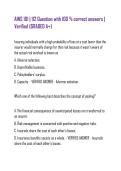
NR 511 CEA Exam | Chamberlain University | NR 511
Comprehensive Clinical Exam (CEA) 2026–2027 | Complete
Questions, Verified Answers & Rationales | Grade A+
Course NR 511 – Differential Diagnosis and Primary Care Practicum
Exam Comprehensive Clinical Exam (CEA)
Institution Chamberlain University
Format Multiple-choice, scenario-based questions
Core Advanced health assessment, differential diagnosis, primary care management,
Topics pathophysiology, pharmacology, evidence-based practice, clinical reasoning
Question 1
What is the official Professional Crisis Management Association (PCMA) definition of a
crisis, often abbreviated as the acronym CASH?
A) Continuous Anguish, Severe Hostility, and Hyperactivity
B) Constant Agitation, Self-Harm, and High Disruption
C) Continuous Aggression, continuous Self-Injury, and/or continuous High-Magnitude
Disruption
D) Chronic Altercations, Serious Homicide, and Extreme Destruction
Answer: C) Continuous Aggression, continuous Self-Injury, and/or continuous
High-Magnitude Disruption
Rationale: PCMA explicitly defines a crisis using the acronym CASH, which stands for
continuous aggression, continuous self-injury, and/or continuous high-magnitude
disruption. All three conditions require an immediate crisis intervention strategy.
Question 2
,Which level of staff certification allows a practitioner to implement non-physical
strategies, personal safety procedures, and physical transportation procedures, but
NOT immobilization?
A) Practitioner 1
B) Practitioner
C) Practitioner 2 (PS)
D) Instructor
Answer: B) Practitioner
Rationale: Individuals holding a standard "Practitioner" certification are trained and
authorized to implement non-physical strategies, personal safety, and physical
transportation procedures. They do not possess the training required for vertical or
horizontal immobilization.
Question 3
What are the four primary strategies and interventions structured within the Professional
Crisis Management (PCM) system?
A) Prevention, De-escalation, Intervention, and Reintegration
B) Monitoring, Restraint, Isolation, and Debriefing
C) Assessment, Containment, Medication, and Discharge
D) Detection, Deflection, Detention, and Rehabilitation
Answer: A) Prevention, De-escalation, Intervention, and Reintegration
Rationale: The PCM system organizes its behavioral strategies into four distinct
sequential phases designed to manage a crisis cycle: crisis prevention, crisis de-
escalation, crisis intervention, and post-crisis reintegration.
Question 4
Which of the following describes the core objective of using "prevention strategies"
during a period of stable functioning?
A) To safely transport an individual to a designated quiet area
B) To increase on-task or engaged behaviors that are incompatible with crisis behaviors
C) To implement temporary vertical immobilization procedures
D) To administer physical feedback following an aggressive outburst
Answer: B) To increase on-task or engaged behaviors that are incompatible with
crisis behaviors
,Rationale: Prevention strategies focus on boosting engagement and positive on-task
behavior. When an individual is fully engaged in a productive task, they cannot
simultaneously display crisis-level behaviors, making the responses structurally
incompatible.
Question 5
When an individual transitions into the pre-crisis phase on the Cycle of Crisis, which set
of management procedures must the staff deploy?
A) Prevention strategies
B) De-escalation strategies
C) Crisis intervention procedures
D) Reintegration strategies
Answer: B) De-escalation strategies
Rationale: Each level of the Cycle of Crisis dictates a corresponding staff response.
Stable functioning pairs with prevention, pre-crisis pairs with de-escalation, active crisis
pairs with crisis intervention, and post-crisis pairs with reintegration.
Question 6
According to PCMA guiding principles, what rule governs how restrictive a physical
procedure should be?
A) Practitioners should always select the fastest procedure regardless of restriction
level.
B) Practitioners must only use the procedures needed to stop the crisis, ensuring it is
nothing more restrictive than necessary.
C) Practitioners must defer to local security guards before initiating any hold.
D) Practitioners must increase restriction levels incrementally by a fixed timer.
Answer: B) Practitioners must only use the procedures needed to stop the crisis,
ensuring it is nothing more restrictive than necessary.
Rationale: PCMA emphasizes the principle of the least restrictive alternative. Staff
members must only utilize the degree of physical management strictly required to
establish safety and dissolve the crisis behavioral pattern.
, Question 7
What is the structural risk of using physical transportation procedures when an
individual is attempting to avoid an assigned task or setting?
A) It causes immediate physical exhaustion to the staff.
B) It could possibly reinforce the crisis behavior by removing the individual from a
situation they dislike.
C) It automatically invalidates the practitioner's active certification.
D) It eliminates the need for future post-crisis reintegration.
Answer: B) It could possibly reinforce the crisis behavior by removing the
individual from a situation they dislike.
Rationale: If an individual exhibits crisis behavior to escape an unwanted environment
or demand, physically transporting them out of that room fulfills their objective. This
accidental reinforcement increases the probability that the individual will repeat the
crisis behavior in the future.
Question 8
The PCM system incorporates automatic behavioral shaping and fading principles
during transportation procedures. What is this process called?
A) Static Securing
B) Continuous Containment
C) Dynamic Holding
D) Mechanical Mitigation
Answer: C) Dynamic Holding
Rationale: Dynamic Holding refers to the continuous adjustment of physical pressure
during a transportation procedure. Staff members immediately reduce hold intensity
(fade) as the individual complies, or step up control (shape) if resistance returns.
Question 9
Which practitioner certification level is required to implement vertical immobilization
procedures?
A) Practitioner
B) Practitioner 1
C) Both Practitioner 1 and Practitioner 2 (PS)
D) Certified Personal Safety Associate
Comprehensive Clinical Exam (CEA) 2026–2027 | Complete
Questions, Verified Answers & Rationales | Grade A+
Course NR 511 – Differential Diagnosis and Primary Care Practicum
Exam Comprehensive Clinical Exam (CEA)
Institution Chamberlain University
Format Multiple-choice, scenario-based questions
Core Advanced health assessment, differential diagnosis, primary care management,
Topics pathophysiology, pharmacology, evidence-based practice, clinical reasoning
Question 1
What is the official Professional Crisis Management Association (PCMA) definition of a
crisis, often abbreviated as the acronym CASH?
A) Continuous Anguish, Severe Hostility, and Hyperactivity
B) Constant Agitation, Self-Harm, and High Disruption
C) Continuous Aggression, continuous Self-Injury, and/or continuous High-Magnitude
Disruption
D) Chronic Altercations, Serious Homicide, and Extreme Destruction
Answer: C) Continuous Aggression, continuous Self-Injury, and/or continuous
High-Magnitude Disruption
Rationale: PCMA explicitly defines a crisis using the acronym CASH, which stands for
continuous aggression, continuous self-injury, and/or continuous high-magnitude
disruption. All three conditions require an immediate crisis intervention strategy.
Question 2
,Which level of staff certification allows a practitioner to implement non-physical
strategies, personal safety procedures, and physical transportation procedures, but
NOT immobilization?
A) Practitioner 1
B) Practitioner
C) Practitioner 2 (PS)
D) Instructor
Answer: B) Practitioner
Rationale: Individuals holding a standard "Practitioner" certification are trained and
authorized to implement non-physical strategies, personal safety, and physical
transportation procedures. They do not possess the training required for vertical or
horizontal immobilization.
Question 3
What are the four primary strategies and interventions structured within the Professional
Crisis Management (PCM) system?
A) Prevention, De-escalation, Intervention, and Reintegration
B) Monitoring, Restraint, Isolation, and Debriefing
C) Assessment, Containment, Medication, and Discharge
D) Detection, Deflection, Detention, and Rehabilitation
Answer: A) Prevention, De-escalation, Intervention, and Reintegration
Rationale: The PCM system organizes its behavioral strategies into four distinct
sequential phases designed to manage a crisis cycle: crisis prevention, crisis de-
escalation, crisis intervention, and post-crisis reintegration.
Question 4
Which of the following describes the core objective of using "prevention strategies"
during a period of stable functioning?
A) To safely transport an individual to a designated quiet area
B) To increase on-task or engaged behaviors that are incompatible with crisis behaviors
C) To implement temporary vertical immobilization procedures
D) To administer physical feedback following an aggressive outburst
Answer: B) To increase on-task or engaged behaviors that are incompatible with
crisis behaviors
,Rationale: Prevention strategies focus on boosting engagement and positive on-task
behavior. When an individual is fully engaged in a productive task, they cannot
simultaneously display crisis-level behaviors, making the responses structurally
incompatible.
Question 5
When an individual transitions into the pre-crisis phase on the Cycle of Crisis, which set
of management procedures must the staff deploy?
A) Prevention strategies
B) De-escalation strategies
C) Crisis intervention procedures
D) Reintegration strategies
Answer: B) De-escalation strategies
Rationale: Each level of the Cycle of Crisis dictates a corresponding staff response.
Stable functioning pairs with prevention, pre-crisis pairs with de-escalation, active crisis
pairs with crisis intervention, and post-crisis pairs with reintegration.
Question 6
According to PCMA guiding principles, what rule governs how restrictive a physical
procedure should be?
A) Practitioners should always select the fastest procedure regardless of restriction
level.
B) Practitioners must only use the procedures needed to stop the crisis, ensuring it is
nothing more restrictive than necessary.
C) Practitioners must defer to local security guards before initiating any hold.
D) Practitioners must increase restriction levels incrementally by a fixed timer.
Answer: B) Practitioners must only use the procedures needed to stop the crisis,
ensuring it is nothing more restrictive than necessary.
Rationale: PCMA emphasizes the principle of the least restrictive alternative. Staff
members must only utilize the degree of physical management strictly required to
establish safety and dissolve the crisis behavioral pattern.
, Question 7
What is the structural risk of using physical transportation procedures when an
individual is attempting to avoid an assigned task or setting?
A) It causes immediate physical exhaustion to the staff.
B) It could possibly reinforce the crisis behavior by removing the individual from a
situation they dislike.
C) It automatically invalidates the practitioner's active certification.
D) It eliminates the need for future post-crisis reintegration.
Answer: B) It could possibly reinforce the crisis behavior by removing the
individual from a situation they dislike.
Rationale: If an individual exhibits crisis behavior to escape an unwanted environment
or demand, physically transporting them out of that room fulfills their objective. This
accidental reinforcement increases the probability that the individual will repeat the
crisis behavior in the future.
Question 8
The PCM system incorporates automatic behavioral shaping and fading principles
during transportation procedures. What is this process called?
A) Static Securing
B) Continuous Containment
C) Dynamic Holding
D) Mechanical Mitigation
Answer: C) Dynamic Holding
Rationale: Dynamic Holding refers to the continuous adjustment of physical pressure
during a transportation procedure. Staff members immediately reduce hold intensity
(fade) as the individual complies, or step up control (shape) if resistance returns.
Question 9
Which practitioner certification level is required to implement vertical immobilization
procedures?
A) Practitioner
B) Practitioner 1
C) Both Practitioner 1 and Practitioner 2 (PS)
D) Certified Personal Safety Associate