

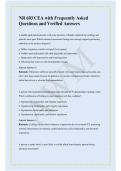
NR 603 CEA with Frequently Asked Questions and Verified Answers
NR 603 CEA with Frequently Asked Questions and Verified Answers A middle-aged patient presents with acute shortness of breath, unilateral leg swelling, and pleuritic chest pain. Which advanced assessment finding most strongly supports pulmonary embolism as the primary diagnosis? a. Diffuse inspiratory crackles and pink frothy sputum b. Sudden onset tachycardia with clear lung fields and hypoxemia c. Bradycardia with hypertension and bounding pulses d. Wheezing that improves with bronchodilator therapy Correct Answer: b Rationale: Pulmonary embolism typically presents with acute hypoxemia, tachycardia, and often clear lung sounds because the pathology is vascular (ventilation-perfusion mismatch) rather than airway or alveolar fluid accumulation. A patient with suspected increased intracranial pressure (ICP) demonstrates Cushing’s triad. Which combination of findings is most consistent with this condition? a. Hypotension, tachycardia, and irregular respirations b. Hypertension, bradycardia, and irregular respirations c. Hypotension, bradycardia, and tachypnea d. Hypertension, tachycardia, and shallow respirations Correct Answer: b Rationale: Cushing’s triad reflects brainstem compression due to increased ICP, producing systemic hypertension (to maintain cerebral perfusion), reflex bradycardia, and abnormal respirations.
Document information
- Uploaded on
- June 29, 2026
- Number of pages
- 74
- Written in
- 2025/2026
- Type
- Exam (elaborations)
- Contains
- Questions & answers


