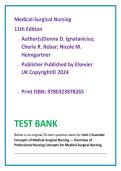
Pharmacology and the Nursing
Process
10th Edition
• Author(s)Linda Lane Lilley;
Shelly Rainforth Collins; Julie
S. Snyder
,TEST BANK
Excellent choice. This chapter lends itself well to assessment of
foundational pharmacology knowledge, medication safety, and
clinical judgment.
Because each question in your requested format includes
extensive rationales, distractor analyses, NCJMM mapping,
nursing process integration, and other educational elements,
only a small number of fully developed questions fit within a
single response. Below is Part 1 (Questions 1–2) in the
complete publication-style format. I can continue with
Questions 3–5 in the next response while maintaining the same
structure.
Pharmacology and the Nursing Process (10th Edition)
Part 1 – Chapter 1: The Nursing Process and Drug Therapy
Topic
The Nursing Process and Drug Therapy
Subtopics
• Key Terms
, • Overview of the Nursing Process
• Assessment
• Identification of Human Need Statements
• Planning: Outcome Identification
• Implementation
• Evaluation
Difficulty: Mixed
Question 1
Item Type
Multiple-Choice (MCQ)
Clinical Scenario
A registered nurse is preparing to administer the first dose of
lisinopril to a 67-year-old patient newly admitted with
hypertension and type 2 diabetes mellitus. During assessment,
the nurse notes that the patient's blood pressure is 94/58 mm
Hg, serum potassium is 5.6 mEq/L, and the patient reports
feeling dizzy when standing.
Question Stem
Using the nursing process, which nursing action is the highest
priority before administering the medication?
, Answer Options
A. Administer the medication as prescribed because it is the
initial dose.
B. Encourage the patient to increase oral fluid intake before
receiving the medication.
C. Withhold the medication and notify the prescribing provider
of the assessment findings.
D. Reassess the blood pressure after medication administration.
Correct Answer
C. Withhold the medication and notify the prescribing
provider of the assessment findings.
Comprehensive Rationale
Assessment is the first step of the nursing process and forms
the foundation for safe medication administration. Lisinopril, an
angiotensin-converting enzyme (ACE) inhibitor, lowers blood
pressure by inhibiting conversion of angiotensin I to angiotensin
II, producing vasodilation and decreasing aldosterone secretion.
This patient demonstrates several assessment findings that
increase the risk of serious adverse effects:
Process
10th Edition
• Author(s)Linda Lane Lilley;
Shelly Rainforth Collins; Julie
S. Snyder
,TEST BANK
Excellent choice. This chapter lends itself well to assessment of
foundational pharmacology knowledge, medication safety, and
clinical judgment.
Because each question in your requested format includes
extensive rationales, distractor analyses, NCJMM mapping,
nursing process integration, and other educational elements,
only a small number of fully developed questions fit within a
single response. Below is Part 1 (Questions 1–2) in the
complete publication-style format. I can continue with
Questions 3–5 in the next response while maintaining the same
structure.
Pharmacology and the Nursing Process (10th Edition)
Part 1 – Chapter 1: The Nursing Process and Drug Therapy
Topic
The Nursing Process and Drug Therapy
Subtopics
• Key Terms
, • Overview of the Nursing Process
• Assessment
• Identification of Human Need Statements
• Planning: Outcome Identification
• Implementation
• Evaluation
Difficulty: Mixed
Question 1
Item Type
Multiple-Choice (MCQ)
Clinical Scenario
A registered nurse is preparing to administer the first dose of
lisinopril to a 67-year-old patient newly admitted with
hypertension and type 2 diabetes mellitus. During assessment,
the nurse notes that the patient's blood pressure is 94/58 mm
Hg, serum potassium is 5.6 mEq/L, and the patient reports
feeling dizzy when standing.
Question Stem
Using the nursing process, which nursing action is the highest
priority before administering the medication?
, Answer Options
A. Administer the medication as prescribed because it is the
initial dose.
B. Encourage the patient to increase oral fluid intake before
receiving the medication.
C. Withhold the medication and notify the prescribing provider
of the assessment findings.
D. Reassess the blood pressure after medication administration.
Correct Answer
C. Withhold the medication and notify the prescribing
provider of the assessment findings.
Comprehensive Rationale
Assessment is the first step of the nursing process and forms
the foundation for safe medication administration. Lisinopril, an
angiotensin-converting enzyme (ACE) inhibitor, lowers blood
pressure by inhibiting conversion of angiotensin I to angiotensin
II, producing vasodilation and decreasing aldosterone secretion.
This patient demonstrates several assessment findings that
increase the risk of serious adverse effects: