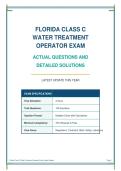
FLORIDA CLASS C
WATER TREATMENT
OPERATOR EXAM
ACTUAL QUESTIONS AND
DETAILED SOLUTIONS
LATEST UPDATE THIS YEAR
EXAM SPECIFICATIONS
Time Allocation: 3 Hours
Total Questions: 100 Questions
Question Format: Multiple Choice with Calculations
Minimum Competency: 70% Required to Pass
Core Focus: Regulations, Treatment, Math, Safety, Laboratory
Florida Class C Water Treatment Operator Exam Latest Update Page 1
, Exam Overview & Content Outline
EXAM PURPOSE
Florida Class C Water Treatment Operator Exam covers water treatment plant operations,
regulations, mathematics, safety, and laboratory procedures per Florida DEP Chapter 62-602 F.A.C.
for 2026/2027 certification. Class C covers plants treating groundwater or purchase systems.
CONTENT DISTRIBUTION
• Regulations & Safety (25%) — SDWA, Florida DEP 62-555/62-602, operator responsibilities,
safety, sampling
• Water Treatment Processes (30%) — Coagulation, flocculation, sedimentation, filtration,
disinfection, fluoridation
• Mathematics & Hydraulics (25%) — Dosage, detention time, flow, velocity, pressure, pumping,
chemical feed
• Laboratory & Monitoring (20%) — Sampling, chlorine residual, turbidity, pH, bacteriological,
compliance
QUESTION FORMAT & SCORING
Each item presents four options with calculations. Correct answers are highlighted in green with
checkmark (✓). Every question includes detailed solution with formulas. Florida DEP requires 70%
to pass.
STUDY STRATEGY
Master water treatment math formulas. Know SDWA MCLs and treatment techniques. Understand
disinfection CT values. Review chlorination, fluoridation, pH adjustment. Study sampling procedures
and hold times. Know safety procedures and chemical handling. Practice calculations.
CURRICULUM ALIGNMENT
Questions reflect 2026 standards: Florida DEP Chapter 62-602 F.A.C., Safe Drinking Water Act, EPA
regulations, AWWA standards, and Class C operator requirements.
Florida Class C Water Treatment Operator Exam Latest Update Page 2
, SECTION I: Regulations & Safety
1. Safe Drinking Water Act (SDWA) MCL for total coliform:
A. 1 positive sample/month
✓ B. 0 - no more than 5% positive samples/month
C. 10 positive samples
D. No limit
Rationale: SDWA Total Coliform Rule: MCL = 0. No more than 5.0% of monthly samples can be total
coliform positive for systems collecting ≥40 samples/month. For systems <40 samples/month, no more than
1 positive. Positive requires repeat sampling and E. coli testing. E. coli MCL = 0. Acute violation if E. coli
positive.
2. Florida DEP requires Class C operators to hold license for:
A. No license needed
✓ B. Water treatment plants treating groundwater or purchase systems
C. Wastewater only
D. All water systems
Rationale: Florida DEP 62-602: Class C license for water treatment plants treating groundwater, purchase
water systems, or Class C distribution systems. Class A: surface water. Class B: groundwater under direct
influence or complex treatment. Class D: very small systems. License requires exam, experience, CEUs.
Direct responsible charge required.
3. Chlorine residual minimum in distribution system:
A. 0.0 mg/L
✓ B. 0.2 mg/L free or 0.6 mg/L total
C. 4.0 mg/L
D. 10.0 mg/L
Rationale: Florida 62-555: Minimum 0.2 mg/L free chlorine or 0.6 mg/L total chlorine residual at distant
points in distribution. Maximum 4.0 mg/L MRDL (Maximum Residual Disinfectant Level). Measure daily. Low
residual: increase feed, flush mains, check for contamination. Chlorine demand varies with temperature, pH,
organics.
4. Confined space entry requires:
A. No permit
✓ B. Permit, atmospheric testing, attendant, rescue plan
C. One person only
D. No PPE
Rationale: OSHA Confined Space: Permit required. Test atmosphere: O2 19.5-23.5%, LEL <10%, H2S <10
ppm, CO <35 ppm. Attendant outside, communication, rescue equipment. Ventilate. Lockout/tagout.
Examples: tanks, vaults, manholes, clarifiers. Hazards: asphyxiation, engulfment, toxic gases, entrapment.
5. SDS (Safety Data Sheet) must be available for:
Florida Class C Water Treatment Operator Exam Latest Update Page 3
WATER TREATMENT
OPERATOR EXAM
ACTUAL QUESTIONS AND
DETAILED SOLUTIONS
LATEST UPDATE THIS YEAR
EXAM SPECIFICATIONS
Time Allocation: 3 Hours
Total Questions: 100 Questions
Question Format: Multiple Choice with Calculations
Minimum Competency: 70% Required to Pass
Core Focus: Regulations, Treatment, Math, Safety, Laboratory
Florida Class C Water Treatment Operator Exam Latest Update Page 1
, Exam Overview & Content Outline
EXAM PURPOSE
Florida Class C Water Treatment Operator Exam covers water treatment plant operations,
regulations, mathematics, safety, and laboratory procedures per Florida DEP Chapter 62-602 F.A.C.
for 2026/2027 certification. Class C covers plants treating groundwater or purchase systems.
CONTENT DISTRIBUTION
• Regulations & Safety (25%) — SDWA, Florida DEP 62-555/62-602, operator responsibilities,
safety, sampling
• Water Treatment Processes (30%) — Coagulation, flocculation, sedimentation, filtration,
disinfection, fluoridation
• Mathematics & Hydraulics (25%) — Dosage, detention time, flow, velocity, pressure, pumping,
chemical feed
• Laboratory & Monitoring (20%) — Sampling, chlorine residual, turbidity, pH, bacteriological,
compliance
QUESTION FORMAT & SCORING
Each item presents four options with calculations. Correct answers are highlighted in green with
checkmark (✓). Every question includes detailed solution with formulas. Florida DEP requires 70%
to pass.
STUDY STRATEGY
Master water treatment math formulas. Know SDWA MCLs and treatment techniques. Understand
disinfection CT values. Review chlorination, fluoridation, pH adjustment. Study sampling procedures
and hold times. Know safety procedures and chemical handling. Practice calculations.
CURRICULUM ALIGNMENT
Questions reflect 2026 standards: Florida DEP Chapter 62-602 F.A.C., Safe Drinking Water Act, EPA
regulations, AWWA standards, and Class C operator requirements.
Florida Class C Water Treatment Operator Exam Latest Update Page 2
, SECTION I: Regulations & Safety
1. Safe Drinking Water Act (SDWA) MCL for total coliform:
A. 1 positive sample/month
✓ B. 0 - no more than 5% positive samples/month
C. 10 positive samples
D. No limit
Rationale: SDWA Total Coliform Rule: MCL = 0. No more than 5.0% of monthly samples can be total
coliform positive for systems collecting ≥40 samples/month. For systems <40 samples/month, no more than
1 positive. Positive requires repeat sampling and E. coli testing. E. coli MCL = 0. Acute violation if E. coli
positive.
2. Florida DEP requires Class C operators to hold license for:
A. No license needed
✓ B. Water treatment plants treating groundwater or purchase systems
C. Wastewater only
D. All water systems
Rationale: Florida DEP 62-602: Class C license for water treatment plants treating groundwater, purchase
water systems, or Class C distribution systems. Class A: surface water. Class B: groundwater under direct
influence or complex treatment. Class D: very small systems. License requires exam, experience, CEUs.
Direct responsible charge required.
3. Chlorine residual minimum in distribution system:
A. 0.0 mg/L
✓ B. 0.2 mg/L free or 0.6 mg/L total
C. 4.0 mg/L
D. 10.0 mg/L
Rationale: Florida 62-555: Minimum 0.2 mg/L free chlorine or 0.6 mg/L total chlorine residual at distant
points in distribution. Maximum 4.0 mg/L MRDL (Maximum Residual Disinfectant Level). Measure daily. Low
residual: increase feed, flush mains, check for contamination. Chlorine demand varies with temperature, pH,
organics.
4. Confined space entry requires:
A. No permit
✓ B. Permit, atmospheric testing, attendant, rescue plan
C. One person only
D. No PPE
Rationale: OSHA Confined Space: Permit required. Test atmosphere: O2 19.5-23.5%, LEL <10%, H2S <10
ppm, CO <35 ppm. Attendant outside, communication, rescue equipment. Ventilate. Lockout/tagout.
Examples: tanks, vaults, manholes, clarifiers. Hazards: asphyxiation, engulfment, toxic gases, entrapment.
5. SDS (Safety Data Sheet) must be available for:
Florida Class C Water Treatment Operator Exam Latest Update Page 3