

Genetic Code
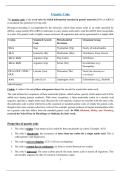
The genetic code: is the set of rules by which information encoded in genetic material (DNA or mRNA)
is translated into proteins by living cells.
Biological decoding is accomplished by the ribosome, which links amino acids in an order specified by
mRNA, using transfer RNA (tRNA) molecules to carry amino acids and to read the mRNA three nucleotides
at a time. The genetic code is highly conserved across all organisms and can be represented in a simple table
Codon Standard Genetic Mitochondrial Organism/Group
Code Deviation
UGA Stop Tryptophan (Trp) Nearly all mitochondria
AUA Isoleucine (Ile) Methionine (Met) Vertebrates, Yeast, Insects
AGA / AGG Arginine (Arg) Stop Codon Vertebrates
AGA / AGG Arginine (Arg) Serine (Ser) Invertebrates (e.g.,
Drosophila)
CUA / CUC / CUG / Leucine (Leu) Threonine (Thr) Yeast (Saccharomyces
CUU cerevisiae)
AAA Lysine (Lys) Asparagine (Asn) Echinoderms (e.g., Starfish)
with 64 entries.
Codon: A codon is the set of three nitrogenous bases that encode for a particular amino acid.
The code defines how sequences of these nucleotide triplets, called codons, specify which amino acid will be
added next during protein synthesis. With some exceptions, a three-nucleotide codon in a nucleic acid
sequence specifies a single amino acid. Because the vast majority of genes are encoded with the same code,
this particular code is often referred to as the canonical or standard genetic code, or simply the genetic code,
though in fact some variant codes have evolved. For example, protein synthesis in human mitochondria relies
on a genetic code that differs from the standard genetic code. In 1968, Khorana, Holley, and Nirenberg
received the Nobel Prize in Physiology or Medicine for their work.
Properties of genetic code
1. The code is triplet: Each amino acid is coded by three nucleotides (a codon). Example: AUG.
2. The code is degenerate: the occurrence of more than one codon for a single amino acid. This is
called genetic code degeneracy.
3. The code is non-overlapping: CCU CAG (no overlapping)
4. The code is comma-less or continuous: no letter is wasted between two codons
5. The code is universal: The same codons specify the same amino acids in nearly all organisms. This
universality supports the idea of common evolutionary origin.
1
The genetic code: is the set of rules by which information encoded in genetic material (DNA or mRNA)
is translated into proteins by living cells.
Biological decoding is accomplished by the ribosome, which links amino acids in an order specified by
mRNA, using transfer RNA (tRNA) molecules to carry amino acids and to read the mRNA three nucleotides
at a time. The genetic code is highly conserved across all organisms and can be represented in a simple table
Codon Standard Genetic Mitochondrial Organism/Group
Code Deviation
UGA Stop Tryptophan (Trp) Nearly all mitochondria
AUA Isoleucine (Ile) Methionine (Met) Vertebrates, Yeast, Insects
AGA / AGG Arginine (Arg) Stop Codon Vertebrates
AGA / AGG Arginine (Arg) Serine (Ser) Invertebrates (e.g.,
Drosophila)
CUA / CUC / CUG / Leucine (Leu) Threonine (Thr) Yeast (Saccharomyces
CUU cerevisiae)
AAA Lysine (Lys) Asparagine (Asn) Echinoderms (e.g., Starfish)
with 64 entries.
Codon: A codon is the set of three nitrogenous bases that encode for a particular amino acid.
The code defines how sequences of these nucleotide triplets, called codons, specify which amino acid will be
added next during protein synthesis. With some exceptions, a three-nucleotide codon in a nucleic acid
sequence specifies a single amino acid. Because the vast majority of genes are encoded with the same code,
this particular code is often referred to as the canonical or standard genetic code, or simply the genetic code,
though in fact some variant codes have evolved. For example, protein synthesis in human mitochondria relies
on a genetic code that differs from the standard genetic code. In 1968, Khorana, Holley, and Nirenberg
received the Nobel Prize in Physiology or Medicine for their work.
Properties of genetic code
1. The code is triplet: Each amino acid is coded by three nucleotides (a codon). Example: AUG.
2. The code is degenerate: the occurrence of more than one codon for a single amino acid. This is
called genetic code degeneracy.
3. The code is non-overlapping: CCU CAG (no overlapping)
4. The code is comma-less or continuous: no letter is wasted between two codons
5. The code is universal: The same codons specify the same amino acids in nearly all organisms. This
universality supports the idea of common evolutionary origin.
1


