
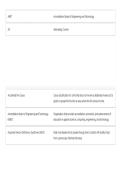
ABET Accreditation Board of Engineering and Technology.
AC Alternating Current.
Accidental Fire Cause Cause classification for a fire that does not involve a deliberate human act to
ignite or spread the fire into an area where the fire should not be.
Accreditation Board of Engineering and Technology Organization that provides accreditation, promotion, and advancement of
(ABET) education in applied science, computing, engineering, and technology.
Acquired Immune Deficiency Syndrome (AIDS) Fatal viral disease that is spread through direct contact with bodily fluids
from a previously infected individual.
,Administrative Search Warrant Court order that allows investigators the right to enter a scene after the fire
department has left the scene or to reenter the scene if the investigator
arrived while the fire department had control of the scene.
AFCI Arc-Fault Circuit Interrupter.
AFSA American Fire Sprinkler Association.
Aggregate Gravel, stone, sand, or other inert materials used in concrete; these materials
may be fine or coarse.
AHJ Authority Having Jurisdiction.
AIDS Acquired Immune Deficiency Syndrome.
,Alarm-Initiating Device Mechanical or electrical device that activates an alarm system. There are
three basic types of alarm-initiating devices: manual, products-of-
combustion detectors, and extinguishing system activation devices.
Alarm System System by which occupants and/or emergency personnel can be alerted to
the existence of a hostile fire.
Alpha particle Particle having a large mass and a positive electrical charge; least
penetrating of the three common forms of radioactive substances. It is
normally not considered dangerous to plants, animals, or people unless it
gets into the body.
Alternating Current (AC) Circuit Electrical circuit in which the current can move through the circuit in both
directions and the flow can be constantly reversing.
American Board of Criminalistics (ABC) National peer-review group that certifies forensic scientists in specific
disciplines including fire debris analysis.
American Fire Sprinkler Association (AFSA) Nonprofit, international association representing open shop fire sprinkler
contractors, dedicated to the educational advancement of its members and
promotion of the use of automatic fire sprinkler systems.
, American Society of Testing and Materials (ASTM) Voluntary standards-setting organization that establishes characteristics and
performance of materials, products, systems and services; for example the
quality of concrete or the flammability of interior finishes.
American Wire Gauge (AWG) Measurement unit for the diameter of wire; larger AWG numbers indicate
smaller diameters than smaller AWG numbers; for example, No.14AWGwire is
smaller than No. 8AWGwire.
Ammeter Instrument for measuring electric current in amperes.
Ampacity The current-carrying capacity of conductors or equipment, expressed in
amperes.
Ampere Basic unit of electrical current that may be abbreviated either by A or I.
Amount of current sent by one volt through one ohm of resistance.


