

Written by students who passed Immediately available after payment Read online or as PDF Wrong document? Swap it for free 4.6 TrustPilot
logo-home
Document preview thumbnail
Preview 2 out of 9 pages
Exam (elaborations)

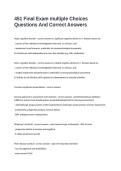
451 Final Exam multiple Choices Questions And Correct Answers

Document preview thumbnail
Preview 2 out of 9 pages

Major cognitive disorder - correct answers A. significant cognitive decline in 1+ domains based on: - concern of the individual, knowledgeable informant, or clinician ; and - impairment in performance, preferably via neuropsychological assessment B. Interference with independence in every day activities (e.g. bills, medication) Minor cognitive disorder - correct answers A. Modest cognitive decline in 1+ domains based on: - concern of the individual, knowledgeable informant, or clinician, and; - modest impairment and performance, preferably via neuropsychological assessment B. Deficits do not interfere with capacity for independence in everyday activities Common symptoms/presentations - correct answers General approach to assessment and treatment - correct answers -acetylcholinesterase inhibitors: inhibits an enzyme from breaking down acetylcholine(important for learning and memory) - anticholinergic drugs & lesions of the basal forebrain cholinergic system produce memory impairment -acetylcholine antagonists produce memory deficits -SSRI: antidepressants/ antipsychotics Alzheimer's (cortical) - correct answers - most common type of dementia, 50% of cases - progressive decline in memory and cognition -5 million americans have AD Pick's disease (cortical) - correct answers - type of frontal lobe dementia - loss of judgement and disinhibition -onset around 50-60 -more common in women -rare, 2% of dementia patients - personality changes (silliness, apathy, eating) lewy body (cortical) - correct answers - lewy bodies (protein deposits) found throughout cortex - symptoms include: motor dysfunction, visual hallucinations, delusions, severe cognitive fluctuations -more rapid decline parkinsons (subcortical) - correct answers - involuntary motor tremor with weakness - neuronal loss in basal ganglia - loss of nerve cells and dopamine - when symptoms appear, already 60% of neurons lost, dopamine levels decreased by 80% -restlessness/rigidity huntingtons/chorea (subcortical) - correct answers - inherited: 50% of offspring expected to inherit - cognitive, personality, motor impairments - involuntary spasmodic movements Progressive supranuclera pasly (subcortical) - correct answers - neuronal loss in striatum and substantia niagra with degeneration of basal ganglia, upper brainstem, & cerebellum - gait disorder/falling - tremor or motor symptoms: gaze, speech, swallowing, dexterity pseudo-dementia - correct answers depression, treatable dementia TBI: common causes/symptoms - correct answers - most common cause of brain damage - mortality varies from 5% to 10% -Falls (infants, children, elderly) and MVA are most common - most injuries are closed (intact skull, brain unexposed) - peak ages are 15-24 and elderly - males, low SES, unemployed, low education, alcohol & drug use, previous injuries GCS (glasgow coma scale) - correct answers - depth and duration of altered consciousness - based on eye opening, best motor response, best verbal response - commonly used with head injury - scoring: range of 3-15 (lower score=worse injury) - coma: typically scores of 3-8 - head injury rating: severe 9, moderate 9-12, mild 13-15 PTA correlates with injury severity and GCS - correct answers Injury - correct answers -Ischemia: absence of normal blood flow in affected area - Edema: tissue swelling - Hematoma: swelling filled with blood; acts as a growing mass and creates pressure, which pushes against brain tissue open injury - correct answers - focal lesion or damage (e.g. puncture, bullet) - rapid improvement within 1-2 years -highly productive of seizures closed injury - correct answers - primary injury occurs at time of impact - secondary injury consists of effects of physiological processes related to primary injury (e.g. hemorrhage, tissue, swelling, alterations in blood flow) - contrecoup lesion: brain sustains a contusion/bruise in an area opposite from the blow when brain strikes the skull - Diffuse axonal injury (DAI): damage to axons from acceleration/deceleration, accompanied by ruptured blood vessels. Utility of imaging - correct answers DSM criteria (major vs. mild due to TBI) - correct answers A. criteria met for major or mild neurocognitive disorder B. evidence of TBI with 1+: - LOC - post-traumatic amnesia - disorientation, confusion - neurological signs (e.g. imaging, seizures, etc.) C. Symptoms present immediately after TBI or recovery of consciousness and persist past acute injury period Recovery - correct answers Kennard effect: -ability of the young to recover from brain damage more thoroughly than adults -observed across several species Second Impact syndrome: - experiencing another TBI prior to full recovery from previous TBI -can lead to severe effects, including death - not well understood Limiting exertion: - brain has difficulty coping with normal demands, resulting in symptoms - avoid physical exercise, schoolwork, reading, driving, alcohol & caffeine. Common assessments: On-feild testing - correct answers - orientation: city stadium, opposing team, month, day - anterograde amnesia (immediate memory): repeat word list -Retrograde amnesia: memory of the hit and events leading up to the hit, score prior to the hit, what happened prior quarter/period? - concentration: digit span backwards - memory: delayed recall of word list Common assessments: Headminder - correct answers - 25 minute technician assisted computerized bedside cognitive screening tool - symptom survey (depression and health screening) - brief computerized neurocognitive tests: keyboard proficiency (number pressing), motor speed (number pressing), processing speed (symbol search with number entry), memory/speed (visual recognition of series of images) & learning/memory ImPACT - correct answers -concussion symptom checklist -brief computerized neurocognitive tests: verbal memory (word list), visual memory (designs), visual motor speed, reaction time, & impulse control Artery vs. Vein - correct answers Arteries: ascending, carry oxygenated blood from heart to parts of body Veins: descending, cary deoxygenated blood toward heart Meninges - correct answers Pia: Inner membrane surrounding the brain and spinal cord Arachnoid: middle membrane, subarachnoid space - under arachnoid, contains CSF Dura: outer layer Stroke Terminology - correct answers - cerebral hemorrhage: blood vessel bursts (epidural, subdural, subarachnoid, intracerebral) - Ischemic stroke: clogged vessel; reduced blood flow (thrombotic: locally formed clot, embolic: blood clot travels, lodging in vessel) - Transient ischemic attack (temporary, clot may dissolve or dislodge) TIA Multi-infarct dementia - correct answers - death of brain tissue (infarct) after series of small strokes, often at different sites and may be small enough to avoid notice - a type of vascular dementia - differs from alzheimer's: onset tends to be acute with fluctuating symptom severity; progresses in stepwise fashion - history of hypertension and stroke - evident focal neurological signs - better memory test performance - reduced verbal output Multiple sclerosis (MS) symptoms - correct answers Prominent symptoms: - weakness or loss of control of limb - transient blindness in one eye - eye muscle imbalance causing double vision - dysarthria - loss of sphincter control - sensory changes such as numbness, fatigue Average age of onset - 30 - 10% have onset after 50 - more common in women Survival is 85% of normal expectations MS etiology - correct answers Neuronal death is not the initiating process - possible autoimmune disease - blood destroys myelin Patchy destruction of myelin sheath - disrupts transmission of nerve impulses - ineffective re-myelination with plaques build up around damaged sites - MRI can visualize plaques in many cases Progressive neurological symptoms - erratic flare-up of symptoms with stable periods. each acute attack may involve different areas and produce different symptoms that mostly resolve with some residual problems MS: Disease process - correct answers - Most begin with relapsing-remitting course - some change to rapid secondary progression - early symptoms tend to be visual changes - flare-ups occur less than once a year and leave some permanent neuronal damage and residual symptoms, which accumulate over time - 10-15% have "chronic-progressive" MS, later age of onset MS: Management - correct answers Vulnerabilities - fatigue, usually difficult to do activities for more than a few hours - heat and stress may exacerbate symptoms Treatment - intereron beta-ib may slow disease progression -anti-inflamatory drugs (corticosteroids, ACTH) may reduce severity/duration of acute steroids Korsakoff's psychosis - correct answers - insufficient diet may lead to thiamine deficiency and then impaired neuronal function, cell death and hemorrhagic lesions in thalamic nuclei, mammillary bodies, limbic system. Depressed neurotransmitter levels - gross memory impairment - sudden onset, often appears as residual condition of confusional state with gain and occulomotor abnormalities - symptoms: confusion, disordered eye and limb movements, similar cognitive impairments to alcoholism with significant memory impairment, anterograde and retrograde deficits Mechanism for early vs. long-term recovery - correct answers - early recovery within hours is often related to edema(swelling) - long-term recovery can take years: cortical reorganization, alternative behavioral strategies Goals of rehabilitation - correct answers Restoration: - using direct training -improvement may occur on the training task but often fails to generalize to other similar tasks -difficult to use direct training to ameliorate the effects of TBI, Stroke, dementia etc. (physical rehab does not equal cognitive rehab) Compensation: - re-learning skills using different/unimpaired processes -external aids (calendars/reminders) Normalization: - decline with age Acceptance: - coming to terms with your situation - evaluating without judgement (giving up) Examples of computer-based rehabilitation - correct answers Examples of memory and attention compensation strategies - correct answers Lists - break down in small parts Reminders - calendars

Content preview

451 Final Exam multiple Choices
Questions And Correct Answers

Major cognitive disorder - correct answers A. significant cognitive decline in 1+ domains based on:

- concern of the individual, knowledgeable informant, or clinician ; and

- impairment in performance, preferably via neuropsychological assessment

B. Interference with independence in every day activities (e.g. bills, medication)


Minor cognitive disorder - correct answers A. Modest cognitive decline in 1+ domains based on:

- concern of the individual, knowledgeable informant, or clinician, and;

- modest impairment and performance, preferably via neuropsychological assessment

B. Deficits do not interfere with capacity for independence in everyday activities


Common symptoms/presentations - correct answers


General approach to assessment and treatment - correct answers -acetylcholinesterase inhibitors:
inhibits an enzyme from breaking down acetylcholine(important for learning and memory)

- anticholinergic drugs & lesions of the basal forebrain cholinergic system produce memory impairment

-acetylcholine antagonists produce memory deficits

-SSRI: antidepressants/ antipsychotics


Alzheimer's (cortical) - correct answers - most common type of dementia, >50% of cases

- progressive decline in memory and cognition

-5 million americans have AD


Pick's disease (cortical) - correct answers - type of frontal lobe dementia

- loss of judgement and disinhibition

-onset around 50-60

, -more common in women

-rare, 2% of dementia patients

- personality changes (silliness, apathy, eating)


lewy body (cortical) - correct answers - lewy bodies (protein deposits) found throughout cortex

- symptoms include: motor dysfunction, visual hallucinations, delusions, severe cognitive fluctuations

-more rapid decline


parkinsons (subcortical) - correct answers - involuntary motor tremor with weakness

- neuronal loss in basal ganglia

- loss of nerve cells and dopamine

- when symptoms appear, already 60% of neurons lost, dopamine levels decreased by 80%

-restlessness/rigidity


huntingtons/chorea (subcortical) - correct answers - inherited: 50% of offspring expected to inherit

- cognitive, personality, motor impairments

- involuntary spasmodic movements


Progressive supranuclera pasly (subcortical) - correct answers - neuronal loss in striatum and substantia
niagra with degeneration of basal ganglia, upper brainstem, & cerebellum

- gait disorder/falling

- tremor or motor symptoms: gaze, speech, swallowing, dexterity


pseudo-dementia - correct answers depression, treatable dementia


TBI: common causes/symptoms - correct answers - most common cause of brain damage

- mortality varies from <5% to 10%

-Falls (infants, children, elderly) and MVA are most common

- most injuries are closed (intact skull, brain unexposed)

Document information

Uploaded on
June 28, 2026
Number of pages
9
Written in
2025/2026
Type
Exam (elaborations)
Contains
Questions & answers
$15.49

Wrong document? Swap it for free Within 14 days of purchase and before downloading, you can choose a different document. You can simply spend the amount again.
Written by students who passed
Immediately available after payment
Read online or as PDF

Seller avatar
Reputation scores are based on the amount of documents a seller has sold for a fee and the reviews they have received for those documents. There are three levels: Bronze, Silver and Gold. The better the reputation, the more your can rely on the quality of the sellers work.
RealGrades
4.0
(26)
Sold
197
Followers
52
Items
12327
Last sold
3 days ago


Why students choose Stuvia

Created by fellow students, verified by reviews

Quality you can trust: written by students who passed their tests and reviewed by others who've used these notes.

Didn't get what you expected? Choose another document

No worries! You can instantly pick a different document that better fits what you're looking for.

Pay as you like, start learning right away

No subscription, no commitments. Pay the way you're used to via credit card and download your PDF document instantly.

Student with book image

“Bought, downloaded, and aced it. It really can be that simple.”

Alisha Student

Working on your references?

Create accurate citations in APA, MLA and Harvard with our free citation generator.

Working on your references?

Frequently asked questions
