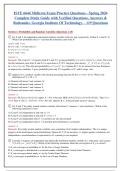
ISYE 6644 Midterm Exam Practice Questions - Spring 2026
Complete Study Guide with Verified Questions, Answers &
Rationales. Georgia Institute Of Technology. - 119 Questions
Section 1: Probability and Random Variables (Questions 1-10)
1 Let X and Y be independent exponential random variables with rate and respectively. Define Z = min(X, Y).
What is the probability that Z > t and that the minimum came from X?
A) e^{-(+)t} * /(+)
B) e^{-(+)t} * /(+) but only if =
C) e^{-t} * (1 - e^{-t})
D) e^{-(+)t} * /(+)
Answer: A
Rationale: The event {Z > t} requires both X>t and Y>t, giving probability e^{-»t}e^{-¼t}=e^{-(»+¼)t}. The event
that the minimum came from X and Z>t is equivalent to Y>X>t. Integrate joint density: _t^ _x^ e^{-x} e^{-y} dy
dx = /(+) e^{-(+)t}. Thus the joint probability is e^{-(+)t} * /(+). Options B, C, D are incorrect because B imposes
an unnecessary condition, C gives probability that only X>t regardless of Y, and D swaps and .
2 Suppose X is a random variable with moment generating function M_X(t) = e^{3t + 2t^2}. What is the
distribution of Y = 2X + 1?
A) Normal with mean 7 and variance 16
B) Normal with mean 6 and variance 8
C) Normal with mean 7 and variance 8
D) Normal with mean 6 and variance 16
Answer: A
Rationale: M_X(t)=e^{3t+2t^2} implies X ~ N(3,4) because MGF of N(¼,Ã^2) is e^{¼t+Ã^2t^2/2}. Thus ¼=3,
^2=4. Then Y=2X+1 ~ N(2*3+1, 4*4) = N(7,16). Options B, C, D miscalculate mean or variance.
3 Let X and Y be jointly normal random variables with means 0, variances 1, and correlation . Which of the
following statements is true?
A) X and Y are independent if and only if = 0
B) X and Y are independent if and only if = 0 or = 1
C) X and Y are independent only if = 0 and they are also uncorrelated
D) X and Y are independent only if = 0 and their joint distribution is symmetric
Answer: A
Rationale: For jointly normal random variables, zero correlation (Á=0) implies independence. This is a unique
property of the multivariate normal distribution. Options B, C, D are incorrect: =1 implies perfect correlation, not
independence; uncorrelatedness is equivalent to =0; symmetry is not required.
4 Consider a sequence of independent and identically distributed random variables X_i with mean and variance
^2. Let S_n = _{i=1}^n X_i. Which of the following statements about the convergence of S_n is correct?
A) S_n/n converges in probability to by the Law of Large Numbers
B) S_n converges in distribution to a normal random variable by the Central Limit Theorem
C) S_n/n converges almost surely to by the Central Limit Theorem
D) S_n converges in probability to by the Law of Large Numbers
,Answer: A
Rationale: The Law of Large Numbers states that the sample mean S_n/n converges in probability (and almost
surely under additional conditions) to . Option B is incorrect because S_n itself diverges; it is (S_n - n)/n that
converges in distribution. Option C incorrectly attributes almost sure convergence to the CLT. Option D is wrong
because S_n does not converge to ; it grows without bound.
5 Let X be a random variable with probability density function f(x) = 2x for 0 < x < 1, and 0 otherwise. Find the
distribution of Y = -ln X.
A) Exponential with rate 2
B) Exponential with rate 1
C) Gamma with shape 2 and rate 1
D) Uniform on (0, 1)
Answer: A
Rationale: Using transformation method: for y>0, the CDF of Y is P(Y "d y) = P(-ln X "d y) = P(X "e e^{-y}) =
_{e^{-y}}^1 2x dx = 1 - e^{-2y}. Differentiating gives pdf f_Y(y)=2e^{-2y}, which is exponential with rate 2.
Options B, C, D are incorrect: exponential rate 1 would give pdf e^{-y}, gamma(2,1) would be y e^{-y}, uniform
would be constant.
6 Suppose X and Y are independent random variables, each uniformly distributed on (0,1). What is the probability
that X^2 + Y^2 1?
A) /4
B) /2
C) 1/2
D) 1/4
Answer: A
Rationale: The condition X^2+Y^2 "d 1 describes a quarter of a unit circle in the square [0,1]×[0,1]. The area of that
quarter circle is /4, and since the joint distribution is uniform over the unit square, the probability is area = /4.
Options B, C, D are incorrect: /2 is half the circle, 1/2 and 1/4 are not the correct area.
7 Let X be a random variable with mean 0 and variance 1. Which of the following is always true for any random
variable X satisfying these conditions?
A) P(|X| 2) 1/4
B) P(|X| 2) 1/2
C) P(|X| 2) 1/8
D) P(|X| 2) 1
Answer: A
Rationale: Chebyshev's inequality states that for any k>0, P(|X-¼| "e kÃ) "d 1/k^2. Here ¼=0, Ã=1, k=2, so P(|X| "e 2) "d
1/4. Options B, C, D are incorrect because 1/2 and 1/8 are not guaranteed by Chebyshev, and 1 is trivial but not the
sharp bound.
8 Two fair dice are rolled independently. Let X be the sum of the two dice. What is the conditional expectation
E[X | the two dice show different numbers]?
A) 7
B) 6.5
C) 7.5
D) 6
Answer: A
,Rationale: The unconditional expectation of the sum is 7. Given that the dice show different numbers, the sum is
still symmetric and the conditional expectation remains 7 because the condition does not bias the sum. Formally,
E[X|X2,4,6,8,10,12] but the symmetry holds. Options B, C, D are incorrect because they assume a shift due to the
condition, but the expectation of each die given different numbers is still 3.5.
9 Let X and Y be independent Poisson random variables with means and respectively. What is the distribution of
X given X+Y = n?
A) Binomial with parameters n and /(+)
B) Poisson with mean
C) Poisson with mean
D) Negative binomial with parameters n and /(+)
Answer: A
Rationale: For independent Poisson variables, the conditional distribution of X given X+Y=n is Binomial(n,
/(+)). This is a well-known property. Options B, C, D are incorrect: Poisson would not sum to n, and negative
binomial is not the conditional distribution.
10 Suppose X is a random variable with moment generating function M(t) = 1/(1 - t) for t<1. Which of the
following is true about X?
A) X follows an exponential distribution with rate 1
B) X follows a geometric distribution with success probability 1/2
C) X follows a chi-square distribution with 2 degrees of freedom
D) X follows a uniform distribution on (0,1)
Answer: A
Rationale: The MGF M(t)=1/(1-t) for t<1 is the MGF of an exponential random variable with rate 1. Exponential(1)
has pdf e^{-x} for x>0 and MGF 1/(1-t). Options B, C, D have different MGFs: geometric has MGF p/(1-(1-p)e^t),
chi-square with 2 df has MGF 1/(1-2t)^{1}, uniform has MGF (e^t-1)/t.
Section 2: Discrete and Continuous Distributions (Questions 11-20)
11 A system's time to failure (in hours) follows a Weibull distribution with shape parameter k=0.5 and scale
parameter =1000. Which of the following statements is correct regarding its hazard rate?
A) The hazard rate is constant over time.
B) The hazard rate decreases with time.
C) The hazard rate increases with time.
D) The hazard rate is unimodal.
Answer: B
Rationale: For a Weibull distribution with shape k<1, the hazard rate is decreasing over time. This is typical for
early-life failures (infant mortality). When k=1, hazard is constant (exponential); when k>1, hazard increases
(wear-out).
12 Let X be a Poisson() random variable. Consider the transformation Y = floor(X/2). Which of the following
correctly describes the distribution of Y?
A) Y is Poisson(/2) but truncated.
B) Y is a Poisson() random variable shifted by 2.
C) Y is a discrete distribution with support on nonnegative integers and probabilities that are sums of consecutive
Poisson probabilities.
D) Y is a binomial random variable.
, Answer: C
Rationale: The floor function groups pairs of Poisson outcomes. For any integer k"e0, P(Y=k)=P(2k "d X <
2k+2)=P(X=2k)+P(X=2k+1). This is not a standard named distribution; it's a derived discrete distribution.
13 In a manufacturing process, the number of defects per unit area follows a Poisson distribution with mean 0.2
defects per square meter. What is the probability that the distance between two consecutive defects exceeds 10
meters?
A) e^{-2}
B) e^{-0.2}
C) 1 - e^{-2}
D) 1 - e^{-0.2}
Answer: A
Rationale: The distance between Poisson events in a spatial Poisson process is exponentially distributed with rate
=0.2 per meter. The probability that the distance exceeds 10 meters is e^{-*10}=e^{-2}.
14 Let X and Y be independent exponential random variables with rates and , respectively. Define Z = min(X,Y).
Which of the following is the moment generating function (MGF) of Z?
A) M_Z(t) = / ((-t)(-t))
B) M_Z(t) = (+) / (+ - t)
C) M_Z(t) = / ( - t) * / ( - t)
D) M_Z(t) = () / ((+)(+ - t))
Answer: B
Rationale: The minimum of independent exponentials is exponential with rate »+¼. Its MGF is (»+¼)/((»+¼)-t) for
t<+. Option A is the MGF of the sum X+Y, C is product of individual MGFs (for sum, not min), D is incorrect.
15 A random variable X follows a gamma distribution with shape =2 and rate =3. What is the distribution of Y =
2X?
A) Chi-square with 4 degrees of freedom
B) Chi-square with 2 degrees of freedom
C) Gamma with shape =2 and rate =6
D) Exponential with rate 3
Answer: A
Rationale: If X ~ Gamma(±, ²), then 2²X ~ Chi-square with 2± degrees of freedom. Here ±=2, so 2²X ~ Dz(4). This
is a standard relationship used in inference for exponential families.
16 Let X be a continuous random variable with pdf f(x)=2x for 0<x<1, and 0 otherwise. Define Y = X^2. Which
of the following is the cumulative distribution function (CDF) of Y?
A) F_Y(y)=y for 0<y<1
B) F_Y(y)=y for 0<y<1
C) F_Y(y)=y^2 for 0<y<1
D) F_Y(y)=2y for 0<y<1
Answer: A
Rationale: For y in (0,1), P(Y"dy)=P(X^2"dy)=P(X"d"y)="+_0^{"y} 2x dx = ("y)^2 = y. Thus Y ~ Uniform(0,1). So
F_Y(y)=y.
17 Suppose X has a Pareto distribution with parameters >0 and x_m>0, with pdf f(x)= x_m^ / x^{+1} for xx_m.
Which transformation yields an exponential distribution?
Complete Study Guide with Verified Questions, Answers &
Rationales. Georgia Institute Of Technology. - 119 Questions
Section 1: Probability and Random Variables (Questions 1-10)
1 Let X and Y be independent exponential random variables with rate and respectively. Define Z = min(X, Y).
What is the probability that Z > t and that the minimum came from X?
A) e^{-(+)t} * /(+)
B) e^{-(+)t} * /(+) but only if =
C) e^{-t} * (1 - e^{-t})
D) e^{-(+)t} * /(+)
Answer: A
Rationale: The event {Z > t} requires both X>t and Y>t, giving probability e^{-»t}e^{-¼t}=e^{-(»+¼)t}. The event
that the minimum came from X and Z>t is equivalent to Y>X>t. Integrate joint density: _t^ _x^ e^{-x} e^{-y} dy
dx = /(+) e^{-(+)t}. Thus the joint probability is e^{-(+)t} * /(+). Options B, C, D are incorrect because B imposes
an unnecessary condition, C gives probability that only X>t regardless of Y, and D swaps and .
2 Suppose X is a random variable with moment generating function M_X(t) = e^{3t + 2t^2}. What is the
distribution of Y = 2X + 1?
A) Normal with mean 7 and variance 16
B) Normal with mean 6 and variance 8
C) Normal with mean 7 and variance 8
D) Normal with mean 6 and variance 16
Answer: A
Rationale: M_X(t)=e^{3t+2t^2} implies X ~ N(3,4) because MGF of N(¼,Ã^2) is e^{¼t+Ã^2t^2/2}. Thus ¼=3,
^2=4. Then Y=2X+1 ~ N(2*3+1, 4*4) = N(7,16). Options B, C, D miscalculate mean or variance.
3 Let X and Y be jointly normal random variables with means 0, variances 1, and correlation . Which of the
following statements is true?
A) X and Y are independent if and only if = 0
B) X and Y are independent if and only if = 0 or = 1
C) X and Y are independent only if = 0 and they are also uncorrelated
D) X and Y are independent only if = 0 and their joint distribution is symmetric
Answer: A
Rationale: For jointly normal random variables, zero correlation (Á=0) implies independence. This is a unique
property of the multivariate normal distribution. Options B, C, D are incorrect: =1 implies perfect correlation, not
independence; uncorrelatedness is equivalent to =0; symmetry is not required.
4 Consider a sequence of independent and identically distributed random variables X_i with mean and variance
^2. Let S_n = _{i=1}^n X_i. Which of the following statements about the convergence of S_n is correct?
A) S_n/n converges in probability to by the Law of Large Numbers
B) S_n converges in distribution to a normal random variable by the Central Limit Theorem
C) S_n/n converges almost surely to by the Central Limit Theorem
D) S_n converges in probability to by the Law of Large Numbers
,Answer: A
Rationale: The Law of Large Numbers states that the sample mean S_n/n converges in probability (and almost
surely under additional conditions) to . Option B is incorrect because S_n itself diverges; it is (S_n - n)/n that
converges in distribution. Option C incorrectly attributes almost sure convergence to the CLT. Option D is wrong
because S_n does not converge to ; it grows without bound.
5 Let X be a random variable with probability density function f(x) = 2x for 0 < x < 1, and 0 otherwise. Find the
distribution of Y = -ln X.
A) Exponential with rate 2
B) Exponential with rate 1
C) Gamma with shape 2 and rate 1
D) Uniform on (0, 1)
Answer: A
Rationale: Using transformation method: for y>0, the CDF of Y is P(Y "d y) = P(-ln X "d y) = P(X "e e^{-y}) =
_{e^{-y}}^1 2x dx = 1 - e^{-2y}. Differentiating gives pdf f_Y(y)=2e^{-2y}, which is exponential with rate 2.
Options B, C, D are incorrect: exponential rate 1 would give pdf e^{-y}, gamma(2,1) would be y e^{-y}, uniform
would be constant.
6 Suppose X and Y are independent random variables, each uniformly distributed on (0,1). What is the probability
that X^2 + Y^2 1?
A) /4
B) /2
C) 1/2
D) 1/4
Answer: A
Rationale: The condition X^2+Y^2 "d 1 describes a quarter of a unit circle in the square [0,1]×[0,1]. The area of that
quarter circle is /4, and since the joint distribution is uniform over the unit square, the probability is area = /4.
Options B, C, D are incorrect: /2 is half the circle, 1/2 and 1/4 are not the correct area.
7 Let X be a random variable with mean 0 and variance 1. Which of the following is always true for any random
variable X satisfying these conditions?
A) P(|X| 2) 1/4
B) P(|X| 2) 1/2
C) P(|X| 2) 1/8
D) P(|X| 2) 1
Answer: A
Rationale: Chebyshev's inequality states that for any k>0, P(|X-¼| "e kÃ) "d 1/k^2. Here ¼=0, Ã=1, k=2, so P(|X| "e 2) "d
1/4. Options B, C, D are incorrect because 1/2 and 1/8 are not guaranteed by Chebyshev, and 1 is trivial but not the
sharp bound.
8 Two fair dice are rolled independently. Let X be the sum of the two dice. What is the conditional expectation
E[X | the two dice show different numbers]?
A) 7
B) 6.5
C) 7.5
D) 6
Answer: A
,Rationale: The unconditional expectation of the sum is 7. Given that the dice show different numbers, the sum is
still symmetric and the conditional expectation remains 7 because the condition does not bias the sum. Formally,
E[X|X2,4,6,8,10,12] but the symmetry holds. Options B, C, D are incorrect because they assume a shift due to the
condition, but the expectation of each die given different numbers is still 3.5.
9 Let X and Y be independent Poisson random variables with means and respectively. What is the distribution of
X given X+Y = n?
A) Binomial with parameters n and /(+)
B) Poisson with mean
C) Poisson with mean
D) Negative binomial with parameters n and /(+)
Answer: A
Rationale: For independent Poisson variables, the conditional distribution of X given X+Y=n is Binomial(n,
/(+)). This is a well-known property. Options B, C, D are incorrect: Poisson would not sum to n, and negative
binomial is not the conditional distribution.
10 Suppose X is a random variable with moment generating function M(t) = 1/(1 - t) for t<1. Which of the
following is true about X?
A) X follows an exponential distribution with rate 1
B) X follows a geometric distribution with success probability 1/2
C) X follows a chi-square distribution with 2 degrees of freedom
D) X follows a uniform distribution on (0,1)
Answer: A
Rationale: The MGF M(t)=1/(1-t) for t<1 is the MGF of an exponential random variable with rate 1. Exponential(1)
has pdf e^{-x} for x>0 and MGF 1/(1-t). Options B, C, D have different MGFs: geometric has MGF p/(1-(1-p)e^t),
chi-square with 2 df has MGF 1/(1-2t)^{1}, uniform has MGF (e^t-1)/t.
Section 2: Discrete and Continuous Distributions (Questions 11-20)
11 A system's time to failure (in hours) follows a Weibull distribution with shape parameter k=0.5 and scale
parameter =1000. Which of the following statements is correct regarding its hazard rate?
A) The hazard rate is constant over time.
B) The hazard rate decreases with time.
C) The hazard rate increases with time.
D) The hazard rate is unimodal.
Answer: B
Rationale: For a Weibull distribution with shape k<1, the hazard rate is decreasing over time. This is typical for
early-life failures (infant mortality). When k=1, hazard is constant (exponential); when k>1, hazard increases
(wear-out).
12 Let X be a Poisson() random variable. Consider the transformation Y = floor(X/2). Which of the following
correctly describes the distribution of Y?
A) Y is Poisson(/2) but truncated.
B) Y is a Poisson() random variable shifted by 2.
C) Y is a discrete distribution with support on nonnegative integers and probabilities that are sums of consecutive
Poisson probabilities.
D) Y is a binomial random variable.
, Answer: C
Rationale: The floor function groups pairs of Poisson outcomes. For any integer k"e0, P(Y=k)=P(2k "d X <
2k+2)=P(X=2k)+P(X=2k+1). This is not a standard named distribution; it's a derived discrete distribution.
13 In a manufacturing process, the number of defects per unit area follows a Poisson distribution with mean 0.2
defects per square meter. What is the probability that the distance between two consecutive defects exceeds 10
meters?
A) e^{-2}
B) e^{-0.2}
C) 1 - e^{-2}
D) 1 - e^{-0.2}
Answer: A
Rationale: The distance between Poisson events in a spatial Poisson process is exponentially distributed with rate
=0.2 per meter. The probability that the distance exceeds 10 meters is e^{-*10}=e^{-2}.
14 Let X and Y be independent exponential random variables with rates and , respectively. Define Z = min(X,Y).
Which of the following is the moment generating function (MGF) of Z?
A) M_Z(t) = / ((-t)(-t))
B) M_Z(t) = (+) / (+ - t)
C) M_Z(t) = / ( - t) * / ( - t)
D) M_Z(t) = () / ((+)(+ - t))
Answer: B
Rationale: The minimum of independent exponentials is exponential with rate »+¼. Its MGF is (»+¼)/((»+¼)-t) for
t<+. Option A is the MGF of the sum X+Y, C is product of individual MGFs (for sum, not min), D is incorrect.
15 A random variable X follows a gamma distribution with shape =2 and rate =3. What is the distribution of Y =
2X?
A) Chi-square with 4 degrees of freedom
B) Chi-square with 2 degrees of freedom
C) Gamma with shape =2 and rate =6
D) Exponential with rate 3
Answer: A
Rationale: If X ~ Gamma(±, ²), then 2²X ~ Chi-square with 2± degrees of freedom. Here ±=2, so 2²X ~ Dz(4). This
is a standard relationship used in inference for exponential families.
16 Let X be a continuous random variable with pdf f(x)=2x for 0<x<1, and 0 otherwise. Define Y = X^2. Which
of the following is the cumulative distribution function (CDF) of Y?
A) F_Y(y)=y for 0<y<1
B) F_Y(y)=y for 0<y<1
C) F_Y(y)=y^2 for 0<y<1
D) F_Y(y)=2y for 0<y<1
Answer: A
Rationale: For y in (0,1), P(Y"dy)=P(X^2"dy)=P(X"d"y)="+_0^{"y} 2x dx = ("y)^2 = y. Thus Y ~ Uniform(0,1). So
F_Y(y)=y.
17 Suppose X has a Pareto distribution with parameters >0 and x_m>0, with pdf f(x)= x_m^ / x^{+1} for xx_m.
Which transformation yields an exponential distribution?