
1
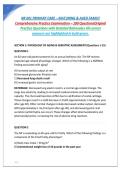
NR 601 PRIMARY CARE – MATURING & AGED FAMILY
Comprehensive Practice Examination – 100 QuestionsOriginal
Practice Questions with Detailed Rationales All correct
answers are highlighted in bold green.
SECTION 1: PHYSIOLOGY OF AGING & GERIATRIC ASSESSMENT (Questions 1-15)
QUESTION 1
An 82-year-old patient presents for an annual wellness visit. The NP reviews
expected age-related physiologic changes. Which of the following is a NORMAL
finding associated with aging?
A) Increased cardiac output at rest
B) Increased glomerular filtration rate
C) Decreased lung elastic recoil
D) Increased gastric acid secretion
RATIONALE: Decreased lung elastic recoil is a normal age-related change. The
lungs lose elasticity, leading to increased residual volume and decreased vital
capacity. The chest wall becomes stiffer due to calcification of costal cartilage.
These changes result in a mild decrease in PaO2 (approximately 1 mmHg per year
after age 40). Other normal changes include decreased cardiac output, decreased
GFR (approximately 1 mL/min/year after age 40), and decreased gastric acid
secretion (achlorhydria can occur). These changes affect pharmacokinetics and
pharmacodynamics, increasing the risk of adverse drug reactions.
QUESTION 2
The NP is evaluating an 85-year-old for frailty. Which of the following findings is a
component of the Fried frailty phenotype?
A) Body mass index > 30 kg/m²
B) Unintentional weight loss of 10 pounds in the past year
pg. 1
,2
C) Hypertension requiring three medications
D) Frequent headaches
RATIONALE: The Fried frailty phenotype includes five criteria: (1) Unintentional
weight loss (≥ 10 pounds in the past year), (2) Self-reported exhaustion, (3)
Weakness (decreased grip strength), (4) Slow walking speed, and (5) Low physical
activity. The presence of 3 or more criteria indicates frailty. 1-2 criteria indicate
pre-frailty. Obesity is not a criterion; in fact, some frail patients may be
underweight. Hypertension and headaches are not frailty criteria. Frailty is a state
of increased vulnerability to stressors and is associated with increased risk of falls,
disability, hospitalization, and mortality.
QUESTION 3
Which theory of aging proposes that accumulated oxidative damage from free
radicals leads to cellular dysfunction and aging?
A) Telomere shortening theory
B) Free radical theory
C) Immunosenescence theory
D) Programmed aging theory
RATIONALE: The free radical (oxidative stress) theory of aging proposes that
accumulated damage from reactive oxygen species (free radicals) produced
during normal cellular metabolism leads to DNA damage, lipid peroxidation,
protein oxidation, and ultimately cellular dysfunction and aging. This theory
suggests that antioxidants may slow aging, though clinical trials have not
consistently supported this. The telomere theory focuses on shortening of
telomeres with each cell division, leading to replicative senescence.
Immunosenescence describes the age-related decline in immune function.
Programmed aging theories propose that aging is genetically determined.
QUESTION 4
pg. 2
,3
An 88-year-old is being evaluated after a fall. The NP performs a "Timed Up and
Go" (TUG) test. The patient takes 18 seconds to complete the test. The NP should
interpret this result as:
A) Normal for age; no further evaluation needed
B) Increased fall risk; further evaluation and intervention warranted
C) Diagnostic of Parkinson disease
D) Indicating normal age-related slowing only
RATIONALE: The TUG test measures the time it takes a patient to stand from a
chair, walk 3 meters (10 feet), turn, walk back, and sit down. A time of ≥ 12
seconds indicates an INCREASED RISK OF FALLS. A time of ≥ 20 seconds indicates
significant mobility impairment. This patient's time of 18 seconds is abnormal and
warrants further evaluation (gait assessment, strength testing, environmental
assessment, medication review) and intervention (physical therapy, strengthening
exercises, home safety modifications). Normal for community-dwelling older
adults is < 10 seconds. The TUG is not diagnostic of Parkinson disease.
QUESTION 5
The NP performs a Mini-Mental State Examination (MMSE) on an 80-year-old
patient with 12 years of education. The patient scores 24 out of 30. The NP should
interpret this as:
A) Normal cognition for age
B) Mild cognitive impairment; further evaluation warranted
C) Moderate dementia
D) Delirium
RATIONALE: MMSE scoring: 24-30 = normal (may indicate mild cognitive
impairment at the lower end). 18-23 = mild cognitive impairment/mild dementia.
0-17 = severe cognitive impairment. An MMSE score of 24, especially in a patient
with 12 years of education, is borderline and warrants further evaluation for mild
cognitive impairment (MCI). Education level affects interpretation—higher
education may mask early cognitive decline (patients may score well despite
impairment). The NP should: Perform additional cognitive testing (Montreal
Cognitive Assessment—MoCA is more sensitive for MCI). Evaluate for reversible
pg. 3
, 4
causes of cognitive impairment (B12 deficiency, hypothyroidism, depression,
medication side effects). Follow over time. Delirium is acute and fluctuating; the
MMSE alone does not diagnose delirium.
QUESTION 6
Which of the following is the most commonly used screening tool for assessing
nutritional status in older adults?
A) Braden Scale
B) Mini Nutritional Assessment (MNA)
C) Morse Fall Scale
D) PHQ-9
RATIONALE: The Mini Nutritional Assessment (MNA) is a validated tool
specifically designed for assessing nutritional status in older adults (age ≥ 65). It
evaluates: anthropometric measurements (BMI, weight loss), dietary intake,
global assessment (lifestyle, medication, mobility), and self-assessment. The
MNA-short form (MNA-SF) can be used for initial screening. The Braden Scale
assesses pressure injury risk. The Morse Fall Scale assesses fall risk. The PHQ-9
screens for depression. Malnutrition is common in older adults and is associated
with increased morbidity, mortality, and functional decline.
QUESTION 7
An 85-year-old patient is taking 12 different medications. The NP is concerned
about polypharmacy. Which of the following is the BEST strategy to address this?
A) Discontinue all medications and restart only essential ones
B) Perform medication reconciliation and apply the Beers Criteria to identify
potentially inappropriate medications
C) Refer to a geriatrician for medication management
D) Continue all medications as prescribed
RATIONALE: The best approach to polypharmacy is systematic medication review
and reconciliation. The NP should: Conduct a thorough medication reconciliation
pg. 4
NR 601 PRIMARY CARE – MATURING & AGED FAMILY
Comprehensive Practice Examination – 100 QuestionsOriginal
Practice Questions with Detailed Rationales All correct
answers are highlighted in bold green.
SECTION 1: PHYSIOLOGY OF AGING & GERIATRIC ASSESSMENT (Questions 1-15)
QUESTION 1
An 82-year-old patient presents for an annual wellness visit. The NP reviews
expected age-related physiologic changes. Which of the following is a NORMAL
finding associated with aging?
A) Increased cardiac output at rest
B) Increased glomerular filtration rate
C) Decreased lung elastic recoil
D) Increased gastric acid secretion
RATIONALE: Decreased lung elastic recoil is a normal age-related change. The
lungs lose elasticity, leading to increased residual volume and decreased vital
capacity. The chest wall becomes stiffer due to calcification of costal cartilage.
These changes result in a mild decrease in PaO2 (approximately 1 mmHg per year
after age 40). Other normal changes include decreased cardiac output, decreased
GFR (approximately 1 mL/min/year after age 40), and decreased gastric acid
secretion (achlorhydria can occur). These changes affect pharmacokinetics and
pharmacodynamics, increasing the risk of adverse drug reactions.
QUESTION 2
The NP is evaluating an 85-year-old for frailty. Which of the following findings is a
component of the Fried frailty phenotype?
A) Body mass index > 30 kg/m²
B) Unintentional weight loss of 10 pounds in the past year
pg. 1
,2
C) Hypertension requiring three medications
D) Frequent headaches
RATIONALE: The Fried frailty phenotype includes five criteria: (1) Unintentional
weight loss (≥ 10 pounds in the past year), (2) Self-reported exhaustion, (3)
Weakness (decreased grip strength), (4) Slow walking speed, and (5) Low physical
activity. The presence of 3 or more criteria indicates frailty. 1-2 criteria indicate
pre-frailty. Obesity is not a criterion; in fact, some frail patients may be
underweight. Hypertension and headaches are not frailty criteria. Frailty is a state
of increased vulnerability to stressors and is associated with increased risk of falls,
disability, hospitalization, and mortality.
QUESTION 3
Which theory of aging proposes that accumulated oxidative damage from free
radicals leads to cellular dysfunction and aging?
A) Telomere shortening theory
B) Free radical theory
C) Immunosenescence theory
D) Programmed aging theory
RATIONALE: The free radical (oxidative stress) theory of aging proposes that
accumulated damage from reactive oxygen species (free radicals) produced
during normal cellular metabolism leads to DNA damage, lipid peroxidation,
protein oxidation, and ultimately cellular dysfunction and aging. This theory
suggests that antioxidants may slow aging, though clinical trials have not
consistently supported this. The telomere theory focuses on shortening of
telomeres with each cell division, leading to replicative senescence.
Immunosenescence describes the age-related decline in immune function.
Programmed aging theories propose that aging is genetically determined.
QUESTION 4
pg. 2
,3
An 88-year-old is being evaluated after a fall. The NP performs a "Timed Up and
Go" (TUG) test. The patient takes 18 seconds to complete the test. The NP should
interpret this result as:
A) Normal for age; no further evaluation needed
B) Increased fall risk; further evaluation and intervention warranted
C) Diagnostic of Parkinson disease
D) Indicating normal age-related slowing only
RATIONALE: The TUG test measures the time it takes a patient to stand from a
chair, walk 3 meters (10 feet), turn, walk back, and sit down. A time of ≥ 12
seconds indicates an INCREASED RISK OF FALLS. A time of ≥ 20 seconds indicates
significant mobility impairment. This patient's time of 18 seconds is abnormal and
warrants further evaluation (gait assessment, strength testing, environmental
assessment, medication review) and intervention (physical therapy, strengthening
exercises, home safety modifications). Normal for community-dwelling older
adults is < 10 seconds. The TUG is not diagnostic of Parkinson disease.
QUESTION 5
The NP performs a Mini-Mental State Examination (MMSE) on an 80-year-old
patient with 12 years of education. The patient scores 24 out of 30. The NP should
interpret this as:
A) Normal cognition for age
B) Mild cognitive impairment; further evaluation warranted
C) Moderate dementia
D) Delirium
RATIONALE: MMSE scoring: 24-30 = normal (may indicate mild cognitive
impairment at the lower end). 18-23 = mild cognitive impairment/mild dementia.
0-17 = severe cognitive impairment. An MMSE score of 24, especially in a patient
with 12 years of education, is borderline and warrants further evaluation for mild
cognitive impairment (MCI). Education level affects interpretation—higher
education may mask early cognitive decline (patients may score well despite
impairment). The NP should: Perform additional cognitive testing (Montreal
Cognitive Assessment—MoCA is more sensitive for MCI). Evaluate for reversible
pg. 3
, 4
causes of cognitive impairment (B12 deficiency, hypothyroidism, depression,
medication side effects). Follow over time. Delirium is acute and fluctuating; the
MMSE alone does not diagnose delirium.
QUESTION 6
Which of the following is the most commonly used screening tool for assessing
nutritional status in older adults?
A) Braden Scale
B) Mini Nutritional Assessment (MNA)
C) Morse Fall Scale
D) PHQ-9
RATIONALE: The Mini Nutritional Assessment (MNA) is a validated tool
specifically designed for assessing nutritional status in older adults (age ≥ 65). It
evaluates: anthropometric measurements (BMI, weight loss), dietary intake,
global assessment (lifestyle, medication, mobility), and self-assessment. The
MNA-short form (MNA-SF) can be used for initial screening. The Braden Scale
assesses pressure injury risk. The Morse Fall Scale assesses fall risk. The PHQ-9
screens for depression. Malnutrition is common in older adults and is associated
with increased morbidity, mortality, and functional decline.
QUESTION 7
An 85-year-old patient is taking 12 different medications. The NP is concerned
about polypharmacy. Which of the following is the BEST strategy to address this?
A) Discontinue all medications and restart only essential ones
B) Perform medication reconciliation and apply the Beers Criteria to identify
potentially inappropriate medications
C) Refer to a geriatrician for medication management
D) Continue all medications as prescribed
RATIONALE: The best approach to polypharmacy is systematic medication review
and reconciliation. The NP should: Conduct a thorough medication reconciliation
pg. 4


