
• Wrong document? Swap it for free
  • Written by students who passed
  • Immediately available after payment
  • Read online or as PDF
Sell
Where do you study
Your language
Document preview thumbnail
Preview 3 out of 30 pages
Class notes

Introduction to bacteria

Document preview thumbnail
Preview 3 out of 30 pages

What are bacteria? Bacteria are microscopic, single-celled organisms that belong to the domain Bacteria. They are prokaryotes, meaning they lack a true nucleus and other membrane-bound organelles. Their genetic material is found in a region called the nucleoid. Bacteria are among the oldest life forms on Earth, having existed for over 3.5 billion years. They are found in almost every environment, including soil, water, air, deep oceans, hot springs, polar ice, and inside living organisms. Characteristics of bacteria Unicellular (single-celled) Prokaryotic (no true nucleus) Usually measure 0.2–10 micrometers (µm) Reproduce mainly by binary fission Have a rigid cell wall made of peptidoglycan May be beneficial, harmless, or disease-causing Can survive in a wide range of environments Structure of a bacterial cell A typical bacterial cell contains: Capsule (optional) Protective outer layer. Prevents drying out and helps bacteria evade the immune system. Cell wall Gives shape and protection. Made mainly of peptidoglycan. Cell membrane Controls movement of substances into and out of the cell. Cytoplasm Jelly-like material where metabolic reactions occur. Nucleoid Contains the bacterial chromosome (DNA). Plasmids Small circular DNA molecules carrying extra genes, often including antibiotic resistance genes. Ribosomes (70S) Produce proteins. Flagella Long whip-like structures used for movement. Pili (fimbriae) Hair-like structures used for attachment and DNA transfer. Shapes of bacteria There are four common shapes: Cocci – Spherical (round) Bacilli – Rod-shaped Spirilla – Spiral-shaped Vibrios – Comma-shaped Classification by Gram stain Gram-positive bacteria Thick peptidoglycan cell wall Retain crystal violet stain and appear purple Examples: Staphylococcus aureus Streptococcus pyogenes Gram-negative bacteria Thin peptidoglycan layer Outer membrane present Appear pink or red after staining Examples: Escherichia coli Salmonella enterica Nutrition of bacteria Bacteria obtain food in different ways: Autotrophs Make their own food. Photosynthetic bacteria use sunlight. Chemosynthetic bacteria use chemical energy. Heterotrophs Obtain nutrients from other organisms. Include: Saprophytes (feed on dead matter) Parasites (feed on living hosts) Symbionts (live in mutual benefit with hosts) Reproduction Bacteria reproduce mainly through binary fission: DNA replicates. Cell elongates. Septum forms. Cell divides into two identical daughter cells. Under favorable conditions, some bacteria divide every 20–30 minutes. Genetic exchange Although bacteria do not reproduce sexually, they exchange genes through: Conjugation Transformation Transduction These processes increase genetic diversity and can spread antibiotic resistance. Growth requirements Bacteria need: Nutrients Water Suitable temperature Appropriate pH Oxygen (depending on species) Oxygen requirements Obligate aerobes – Need oxygen. Obligate anaerobes – Oxygen is toxic. Facultative anaerobes – Can grow with or without oxygen. Microaerophiles – Require low oxygen levels. Beneficial bacteria Many bacteria are essential for life. Examples include: Helping digest food in the human intestine. Producing vitamins such as vitamin K. Fixing nitrogen in soil for plants. Fermenting foods like yogurt and cheese. Producing antibiotics and enzymes used in medicine and industry. Decomposing dead organisms and recycling nutrients. Harmful bacteria Some bacteria cause diseases by producing toxins or invading body tissues. Examples include: Tuberculosis – caused by Mycobacterium tuberculosis Cholera – caused by Vibrio cholerae Typhoid fever – caused by Salmonella Typhi Tetanus – caused by Clostridium tetani Prevention of bacterial infections Wash hands regularly. Drink clean, safe water. Practice good food hygiene. Get recommended vaccinations. Clean and cover wounds. Use antibiotics only as prescribed. Complete the full course of antibiotics to reduce the risk of resistance. Importance of bacteria

Content preview

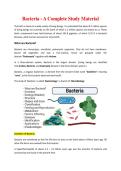
Bacteria - A Complete Study Material
The Earth is home to a wide variety of living beings. It is estimated that about 8.7 million species
of living beings are currently on the Earth of which 1.2 million species are known to us. These
biotic components have total biomass of about 545.8 gigatons, of which 12.8 % is bacterial
biomass, while human accounts for only 0.01%.

What are Bacteria?
Bacteria are microscopic, unicellular, prokaryotic organisms. They do not have membrane-
bound cell organelles and lack a true nucleus, hence are grouped under the
domain “Prokaryota” together with Archae.

In a three-domain system, Bacteria is the largest domain. (Living beings are classified
into Archae, Bacteria, and Eukaryota domain in the three-domain system.)

Bacteria, a singular bacterium, is derived from the Ancient Greek word “backērion” meaning
“cane”, as the first bacteria observed were bacilli.

The study of ‘Bacteria’ is called ‘Bacteriology’; a branch of ‘Microbiology’.


Evolution of Bacteria

Bacteria are considered as the first life-form to arise on the Earth about 4 billion years ago. All
other life-forms are evolved from the bacteria.

A hyperthermophile of about 2.5 – 3.2 billion years ago was the ancestor of bacteria and
archaea that are found in the present time.

,Endosymbiotic association between different bacteria around 1.6 – 2.0 billion years ago give rise
to the first proto-eukaryotic cell, which gradually gives rise to eukaryotes.

Ecology (Habitat) of Bacteria

Bacteria are evolved to adapt and survive in any kind of ecological niches; from normal
to extreme environments. Hence, they are ubiquitous.

They are found in every possible habitat on the Earth; soil, air, and water. They are associated
with all the biotic and abiotic components of the Earth. They are essential components of every
ecosystem.

They are not only in normal ecological habitats but are also found in extreme environments.
Such bacteria are called extremophilic bacteria. They are found in extreme cold (Psychrophiles),
extremely hot (thermophiles), extreme pH (acidophiles and Alkaliphiles), extreme pressure
(barophiles), anoxic environments (anaerobic), desertic area (xerophiles), high radiation area,
toxic wastes, barren sand and rocks, deep underground and mountain tip, etc.


Ecology (Habitat) of Bacteria

Soil is the most heavily habituated place where they constitute about 0.5% W/W of the soil
mass. One gram of topsoil may contain as many as one billion bacterial cells.

It is estimated that there are approximately 2×1030 bacteria on the Earth, but only around 2% of
them are fully studied to date. Hence, there is a huge research gap on the diversity and ecology
of many unknown bacterial species.

Wide varieties of bacteria live in the body of all living beings, including higher plants, animals,
and even the human body. In an average human body (normal), there are about 10 14 bacterial
cells, while the body itself is made up of only 1013 human cells.

, Structure of a Bacterial Cell

Bacteria are unicellular i.e., made up of a single cell. They are prokaryotes and their cells are
different from animal and plant cells. In general, the structure of bacteria can be studied as
external and internal structures;


Structure of a Bacterial Cell

External Structure of a Bacteria
It includes a cell wall and all the structures outside the cell wall.

1. Flagella (sing. Flagellum)

Flagella are long hair-like filamentous structures of about 4 – 5 μm long and 0.01 – 0.03 μm in
diameter. They confer motility to the bacteria. Flagella are divided into three parts; filament,
hook, and the basal body.

The filament is a threadlike part extending outside the cell wall. It is made up of flagellin
protein.

The hook is a short-curved structure that joins filament with the basal body. It produces
repulsion like the propeller during the revolving of flagella.

The basal body is a set of rings embedded in the cell wall and plasma membrane. It consists of 2
pairs of rings in Gram-Negative bacteria and 1 pair of rings in Gram-Positive bacteria. It


Document information

Uploaded on
June 27, 2026
Number of pages
30
Written in
2025/2026
Type
Class notes
Professor(s)
Peter swiss
Contains
All classes
$10.99

Wrong document? Swap it for free Within 14 days of purchase and before downloading, you can choose a different document. You can simply spend the amount again.
Written by students who passed
Immediately available after payment
Read online or as PDF

Sold
0
Followers
0
Items
5
Last sold
-


Why students choose Stuvia

Created by fellow students, verified by reviews

Quality you can trust: written by students who passed their tests and reviewed by others who've used these notes.

Didn't get what you expected? Choose another document

No worries! You can instantly pick a different document that better fits what you're looking for.

Pay as you like, start learning right away

No subscription, no commitments. Pay the way you're used to via credit card and download your PDF document instantly.

Student with book image

“Bought, downloaded, and aced it. It really can be that simple.”

Alisha Student

Working on your references?

Create accurate citations in APA, MLA and Harvard with our free citation generator.

Working on your references?

Frequently asked questions
