
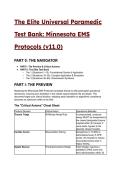
The Elite Universal Paramedic
Test Bank: Minnesota EMS
Protocols (v11.0)
PART 0: THE NAVIGATOR
● PART I: The Preview & Critical Axioms
● PART II: The Elite Test Bank
○ Tier 1 (Questions 1–15): Foundational Syntax & Application
○ Tier 2 (Questions 16–35): Complex Application & Simulation
○ Tier 3 (Questions 36–60): Grandmaster Synthesis
PART I: THE PREVIEW
Mastering the Minnesota EMS Protocols translates directly to elite prehospital operational
dominance, ensuring zero hesitation in the chaotic space between life and death. This
document forges your clinical intuition, stripping away hesitation so algorithmic compliance
becomes an autonomic reflex in the field.
The "Critical Axioms" Cheat Sheet
Protocol Domain Critical Axiom Operational Mandate
Trauma Triage 30-Minute Airway Rule A compromised, unsecure
airway MUST be transported to
the closest designated trauma
hospital within 30 minutes; if
none exists, bypass to the
absolute closest hospital.
Cardiac Arrest Resuscitation Pacing Epinephrine (1:10,000) is
administered every 5 CPR
cycles (10 minutes) to reduce
myocardial toxicity seen in
legacy dosing.
Opiate Rescue The Buprenorphine Bridge Field initiation requires a
validated COWS score and
strict administration within 30
,Protocol Domain Critical Axiom Operational Mandate
minutes of the last Naloxone
dose to prevent precipitated
withdrawal.
Neuro-Sedation Ketamine Surveillance Ketamine administration for
Excited Delirium mandates
continuous EtCO2 and cardiac
monitoring. Prone positioning is
strictly forbidden.
LVO Stroke FAST-ED Triage A FAST-ED score ≥ 4 signifies
a ~60% or higher likelihood of a
Large Vessel Occlusion (LVO),
mandating rapid diversion to a
comprehensive stroke center.
PART II: THE ELITE TEST BANK
Tier 1: Foundational Syntax & Application
Q1: A paramedic assesses an adult male who suffered blunt force trauma to the chest and face.
He has a compromised, unsecure airway. A Level I Trauma Center is 40 minutes away, a Level
III Trauma Center is 20 minutes away, and an undesignated community hospital is 5 minutes
away. Based on the Minnesota Statewide Trauma Triage Guidelines, which destination decision
is MOST APPROPRIATE? A) Transport to the Level I Trauma Center because a compromised
airway requires the highest level of surgical care. B) Transport to the undesignated community
hospital because it is the closest facility for an unsecure airway. C) Transport to the Level III
Trauma Center because it is the closest designated trauma hospital within 30 minutes. D) Wait
on scene for an aeromedical helicopter to transport the patient to the Level I facility.
● The Answer: C (Transport to the Level III Trauma Center because it is the closest
designated trauma hospital within 30 minutes.)
● Distractor Analysis:
○ A is incorrect: The 30-minute rule strictly prohibits bypassing a designated trauma
center if the higher-level center is greater than 30 minutes away with an unsecure
airway.
○ B is incorrect: You only default to an undesignated hospital if no designated trauma
hospital exists within 30 minutes.
○ D is incorrect: Waiting on scene with an unsecure airway violates the mandate for
immediate transport.
The Mentor's Analysis: A compromised airway is the ultimate prehospital ticking clock. When
facing an unsecure airway, the immediate priority is finding the nearest specialized trauma
capabilities within a strict 30-minute window. By utilizing statewide bypass protocols, you bypass
the common trap of over-triage to distant Level I centers while a patient suffocates.
Professional/Academic Intuition: The 30-minute trauma rule dictates that an undesignated
hospital is bypassed ONLY for a designated trauma hospital within that exact time threshold.
Q2: During the resuscitation of an adult patient in ventricular fibrillation, the crew is utilizing a
LUCAS device. Based on Regions EMS Cardiac Arrest protocols, what is the MOST
ACCURATE interval for administering 1 mg of 1:10,000 Epinephrine? A) Every 3 to 5 minutes
consecutively. B) Every 5 CPR cycles, which equates to approximately 10 minutes. C)
,Immediately after the first defibrillation, then every 2 minutes. D) Only after establishing an
advanced airway.
● The Answer: B (Every 5 CPR cycles, which equates to approximately 10 minutes.)
● Distractor Analysis:
○ A is incorrect: This is the standard AHA guideline, but Regions EMS specifically
extends this to reduce myocardial stunning and toxicity.
○ C is incorrect: Epinephrine is withheld until later in the algorithm to prioritize
unbroken high-performance CPR and defibrillation.
○ D is incorrect: Medication administration is not dependent on advanced airways.
The Mentor's Analysis: Excessive exogenous catecholamines during cardiac arrest decrease
microvascular perfusion. When facing refractory arrest, the immediate priority is mechanical
circulation. By utilizing spaced Epinephrine dosing (every 10 minutes), you bypass the common
trap of chemically overloading an ischemic heart. Professional/Academic Intuition: Compress
the chest, space the drugs; 5 cycles equals 10 minutes in the Regions EMS operational
framework.
Q3: A 25-year-old female was revived from an opioid overdose by police using 4 mg of
intranasal Naloxone prior to EMS arrival. She is now awake, combative, vomiting, and
experiencing severe body aches. The paramedic decides to initiate the Hennepin EMS
Buprenorphine protocol. What is the FIRST strict physiological or temporal parameter that must
be met? A) Administration must occur within 30 minutes of the last Naloxone dose. B) The
patient must have a Glasgow Coma Scale (GCS) of exactly 15. C) The patient must be
transferred to law enforcement custody. D) The patient must wait 24 hours to prevent
precipitated withdrawal.
● The Answer: A (Administration must occur within 30 minutes of the last Naloxone dose.)
● Distractor Analysis:
○ B is incorrect: While altered mental status is a consideration, the defining protocol
trigger is the timing relative to the antagonist.
○ C is incorrect: Custody has no bearing on clinical withdrawal treatment.
○ D is incorrect: This applies to patients ceasing opioid use naturally, not those in
acute Naloxone-induced withdrawal.
The Mentor's Analysis: Naloxone aggressively rips opioids from Mu receptors, creating
immediate, violent withdrawal. When facing Naloxone-induced withdrawal, the immediate
priority is receptor stabilization. By utilizing rapid Buprenorphine induction within 30 minutes,
you bypass the common trap of allowing the patient to refuse transport and immediately seek
illicit fentanyl to stop their suffering. Professional/Academic Intuition: Strike while the receptor
is empty; Buprenorphine must follow Naloxone within 30 minutes to capture the therapeutic
window.
Q4: A patient is assessed using the FAST-ED stroke scale and scores a 5. Based on this score,
what is the MOST LOGICAL clinical conclusion regarding this patient's pathology? A) The
patient has a less than 15% chance of a stroke and can be released. B) The patient is
experiencing a hemorrhagic stroke and needs immediate TXA. C) The patient has
approximately a 60% or higher likelihood of a Large Vessel Occlusion (LVO). D) The patient has
a transient ischemic attack (TIA) and requires an aspirin.
● The Answer: C (The patient has approximately a 60% or higher likelihood of a Large
Vessel Occlusion (LVO).)
● Distractor Analysis:
○ A is incorrect: A score of 0-1 correlates to a <15% chance. * B is incorrect:
FAST-ED does not differentiate between ischemic and hemorrhagic, and TXA is
, contraindicated for stroke.
○ D is incorrect: A score of 5 indicates a massive neurological deficit, not a TIA.
The Mentor's Analysis: Stroke survival is dictated by plumbing; large pipes require surgical
extraction. When facing sudden neurological deficits, the immediate priority is quantifying the
occlusion size. By utilizing the FAST-ED metric, you bypass the common trap of transporting a
massive stroke to a facility incapable of endovascular thrombectomy. Professional/Academic
Intuition: A FAST-ED score of 4 or higher demands diversion to a Comprehensive Stroke
Center capable of interventional neurology.
Q5: An adult male is experiencing severe Excited Delirium and is violently thrashing. The crew
administers 400 mg of Ketamine IM. According to Regions EMS critical care guidelines, what is
the IMMEDIATELY mandated clinical monitoring step following this administration? A)
Application of a soft restraint mask. B) Continuous EtCO2 and cardiac monitoring. C)
Administration of 5 mg Midazolam to prevent emergence reactions. D) Checking a blood
glucose level.
● The Answer: B (Continuous EtCO2 and cardiac monitoring.)
● Distractor Analysis:
○ A is incorrect: While a spit hood may be used, it is not the mandated clinical
monitoring step.
○ C is incorrect: Midazolam is not prophylactically given for emergence during the
acute sedation phase of delirium.
○ D is incorrect: While BGL is important, continuous respiratory monitoring (EtCO2) is
the strict legal and clinical mandate once the dissociative anesthetic is given.
The Mentor's Analysis: Ketamine is a profound dissociative that can rarely trigger
laryngospasm or apnea. When facing chemical takedowns, the immediate priority is airway
surveillance. By utilizing continuous capnography, you bypass the common trap of missing
silent respiratory failure in an immobilized patient. Professional/Academic Intuition: If you
take their brain, you must watch their breath. Ketamine strictly equals EtCO2.
Q6: A 4-year-old, 20 kg child is in status epilepticus. Intravenous access is unavailable due to
severe convulsing. Under Regions EMS guidelines, what is the MOST ACCURATE dose and
route for the first-line benzodiazepine? A) 2 mg Midazolam IV push. B) 10 mg Diazepam
rectally. C) 4 mg Midazolam IM (Intramuscular). D) 0.5 mg/kg Lorazepam IN (Intranasal).
● The Answer: C (4 mg Midazolam IM (Intramuscular).)
● Distractor Analysis:
○ A is incorrect: IV access is explicitly stated as unavailable.
○ B is incorrect: While Diastat is used, Midazolam IM/IN is the preferred prehospital
first-line when IV is absent.
○ D is incorrect: Lorazepam is not optimally absorbed intranasally and the dose is
lethally high. The correct Midazolam IM dose is 0.2 mg/kg (20kg x 0.2 = 4 mg).
The Mentor's Analysis: Pediatric seizures rapidly deplete cerebral glucose and oxygen. When
facing a convulsing child without vascular access, the immediate priority is rapid mucosal or
muscle absorption. By utilizing Midazolam's high lipid solubility via the IM route, you bypass the
common trap of delaying termination while hunting for a vein. Professional/Academic
Intuition: When the vein hides, use the muscle: Midazolam 0.2 mg/kg IM is the definitive
rescue.
Q7: A paramedic is treating an adult trauma patient with clinical signs of hemorrhagic shock
following a severe motor vehicle collision. The injury occurred 45 minutes ago. Based on
updated guidelines for prehospital Tranexamic Acid (TXA) administration, which action is MOST
APPROPRIATE? A) Administer 1g IV/IO followed by a field infusion of a second 1g. B)
Test Bank: Minnesota EMS
Protocols (v11.0)
PART 0: THE NAVIGATOR
● PART I: The Preview & Critical Axioms
● PART II: The Elite Test Bank
○ Tier 1 (Questions 1–15): Foundational Syntax & Application
○ Tier 2 (Questions 16–35): Complex Application & Simulation
○ Tier 3 (Questions 36–60): Grandmaster Synthesis
PART I: THE PREVIEW
Mastering the Minnesota EMS Protocols translates directly to elite prehospital operational
dominance, ensuring zero hesitation in the chaotic space between life and death. This
document forges your clinical intuition, stripping away hesitation so algorithmic compliance
becomes an autonomic reflex in the field.
The "Critical Axioms" Cheat Sheet
Protocol Domain Critical Axiom Operational Mandate
Trauma Triage 30-Minute Airway Rule A compromised, unsecure
airway MUST be transported to
the closest designated trauma
hospital within 30 minutes; if
none exists, bypass to the
absolute closest hospital.
Cardiac Arrest Resuscitation Pacing Epinephrine (1:10,000) is
administered every 5 CPR
cycles (10 minutes) to reduce
myocardial toxicity seen in
legacy dosing.
Opiate Rescue The Buprenorphine Bridge Field initiation requires a
validated COWS score and
strict administration within 30
,Protocol Domain Critical Axiom Operational Mandate
minutes of the last Naloxone
dose to prevent precipitated
withdrawal.
Neuro-Sedation Ketamine Surveillance Ketamine administration for
Excited Delirium mandates
continuous EtCO2 and cardiac
monitoring. Prone positioning is
strictly forbidden.
LVO Stroke FAST-ED Triage A FAST-ED score ≥ 4 signifies
a ~60% or higher likelihood of a
Large Vessel Occlusion (LVO),
mandating rapid diversion to a
comprehensive stroke center.
PART II: THE ELITE TEST BANK
Tier 1: Foundational Syntax & Application
Q1: A paramedic assesses an adult male who suffered blunt force trauma to the chest and face.
He has a compromised, unsecure airway. A Level I Trauma Center is 40 minutes away, a Level
III Trauma Center is 20 minutes away, and an undesignated community hospital is 5 minutes
away. Based on the Minnesota Statewide Trauma Triage Guidelines, which destination decision
is MOST APPROPRIATE? A) Transport to the Level I Trauma Center because a compromised
airway requires the highest level of surgical care. B) Transport to the undesignated community
hospital because it is the closest facility for an unsecure airway. C) Transport to the Level III
Trauma Center because it is the closest designated trauma hospital within 30 minutes. D) Wait
on scene for an aeromedical helicopter to transport the patient to the Level I facility.
● The Answer: C (Transport to the Level III Trauma Center because it is the closest
designated trauma hospital within 30 minutes.)
● Distractor Analysis:
○ A is incorrect: The 30-minute rule strictly prohibits bypassing a designated trauma
center if the higher-level center is greater than 30 minutes away with an unsecure
airway.
○ B is incorrect: You only default to an undesignated hospital if no designated trauma
hospital exists within 30 minutes.
○ D is incorrect: Waiting on scene with an unsecure airway violates the mandate for
immediate transport.
The Mentor's Analysis: A compromised airway is the ultimate prehospital ticking clock. When
facing an unsecure airway, the immediate priority is finding the nearest specialized trauma
capabilities within a strict 30-minute window. By utilizing statewide bypass protocols, you bypass
the common trap of over-triage to distant Level I centers while a patient suffocates.
Professional/Academic Intuition: The 30-minute trauma rule dictates that an undesignated
hospital is bypassed ONLY for a designated trauma hospital within that exact time threshold.
Q2: During the resuscitation of an adult patient in ventricular fibrillation, the crew is utilizing a
LUCAS device. Based on Regions EMS Cardiac Arrest protocols, what is the MOST
ACCURATE interval for administering 1 mg of 1:10,000 Epinephrine? A) Every 3 to 5 minutes
consecutively. B) Every 5 CPR cycles, which equates to approximately 10 minutes. C)
,Immediately after the first defibrillation, then every 2 minutes. D) Only after establishing an
advanced airway.
● The Answer: B (Every 5 CPR cycles, which equates to approximately 10 minutes.)
● Distractor Analysis:
○ A is incorrect: This is the standard AHA guideline, but Regions EMS specifically
extends this to reduce myocardial stunning and toxicity.
○ C is incorrect: Epinephrine is withheld until later in the algorithm to prioritize
unbroken high-performance CPR and defibrillation.
○ D is incorrect: Medication administration is not dependent on advanced airways.
The Mentor's Analysis: Excessive exogenous catecholamines during cardiac arrest decrease
microvascular perfusion. When facing refractory arrest, the immediate priority is mechanical
circulation. By utilizing spaced Epinephrine dosing (every 10 minutes), you bypass the common
trap of chemically overloading an ischemic heart. Professional/Academic Intuition: Compress
the chest, space the drugs; 5 cycles equals 10 minutes in the Regions EMS operational
framework.
Q3: A 25-year-old female was revived from an opioid overdose by police using 4 mg of
intranasal Naloxone prior to EMS arrival. She is now awake, combative, vomiting, and
experiencing severe body aches. The paramedic decides to initiate the Hennepin EMS
Buprenorphine protocol. What is the FIRST strict physiological or temporal parameter that must
be met? A) Administration must occur within 30 minutes of the last Naloxone dose. B) The
patient must have a Glasgow Coma Scale (GCS) of exactly 15. C) The patient must be
transferred to law enforcement custody. D) The patient must wait 24 hours to prevent
precipitated withdrawal.
● The Answer: A (Administration must occur within 30 minutes of the last Naloxone dose.)
● Distractor Analysis:
○ B is incorrect: While altered mental status is a consideration, the defining protocol
trigger is the timing relative to the antagonist.
○ C is incorrect: Custody has no bearing on clinical withdrawal treatment.
○ D is incorrect: This applies to patients ceasing opioid use naturally, not those in
acute Naloxone-induced withdrawal.
The Mentor's Analysis: Naloxone aggressively rips opioids from Mu receptors, creating
immediate, violent withdrawal. When facing Naloxone-induced withdrawal, the immediate
priority is receptor stabilization. By utilizing rapid Buprenorphine induction within 30 minutes,
you bypass the common trap of allowing the patient to refuse transport and immediately seek
illicit fentanyl to stop their suffering. Professional/Academic Intuition: Strike while the receptor
is empty; Buprenorphine must follow Naloxone within 30 minutes to capture the therapeutic
window.
Q4: A patient is assessed using the FAST-ED stroke scale and scores a 5. Based on this score,
what is the MOST LOGICAL clinical conclusion regarding this patient's pathology? A) The
patient has a less than 15% chance of a stroke and can be released. B) The patient is
experiencing a hemorrhagic stroke and needs immediate TXA. C) The patient has
approximately a 60% or higher likelihood of a Large Vessel Occlusion (LVO). D) The patient has
a transient ischemic attack (TIA) and requires an aspirin.
● The Answer: C (The patient has approximately a 60% or higher likelihood of a Large
Vessel Occlusion (LVO).)
● Distractor Analysis:
○ A is incorrect: A score of 0-1 correlates to a <15% chance. * B is incorrect:
FAST-ED does not differentiate between ischemic and hemorrhagic, and TXA is
, contraindicated for stroke.
○ D is incorrect: A score of 5 indicates a massive neurological deficit, not a TIA.
The Mentor's Analysis: Stroke survival is dictated by plumbing; large pipes require surgical
extraction. When facing sudden neurological deficits, the immediate priority is quantifying the
occlusion size. By utilizing the FAST-ED metric, you bypass the common trap of transporting a
massive stroke to a facility incapable of endovascular thrombectomy. Professional/Academic
Intuition: A FAST-ED score of 4 or higher demands diversion to a Comprehensive Stroke
Center capable of interventional neurology.
Q5: An adult male is experiencing severe Excited Delirium and is violently thrashing. The crew
administers 400 mg of Ketamine IM. According to Regions EMS critical care guidelines, what is
the IMMEDIATELY mandated clinical monitoring step following this administration? A)
Application of a soft restraint mask. B) Continuous EtCO2 and cardiac monitoring. C)
Administration of 5 mg Midazolam to prevent emergence reactions. D) Checking a blood
glucose level.
● The Answer: B (Continuous EtCO2 and cardiac monitoring.)
● Distractor Analysis:
○ A is incorrect: While a spit hood may be used, it is not the mandated clinical
monitoring step.
○ C is incorrect: Midazolam is not prophylactically given for emergence during the
acute sedation phase of delirium.
○ D is incorrect: While BGL is important, continuous respiratory monitoring (EtCO2) is
the strict legal and clinical mandate once the dissociative anesthetic is given.
The Mentor's Analysis: Ketamine is a profound dissociative that can rarely trigger
laryngospasm or apnea. When facing chemical takedowns, the immediate priority is airway
surveillance. By utilizing continuous capnography, you bypass the common trap of missing
silent respiratory failure in an immobilized patient. Professional/Academic Intuition: If you
take their brain, you must watch their breath. Ketamine strictly equals EtCO2.
Q6: A 4-year-old, 20 kg child is in status epilepticus. Intravenous access is unavailable due to
severe convulsing. Under Regions EMS guidelines, what is the MOST ACCURATE dose and
route for the first-line benzodiazepine? A) 2 mg Midazolam IV push. B) 10 mg Diazepam
rectally. C) 4 mg Midazolam IM (Intramuscular). D) 0.5 mg/kg Lorazepam IN (Intranasal).
● The Answer: C (4 mg Midazolam IM (Intramuscular).)
● Distractor Analysis:
○ A is incorrect: IV access is explicitly stated as unavailable.
○ B is incorrect: While Diastat is used, Midazolam IM/IN is the preferred prehospital
first-line when IV is absent.
○ D is incorrect: Lorazepam is not optimally absorbed intranasally and the dose is
lethally high. The correct Midazolam IM dose is 0.2 mg/kg (20kg x 0.2 = 4 mg).
The Mentor's Analysis: Pediatric seizures rapidly deplete cerebral glucose and oxygen. When
facing a convulsing child without vascular access, the immediate priority is rapid mucosal or
muscle absorption. By utilizing Midazolam's high lipid solubility via the IM route, you bypass the
common trap of delaying termination while hunting for a vein. Professional/Academic
Intuition: When the vein hides, use the muscle: Midazolam 0.2 mg/kg IM is the definitive
rescue.
Q7: A paramedic is treating an adult trauma patient with clinical signs of hemorrhagic shock
following a severe motor vehicle collision. The injury occurred 45 minutes ago. Based on
updated guidelines for prehospital Tranexamic Acid (TXA) administration, which action is MOST
APPROPRIATE? A) Administer 1g IV/IO followed by a field infusion of a second 1g. B)


