
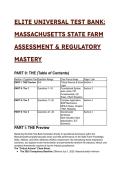
ELITE UNIVERSAL TEST BANK:
MASSACHUSETTS STATE FARM
ASSESSMENT & REGULATORY
MASTERY
PART 0: THE (Table of Contents)
Section / Cognitive Tier Question Range Core Focus Areas Page / Link
PART I: THE Preview N/A Critical Axioms & Exam Section 1
Logic
PART II: Tier 1 Questions 1–10 Foundational Syntax: Section 2
Auto Limits, PIP
Fundamentals, CE
Rules, KSAO Baseline
PART II: Tier 2 Questions 11–20 Complex Application: Section 3
SDIP Mechanics,
MPIUA Rules, Chapter
176D, Rebating
PART II: Tier 3 Questions 21–30 Grandmaster Section 4
Synthesis:
Multi-Variable Claim
Adjudication, SJT
Scenarios
PART I: THE Preview
Mastering this Elite Test Bank translates directly to operational dominance within the
Massachusetts property/casualty sector and elite performance on the State Farm Knowledge,
Skills, Abilities, and Other Attributes (KSAO) Assessment. By internalizing these engineered
scenarios, you bypass novice memorization and permanently hardwire the statutory, ethical, and
analytical frameworks required of top-tier industry practitioners.
The "Critical Axioms" Cheat Sheet:
● The 2025 Compulsory Baseline: Effective July 1, 2025, Massachusetts minimum
, compulsory auto limits strictly escalate. PIP remains fixed at $8,000.
Coverage Part Legacy Minimum (Pre-July Current Compulsory Limit
2025) (Post-July 2025)
Bodily Injury to Others (Part $20k per person / $40k per $25,000 per person / $50,000
1) accident per accident
Uninsured Motorist (Part 3) $20k per person / $40k per $25,000 per person / $50,000
accident per accident
Property Damage (Part 4) $5,000 per accident $30,000 per accident
● The PIP Coordination Protocol: Personal Injury Protection (PIP) pays the primary
$2,000. If private health insurance exists (non-ERISA), it absorbs the excess. PIP only
resumes coverage for non-covered medical co-pays or lost wages, capping strictly at
$8,000.
● The SDIP Threshold Matrix: Under the Safe Driver Insurance Plan, a Minor At-Fault
Accident ($1,001 to $5,000 in damages) yields 3 surcharges points. A Major At-Fault
Accident (>$5,000) yields 4 points.
● The Chapter 93A/176D Lethality: Unfair claim settlement practices trigger Chapter
176D, which acts as a per se violation of Chapter 93A, exposing insurers to mandatory
treble (triple) damages and attorney fees.
● The MPIUA Excess Mandate: Effective April 15, 2025, if a dwelling's 90% replacement
cost exceeds the $1,000,000 FAIR Plan limit, the agent must secure excess insurance
within 30 days, or the MPIUA will force an Actual Cash Value (ACV) endorsement.
● The KSAO Assessment Framework: The State Farm pre-employment assessment tests
cognitive speed and situational judgment. Data entry is untimed but strictly evaluates
absolute accuracy; the typing module permits two minutes per paragraph. The Virtual
Role Play requires balancing immediate customer de-escalation with rigid adherence to
state statutes.
PART II: THE ELITE TEST BANK
Q1: A Massachusetts resident purchases a new State Farm auto policy on August 1, 2025.
They opt for strictly the minimum compulsory coverages. The insured subsequently causes an
at-fault collision, resulting in $38,000 of damage to another driver's vehicle and $15,000 in
bodily injury to the other driver. Based on the July 2025 statutory limit updates, which payout
execution by the insurer is the MOST ACCURATE? A) The insurer pays $38,000 for the vehicle
and $15,000 for the bodily injury, as both fall within the updated 50/100/50 limits. B) The insurer
pays $30,000 for the vehicle and $15,000 for the bodily injury. The insured is personally liable
for the remaining $8,000 in property damage. C) The insurer pays $5,000 for the vehicle and
$15,000 for the bodily injury, leaving the insured liable for $33,000 in property damage. D) The
insurer denies the property damage claim because the insured failed to purchase Optional Part
5 limits.
● The Answer: B (The insurer pays $30,000 for the vehicle and $15,000 for the bodily
injury. The insured is personally liable for the remaining $8,000 in property damage.)
● Distractor Analysis:
○ A is incorrect: The updated Massachusetts minimum compulsory limits are
25/50/30, not 50/100/50. The $38,000 property damage exceeds the mandatory
minimum.
○ C is incorrect: This answer relies on the obsolete pre-July 2025 statutory minimum
, for Property Damage, which was a deeply inadequate $5,000. Under the new
statute, Part 4 Property Damage limits are elevated to $30,000.
○ D is incorrect: Part 5 is Optional Bodily Injury to Others. Property Damage is a
Compulsory Part 4 coverage, and its presence is legally mandated, not optional.
The Mentor's Analysis: Regulatory limit updates are absolute hard-decks in claims
adjudication. When facing post-July 2025 accidents, the immediate priority is locking in the
25/50/30 threshold. By utilizing the updated Compulsory Part 4 limit of $30,000, you bypass the
common trap of adjudicating modern claims using legacy state data. Professional/Academic
Intuition: Policy issuance dates determine statutory applicability; never process a 2025 property
claim using 1980s legacy minimums.
Q2: A State Farm policyholder is injured in an auto accident in Boston. They incur $6,500 in
medical bills. The policyholder possesses active, private health insurance through their
employer (non-ERISA). Based on Massachusetts Personal Injury Protection (PIP) coordination
rules, how FIRST must the medical payments be routed? A) PIP pays the first $2,000. The
remaining $4,500 is submitted to the private health insurer. B) PIP pays the entire $6,500
because the total is under the absolute $8,000 PIP threshold. C) The private health insurer pays
the entire $6,500, and PIP only covers lost wages. D) PIP pays $4,000 and the private health
insurer pays $2,500, effectively splitting the burden proportionally.
● The Answer: A (PIP pays the first $2,000. The remaining $4,500 is submitted to the
private health insurer.)
● Distractor Analysis:
○ B is incorrect: While the absolute PIP limit is $8,000, Massachusetts law mandates
strict coordination of benefits. PIP will not pay the full amount directly if qualifying
private health insurance is active.
○ C is incorrect: PIP is the primary payer for the first fractional tier of medical
expenses before health insurance is legally triggered. It does not exclusively cover
lost wages.
○ D is incorrect: There is no 50/50 proportional split in Massachusetts PIP statutes; it
is a rigid, sequential cascade designed to protect auto carrier reserves.
The Mentor's Analysis: PIP coordination is a sequential filtration mechanism designed to
prevent double recovery and preserve auto insurance pools. When facing medical expenses
with dual coverage, the immediate priority is applying the statutory $2,000 primary threshold. By
utilizing Benefits Coordination, you bypass the common trap of unlawfully exhausting auto PIP
limits while private health coverage sits idle. Professional/Academic Intuition: In
Massachusetts, PIP absorbs the first $2,000; private health insurance absorbs the rest.
Q3: A candidate applies for a resident insurance producer license in Massachusetts to work at a
State Farm agency. The candidate completes their state examination but did not complete any
formal pre-licensing classroom education hours prior to sitting for the exam. The Division of
Insurance reviews the application. What is the MOST LOGICAL outcome regarding the license?
A) The application is rejected because Massachusetts requires 40 hours of strict pre-licensing
education. B) The application is accepted because Massachusetts does not mandate
pre-licensing education prior to the exam. C) The application is suspended until the candidate
completes an emergency 20-hour cram course. D) The application is accepted, but the
candidate is penalized with a 90-day probationary period.
● The Answer: B (The application is accepted because Massachusetts does not mandate
pre-licensing education prior to the exam.)
● Distractor Analysis:
○ A is incorrect: Unlike many other jurisdictions (such as Texas or Florida),
MASSACHUSETTS STATE FARM
ASSESSMENT & REGULATORY
MASTERY
PART 0: THE (Table of Contents)
Section / Cognitive Tier Question Range Core Focus Areas Page / Link
PART I: THE Preview N/A Critical Axioms & Exam Section 1
Logic
PART II: Tier 1 Questions 1–10 Foundational Syntax: Section 2
Auto Limits, PIP
Fundamentals, CE
Rules, KSAO Baseline
PART II: Tier 2 Questions 11–20 Complex Application: Section 3
SDIP Mechanics,
MPIUA Rules, Chapter
176D, Rebating
PART II: Tier 3 Questions 21–30 Grandmaster Section 4
Synthesis:
Multi-Variable Claim
Adjudication, SJT
Scenarios
PART I: THE Preview
Mastering this Elite Test Bank translates directly to operational dominance within the
Massachusetts property/casualty sector and elite performance on the State Farm Knowledge,
Skills, Abilities, and Other Attributes (KSAO) Assessment. By internalizing these engineered
scenarios, you bypass novice memorization and permanently hardwire the statutory, ethical, and
analytical frameworks required of top-tier industry practitioners.
The "Critical Axioms" Cheat Sheet:
● The 2025 Compulsory Baseline: Effective July 1, 2025, Massachusetts minimum
, compulsory auto limits strictly escalate. PIP remains fixed at $8,000.
Coverage Part Legacy Minimum (Pre-July Current Compulsory Limit
2025) (Post-July 2025)
Bodily Injury to Others (Part $20k per person / $40k per $25,000 per person / $50,000
1) accident per accident
Uninsured Motorist (Part 3) $20k per person / $40k per $25,000 per person / $50,000
accident per accident
Property Damage (Part 4) $5,000 per accident $30,000 per accident
● The PIP Coordination Protocol: Personal Injury Protection (PIP) pays the primary
$2,000. If private health insurance exists (non-ERISA), it absorbs the excess. PIP only
resumes coverage for non-covered medical co-pays or lost wages, capping strictly at
$8,000.
● The SDIP Threshold Matrix: Under the Safe Driver Insurance Plan, a Minor At-Fault
Accident ($1,001 to $5,000 in damages) yields 3 surcharges points. A Major At-Fault
Accident (>$5,000) yields 4 points.
● The Chapter 93A/176D Lethality: Unfair claim settlement practices trigger Chapter
176D, which acts as a per se violation of Chapter 93A, exposing insurers to mandatory
treble (triple) damages and attorney fees.
● The MPIUA Excess Mandate: Effective April 15, 2025, if a dwelling's 90% replacement
cost exceeds the $1,000,000 FAIR Plan limit, the agent must secure excess insurance
within 30 days, or the MPIUA will force an Actual Cash Value (ACV) endorsement.
● The KSAO Assessment Framework: The State Farm pre-employment assessment tests
cognitive speed and situational judgment. Data entry is untimed but strictly evaluates
absolute accuracy; the typing module permits two minutes per paragraph. The Virtual
Role Play requires balancing immediate customer de-escalation with rigid adherence to
state statutes.
PART II: THE ELITE TEST BANK
Q1: A Massachusetts resident purchases a new State Farm auto policy on August 1, 2025.
They opt for strictly the minimum compulsory coverages. The insured subsequently causes an
at-fault collision, resulting in $38,000 of damage to another driver's vehicle and $15,000 in
bodily injury to the other driver. Based on the July 2025 statutory limit updates, which payout
execution by the insurer is the MOST ACCURATE? A) The insurer pays $38,000 for the vehicle
and $15,000 for the bodily injury, as both fall within the updated 50/100/50 limits. B) The insurer
pays $30,000 for the vehicle and $15,000 for the bodily injury. The insured is personally liable
for the remaining $8,000 in property damage. C) The insurer pays $5,000 for the vehicle and
$15,000 for the bodily injury, leaving the insured liable for $33,000 in property damage. D) The
insurer denies the property damage claim because the insured failed to purchase Optional Part
5 limits.
● The Answer: B (The insurer pays $30,000 for the vehicle and $15,000 for the bodily
injury. The insured is personally liable for the remaining $8,000 in property damage.)
● Distractor Analysis:
○ A is incorrect: The updated Massachusetts minimum compulsory limits are
25/50/30, not 50/100/50. The $38,000 property damage exceeds the mandatory
minimum.
○ C is incorrect: This answer relies on the obsolete pre-July 2025 statutory minimum
, for Property Damage, which was a deeply inadequate $5,000. Under the new
statute, Part 4 Property Damage limits are elevated to $30,000.
○ D is incorrect: Part 5 is Optional Bodily Injury to Others. Property Damage is a
Compulsory Part 4 coverage, and its presence is legally mandated, not optional.
The Mentor's Analysis: Regulatory limit updates are absolute hard-decks in claims
adjudication. When facing post-July 2025 accidents, the immediate priority is locking in the
25/50/30 threshold. By utilizing the updated Compulsory Part 4 limit of $30,000, you bypass the
common trap of adjudicating modern claims using legacy state data. Professional/Academic
Intuition: Policy issuance dates determine statutory applicability; never process a 2025 property
claim using 1980s legacy minimums.
Q2: A State Farm policyholder is injured in an auto accident in Boston. They incur $6,500 in
medical bills. The policyholder possesses active, private health insurance through their
employer (non-ERISA). Based on Massachusetts Personal Injury Protection (PIP) coordination
rules, how FIRST must the medical payments be routed? A) PIP pays the first $2,000. The
remaining $4,500 is submitted to the private health insurer. B) PIP pays the entire $6,500
because the total is under the absolute $8,000 PIP threshold. C) The private health insurer pays
the entire $6,500, and PIP only covers lost wages. D) PIP pays $4,000 and the private health
insurer pays $2,500, effectively splitting the burden proportionally.
● The Answer: A (PIP pays the first $2,000. The remaining $4,500 is submitted to the
private health insurer.)
● Distractor Analysis:
○ B is incorrect: While the absolute PIP limit is $8,000, Massachusetts law mandates
strict coordination of benefits. PIP will not pay the full amount directly if qualifying
private health insurance is active.
○ C is incorrect: PIP is the primary payer for the first fractional tier of medical
expenses before health insurance is legally triggered. It does not exclusively cover
lost wages.
○ D is incorrect: There is no 50/50 proportional split in Massachusetts PIP statutes; it
is a rigid, sequential cascade designed to protect auto carrier reserves.
The Mentor's Analysis: PIP coordination is a sequential filtration mechanism designed to
prevent double recovery and preserve auto insurance pools. When facing medical expenses
with dual coverage, the immediate priority is applying the statutory $2,000 primary threshold. By
utilizing Benefits Coordination, you bypass the common trap of unlawfully exhausting auto PIP
limits while private health coverage sits idle. Professional/Academic Intuition: In
Massachusetts, PIP absorbs the first $2,000; private health insurance absorbs the rest.
Q3: A candidate applies for a resident insurance producer license in Massachusetts to work at a
State Farm agency. The candidate completes their state examination but did not complete any
formal pre-licensing classroom education hours prior to sitting for the exam. The Division of
Insurance reviews the application. What is the MOST LOGICAL outcome regarding the license?
A) The application is rejected because Massachusetts requires 40 hours of strict pre-licensing
education. B) The application is accepted because Massachusetts does not mandate
pre-licensing education prior to the exam. C) The application is suspended until the candidate
completes an emergency 20-hour cram course. D) The application is accepted, but the
candidate is penalized with a 90-day probationary period.
● The Answer: B (The application is accepted because Massachusetts does not mandate
pre-licensing education prior to the exam.)
● Distractor Analysis:
○ A is incorrect: Unlike many other jurisdictions (such as Texas or Florida),


