
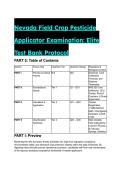
Nevada Field Crop Pesticide
Applicator Examination: Elite
Test Bank Protocol
PART 0: Table of Contents
Section Focus Area Cognitive Tier Question Range Regulatory &
Biological Context
PART I Preview & Critical N/A N/A Directives, Core
Axioms Calibration
Formulas, and
Statutory
Thresholds
PART II Foundational Tier 1 Q1 – Q10 NRS 555 Core
Syntax Definitions, CEU
Quotas, Record
Durations, & Direct
Supervision
PART II Simulation & Tier 2 Q11 – Q20 Trainee
Application Registration,
1/128th Method
Math, Chemigation
Hardware, & Drift
Limits
PART II Grandmaster Tier 3 Q21 – Q30 Multi-Variable
Synthesis Field Calibrations,
Inversion Physics,
& Fiduciary
Spillage Liabilities
PART I: Preview
Mastering this elite test bank directly translates into high-level regulatory compliance,
environmental safety, and advanced crop protection mastery within the state of Nevada. By
digesting these clinically precise operational scenarios, candidates shift from rote memorization
to the rigorous analytical competence demanded of master applicators.
,The "Critical Axioms" Cheat Sheet
● The Ground Calibration Equation: Nozzle flow rate is governed by the standard
agricultural engineering formula: where W represents nozzle spacing in inches (or
bandwidth), and 5940 is the constant mathematical conversion factor.
● The 1/128th Calibration Metric: To calibrate a boom sprayer using the 1/128th method,
determine the exact field travel distance using: Because there are 128 fluid ounces in 1
gallon and the test area represents 1/128th of an acre, the number of fluid ounces
collected from a single nozzle over this distance directly equals the application rate in
Gallons Per Acre (GPA).
● Reporting Windows: Unmixed pesticide spills exceeding 1 gallon of liquid or 4 pounds of
dry weight must be reported to the NDA by telephone within 24 hours. Apparent pesticide
poisonings requiring medical treatment must be reported within 48 hours.
● Drift Mitigation Wind Parameters: Under Nevada standards, ground pesticide
applications must be avoided if wind speeds exceed 10 mph, are below 2 mph (due to
stable air temperature inversion risk), or exceed 5 mph when blowing toward highly
sensitive adjacent downwind crops.
PART II: THE ELITE TEST BANK
Tier 1 (Questions 1–10) - Foundational Syntax & Application
Q1: Under Nevada Revised Statutes (NRS) 555.267, the statutory definition of a "pesticide" is
highly specific regarding chemical classes and biological agents. Which of the following
substances is EXCLUDED from the legal classification of a pesticide under Nevada law?
A) Plant growth regulators used to keep potted greenhouse ornamentals compact B)
Disinfectants and sanitizers used to sterilize plant containers and working surfaces in nurseries
C) Spray adjuvants, such as crop oil concentrates and non-ionic surfactants, added to tank
mixes D) Defoliants and desiccants applied to field crops to accelerate uniform harvest drying
● The Answer: C (Spray adjuvants, such as crop oil concentrates and non-ionic
surfactants, added to tank mixes)
● Distractor Analysis:
○ A is incorrect: Plant growth regulators are explicitly included in the statutory
definition of a pesticide under NRS 555.267.
○ B is incorrect: Disinfectants and sanitizers used in commercial agricultural settings
are legally classified as pesticides.
○ D is incorrect: Defoliants and desiccants are designated as pesticides under
Nevada law because they chemically alter crop foliage.
The Mentor's Analysis: Regulatory definitions dictate the boundaries of licensed enforcement.
When cataloging active chemical compounds, the immediate priority is distinguishing between
substances with direct biological pest-altering activity and auxiliary wetting agents. By utilizing
the precise statutory definitions under NRS 555.267, you bypass the regulatory trap of
misclassifying adjuvants. Professional/Academic Intuition: Plant regulators, defoliants,
desiccants, and agricultural disinfectants are legally pesticides; physical spray adjuvants are
not.
Double-space
Q2: A licensed custom pesticide applicator in Nevada is preparing for their annual business
, license renewal with the Nevada Department of Agriculture (NDA). To maintain their active
status, what are the precise annual continuing education unit (CEU) requirements that must be
met?
A) 8 CEUs total, with at least 2 units in laws and regulations and 2 units in safety. B) 6 CEUs
total, including at least 1 unit in laws and regulations and 1 unit in safe handling and dispensing.
C) 12 CEUs total, with at least 3 units in environmental fate and 3 units in application
technology. D) 10 CEUs total, with no specific category requirements as long as they are
NDA-approved.
● The Answer: B (6 CEUs total, including at least 1 unit in laws and regulations and 1 unit
in safe handling and dispensing.)
● Distractor Analysis:
○ A is incorrect: An 8 CEU requirement is a common standard in other state
jurisdictions or represents outdated models, but falls short of Nevada's active
annual custom requirements.
○ C is incorrect: A 12 CEU requirement applies to certified applicators renewing a
4-year certification, not the annual custom license.
○ D is incorrect: An unallocated 10 CEU block fails to fulfill the mandatory statutory
allocation for laws and safety units.
The Mentor's Analysis: Annual license maintenance is the bedrock of custom applicator
compliance. When planning continuing education, the immediate priority is securing core
competencies in regulatory mandates and human safety. By utilizing the 6 CEU annual structure
with its specific 1-unit laws and 1-unit safety allocations, you bypass the risk of administrative
license suspension on January 1st. Professional/Academic Intuition: Annual custom license
renewal requires 6 CEUs, consisting of a minimum of 1 Law and 1 Safety unit.
Double-space
Q3: A private certified applicator in Nevada uses restricted-use pesticides (RUPs) to produce
forage crops on their family ranch. What is the standard duration of this certification, and what
are the specific recertification requirements if they choose the CEU renewal option?
A) 1 year; they must earn 6 CEUs annually, including 1 unit in laws and regulations. B) 3 years;
they must earn 15 CEUs total, including 3 units in laws and regulations. C) 4 years; they must
earn 12 CEUs total, including at least 2 units in laws and regulations, during their valid
certification period. D) 5 years; they must earn 20 CEUs total, including at least 5 units in laws
and regulations.
● The Answer: C (4 years; they must earn 12 CEUs total, including at least 2 units in laws
and regulations, during their valid certification period.)
● Distractor Analysis:
○ A is incorrect: A 1-year cycle represents the custom business license timeline, not
the private applicator certification window.
○ B is incorrect: A 3-year cycle with 15 CEUs is a legacy or adjacent-state structure
that is invalid under Nevada law.
○ D is incorrect: A 5-year cycle with 20 CEUs represents the Pacific Northwest model
(e.g., Washington) and is not recognized in Nevada.
The Mentor's Analysis: Certification cycles for private applicators are designed to reflect
long-term competency. When tracking certification validity, the immediate priority is scheduling
CEUs within the 4-year statutory window. By utilizing the 12 total CEU track with 2 mandated
laws units, you bypass the requirement of re-taking the core written examinations.
Professional/Academic Intuition: Private pesticide certifications are valid for 4 years, requiring
12 CEUs (minimum 2 in Laws) to renew without examination.
Applicator Examination: Elite
Test Bank Protocol
PART 0: Table of Contents
Section Focus Area Cognitive Tier Question Range Regulatory &
Biological Context
PART I Preview & Critical N/A N/A Directives, Core
Axioms Calibration
Formulas, and
Statutory
Thresholds
PART II Foundational Tier 1 Q1 – Q10 NRS 555 Core
Syntax Definitions, CEU
Quotas, Record
Durations, & Direct
Supervision
PART II Simulation & Tier 2 Q11 – Q20 Trainee
Application Registration,
1/128th Method
Math, Chemigation
Hardware, & Drift
Limits
PART II Grandmaster Tier 3 Q21 – Q30 Multi-Variable
Synthesis Field Calibrations,
Inversion Physics,
& Fiduciary
Spillage Liabilities
PART I: Preview
Mastering this elite test bank directly translates into high-level regulatory compliance,
environmental safety, and advanced crop protection mastery within the state of Nevada. By
digesting these clinically precise operational scenarios, candidates shift from rote memorization
to the rigorous analytical competence demanded of master applicators.
,The "Critical Axioms" Cheat Sheet
● The Ground Calibration Equation: Nozzle flow rate is governed by the standard
agricultural engineering formula: where W represents nozzle spacing in inches (or
bandwidth), and 5940 is the constant mathematical conversion factor.
● The 1/128th Calibration Metric: To calibrate a boom sprayer using the 1/128th method,
determine the exact field travel distance using: Because there are 128 fluid ounces in 1
gallon and the test area represents 1/128th of an acre, the number of fluid ounces
collected from a single nozzle over this distance directly equals the application rate in
Gallons Per Acre (GPA).
● Reporting Windows: Unmixed pesticide spills exceeding 1 gallon of liquid or 4 pounds of
dry weight must be reported to the NDA by telephone within 24 hours. Apparent pesticide
poisonings requiring medical treatment must be reported within 48 hours.
● Drift Mitigation Wind Parameters: Under Nevada standards, ground pesticide
applications must be avoided if wind speeds exceed 10 mph, are below 2 mph (due to
stable air temperature inversion risk), or exceed 5 mph when blowing toward highly
sensitive adjacent downwind crops.
PART II: THE ELITE TEST BANK
Tier 1 (Questions 1–10) - Foundational Syntax & Application
Q1: Under Nevada Revised Statutes (NRS) 555.267, the statutory definition of a "pesticide" is
highly specific regarding chemical classes and biological agents. Which of the following
substances is EXCLUDED from the legal classification of a pesticide under Nevada law?
A) Plant growth regulators used to keep potted greenhouse ornamentals compact B)
Disinfectants and sanitizers used to sterilize plant containers and working surfaces in nurseries
C) Spray adjuvants, such as crop oil concentrates and non-ionic surfactants, added to tank
mixes D) Defoliants and desiccants applied to field crops to accelerate uniform harvest drying
● The Answer: C (Spray adjuvants, such as crop oil concentrates and non-ionic
surfactants, added to tank mixes)
● Distractor Analysis:
○ A is incorrect: Plant growth regulators are explicitly included in the statutory
definition of a pesticide under NRS 555.267.
○ B is incorrect: Disinfectants and sanitizers used in commercial agricultural settings
are legally classified as pesticides.
○ D is incorrect: Defoliants and desiccants are designated as pesticides under
Nevada law because they chemically alter crop foliage.
The Mentor's Analysis: Regulatory definitions dictate the boundaries of licensed enforcement.
When cataloging active chemical compounds, the immediate priority is distinguishing between
substances with direct biological pest-altering activity and auxiliary wetting agents. By utilizing
the precise statutory definitions under NRS 555.267, you bypass the regulatory trap of
misclassifying adjuvants. Professional/Academic Intuition: Plant regulators, defoliants,
desiccants, and agricultural disinfectants are legally pesticides; physical spray adjuvants are
not.
Double-space
Q2: A licensed custom pesticide applicator in Nevada is preparing for their annual business
, license renewal with the Nevada Department of Agriculture (NDA). To maintain their active
status, what are the precise annual continuing education unit (CEU) requirements that must be
met?
A) 8 CEUs total, with at least 2 units in laws and regulations and 2 units in safety. B) 6 CEUs
total, including at least 1 unit in laws and regulations and 1 unit in safe handling and dispensing.
C) 12 CEUs total, with at least 3 units in environmental fate and 3 units in application
technology. D) 10 CEUs total, with no specific category requirements as long as they are
NDA-approved.
● The Answer: B (6 CEUs total, including at least 1 unit in laws and regulations and 1 unit
in safe handling and dispensing.)
● Distractor Analysis:
○ A is incorrect: An 8 CEU requirement is a common standard in other state
jurisdictions or represents outdated models, but falls short of Nevada's active
annual custom requirements.
○ C is incorrect: A 12 CEU requirement applies to certified applicators renewing a
4-year certification, not the annual custom license.
○ D is incorrect: An unallocated 10 CEU block fails to fulfill the mandatory statutory
allocation for laws and safety units.
The Mentor's Analysis: Annual license maintenance is the bedrock of custom applicator
compliance. When planning continuing education, the immediate priority is securing core
competencies in regulatory mandates and human safety. By utilizing the 6 CEU annual structure
with its specific 1-unit laws and 1-unit safety allocations, you bypass the risk of administrative
license suspension on January 1st. Professional/Academic Intuition: Annual custom license
renewal requires 6 CEUs, consisting of a minimum of 1 Law and 1 Safety unit.
Double-space
Q3: A private certified applicator in Nevada uses restricted-use pesticides (RUPs) to produce
forage crops on their family ranch. What is the standard duration of this certification, and what
are the specific recertification requirements if they choose the CEU renewal option?
A) 1 year; they must earn 6 CEUs annually, including 1 unit in laws and regulations. B) 3 years;
they must earn 15 CEUs total, including 3 units in laws and regulations. C) 4 years; they must
earn 12 CEUs total, including at least 2 units in laws and regulations, during their valid
certification period. D) 5 years; they must earn 20 CEUs total, including at least 5 units in laws
and regulations.
● The Answer: C (4 years; they must earn 12 CEUs total, including at least 2 units in laws
and regulations, during their valid certification period.)
● Distractor Analysis:
○ A is incorrect: A 1-year cycle represents the custom business license timeline, not
the private applicator certification window.
○ B is incorrect: A 3-year cycle with 15 CEUs is a legacy or adjacent-state structure
that is invalid under Nevada law.
○ D is incorrect: A 5-year cycle with 20 CEUs represents the Pacific Northwest model
(e.g., Washington) and is not recognized in Nevada.
The Mentor's Analysis: Certification cycles for private applicators are designed to reflect
long-term competency. When tracking certification validity, the immediate priority is scheduling
CEUs within the 4-year statutory window. By utilizing the 12 total CEU track with 2 mandated
laws units, you bypass the requirement of re-taking the core written examinations.
Professional/Academic Intuition: Private pesticide certifications are valid for 4 years, requiring
12 CEUs (minimum 2 in Laws) to renew without examination.


