
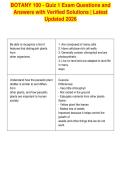
BOTANY 100 - Quiz 1 Exam Questions and
Answers with Verified Solutions | Latest
Updated 2026
Be able to recognize a list of 1. Are composed of many cells
features that distinguish plants 2. Have cellulose-rich cell walls
from 3. Generally contain chlorophyll and are
other organisms. photosynthetic
4. Live on land and are adapted to land life
in many
ways
Understand how the parasitic plant Cuscuta
dodder is similar to and differs Differences:
from - Very little chlorophyll
other plants, and how parasitic - Not rooted in the ground
plants are important to human - Eats/gets nutrients from other plants
society. Same:
- Yellow plant like leaves
- Makes lots of seeds
Important because it helps control the
growth of
weeds and other things that we do not
want.
, Be able to recognize features that Fungi:
distinguish plants from fungi, and - One-celled or masses of filaments
features that distinguish plants - No photosynthetic material
from Algae:
their close protist relatives, the - Single cells or multicelled, microscopic
green sometimes
algae. - Photosythentic pigments
Be able to recognize 5 major - Bryophytes
groups - Lycophytes
of plants by informal name and - Pteridophytes
appearance in photographs, and - Gymnosperms
be - Angiosperms
able to match each group with
importance to humans.
Angiosperms - Some are Woody trees vines or shrubs,
some are
herbs
- Reproduce w flowers, seeds and eggs
- Grow in many habitats, animal foods
- Source of food, medicine, and beverages
and
building materials for humans
Pteridophytes - Some are tree sized
- Ferns
- True stems, roots, leaves with branching
vein
- Spores to reproduce
- Formed coal deposits
- Ground cover
- Ornamentals
Answers with Verified Solutions | Latest
Updated 2026
Be able to recognize a list of 1. Are composed of many cells
features that distinguish plants 2. Have cellulose-rich cell walls
from 3. Generally contain chlorophyll and are
other organisms. photosynthetic
4. Live on land and are adapted to land life
in many
ways
Understand how the parasitic plant Cuscuta
dodder is similar to and differs Differences:
from - Very little chlorophyll
other plants, and how parasitic - Not rooted in the ground
plants are important to human - Eats/gets nutrients from other plants
society. Same:
- Yellow plant like leaves
- Makes lots of seeds
Important because it helps control the
growth of
weeds and other things that we do not
want.
, Be able to recognize features that Fungi:
distinguish plants from fungi, and - One-celled or masses of filaments
features that distinguish plants - No photosynthetic material
from Algae:
their close protist relatives, the - Single cells or multicelled, microscopic
green sometimes
algae. - Photosythentic pigments
Be able to recognize 5 major - Bryophytes
groups - Lycophytes
of plants by informal name and - Pteridophytes
appearance in photographs, and - Gymnosperms
be - Angiosperms
able to match each group with
importance to humans.
Angiosperms - Some are Woody trees vines or shrubs,
some are
herbs
- Reproduce w flowers, seeds and eggs
- Grow in many habitats, animal foods
- Source of food, medicine, and beverages
and
building materials for humans
Pteridophytes - Some are tree sized
- Ferns
- True stems, roots, leaves with branching
vein
- Spores to reproduce
- Formed coal deposits
- Ground cover
- Ornamentals


