

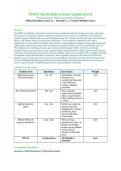
PHYS 165 Module 9 Exam (2026/2027)
Portage Learning - Physics: 25-Question Actual Exam
Official Question Count: 25 | Domains: 4 | Format: Multiple Choice
Abstract
This PHYS 165 Module 9 (2026/2027) actual exam, developed under the Portage Learning university-
level physics curriculum, evaluates advanced competency across four core domains of classical and
modern physics: Fluid Mechanics and Thermodynamics, Wave Motion and Sound, Light and Geometric
Optics, and Modern Physics and Quantum Mechanics. The assessment emphasizes the critical
application of mathematical principles, physical laws, and analytical problem-solving skills required to
understand complex phenomena such as buoyancy and Bernoulli flow, the First and Second Laws of
Thermodynamics, mechanical wave superposition and the Doppler effect, refraction and image
formation by mirrors and lenses, wave-particle duality, the photoelectric effect, atomic spectra, special
relativity, and radioactive decay. Each of the 25 multiple-choice items is paired with a detailed rationale,
an analysis of why each distractor is incorrect, and a specific reference to the 2026/2027 PHYS 165
Module 9 course material and to canonical university physics textbooks. The document is structured to
mirror established scientific standards for assessment design, ensuring that learners can trace every
correct response back to verifiable physical law and quantitative reasoning.
Content Area Overview
Content Area Questions Key Topics Weight
Fluid Mechanics & Q1 - Q7 Archimedes' principle, 25%
Thermodynamics ideal gas laws,
continuity & Bernoulli,
Carnot efficiency,
entropy, adiabatic
processes
Wave Motion & Sound Q8 - Q13 Wave equation, 25%
superposition, Doppler
effect, sound intensity
(dB), standing waves on
a string
Light & Geometric Q14 - Q19 Snell's Law, spherical 25%
Optics mirrors, thin-lens
magnification, Young's
double-slit, total
internal reflection,
critical angle
Modern Physics & Q20 - Q25 Photon energy, 25%
Quantum Mechanics photoelectric effect, de
Broglie wavelength,
atomic spectra (Balmer
series), special
relativity, radioactive
decay
TOTAL 25 Questions All Module 9 100%
domains
Examination Questions
Domain: Fluid Mechanics & Thermodynamics
, Q1. A solid steel ball (density 7,850 kg/m^3) is released into a deep container of mercury
(density 13,534 kg/m^3). Which outcome correctly describes the equilibrium state of the
ball?
A) The ball sinks immediately to the bottom of the container.
B) The ball floats with the majority of its volume submerged below the mercury surface.
C) The ball floats with only a very small fraction of its volume submerged.
D) The ball dissolves completely into the mercury.
Correct Answer: B) The ball floats with the majority of its volume submerged below the
mercury surface.
Rationale: Because the density of steel (7,850 kg/m^3) is less than the density of mercury (13,534
kg/m^3), Archimedes' principle guarantees that the ball floats. The submerged volume fraction equals
the density ratio rho_object/rho_fluid = 7850/13534 ~ 0.58, meaning roughly 58% of the ball sits below
the surface and 42% remains above. The ball therefore floats with the majority of its volume submerged,
eliminating any answer that implies sinking or dissolution.
Why Wrong:
A) Incorrect because mercury is denser than steel, so the buoyant force exceeds the weight of the ball
and prevents sinking.
C) Incorrect because only a very small submerged fraction would require the object density to be far
below the fluid density, which is not the case here.
D) Incorrect because steel and mercury are chemically non-reactive under ordinary conditions;
dissolution is not a buoyancy outcome.
Reference: PHYS 165 Module 9 (2026/2027), Unit 9.1 Fluid Statics; Halliday, Resnick & Walker,
Fundamentals of Physics, Ch. 14 - Fluids, Sec. 14-4 Archimedes' Principle.
Q2. An ideal gas undergoes a quasi-static isothermal expansion at a constant temperature
of 300 K. If the volume of the gas doubles during this process, what happens to the
pressure?
A) The pressure doubles.
B) The pressure is reduced to one-half of its original value.
C) The pressure remains unchanged.
D) The pressure quadruples.
Correct Answer: B) The pressure is reduced to one-half of its original value.
Rationale: For an ideal gas at constant temperature, Boyle's Law applies: PV = nRT = constant. If V
increases by a factor of two, P must decrease by the same factor so that the product PV stays fixed.
Therefore the final pressure equals one-half of the initial pressure. The internal energy of an ideal gas
depends only on temperature, so during an isothermal process there is no change in internal energy; all
heat added is converted into the work done by the gas during expansion.
Why Wrong:
A) Incorrect because pressure and volume are inversely related for an isothermal ideal gas; doubling
volume cannot double pressure.
C) Incorrect because pressure must change to maintain the constant PV product when volume changes.
D) Incorrect because quadrupling would require volume to be quartered, not doubled, under Boyle's
Law.
Reference: PHYS 165 Module 9 (2026/2027), Unit 9.2 Ideal Gas Laws; Young & Freedman, University
Physics, Ch. 18 - Thermal Properties of Matter, Sec. 18.2 Ideal-Gas Equation.
Q3. Incompressible water flows steadily through a horizontal pipe that narrows from a
radius of 4.0 cm to a radius of 2.0 cm. If the flow speed in the wide section is 2.0 m/s, what
is the flow speed in the narrow section?
A) 0.5 m/s
B) 2.0 m/s
C) 4.0 m/s
D) 8.0 m/s
Correct Answer: D) 8.0 m/s
Rationale: The equation of continuity for an incompressible fluid states A1*v1 = A2*v2. Cross-sectional
area scales as the square of the radius, so A1/A2 = (r1/r2)^2 = (4/2)^2 = 4. Therefore v2 = v1 * (A1/A2)
Portage Learning - Physics: 25-Question Actual Exam
Official Question Count: 25 | Domains: 4 | Format: Multiple Choice
Abstract
This PHYS 165 Module 9 (2026/2027) actual exam, developed under the Portage Learning university-
level physics curriculum, evaluates advanced competency across four core domains of classical and
modern physics: Fluid Mechanics and Thermodynamics, Wave Motion and Sound, Light and Geometric
Optics, and Modern Physics and Quantum Mechanics. The assessment emphasizes the critical
application of mathematical principles, physical laws, and analytical problem-solving skills required to
understand complex phenomena such as buoyancy and Bernoulli flow, the First and Second Laws of
Thermodynamics, mechanical wave superposition and the Doppler effect, refraction and image
formation by mirrors and lenses, wave-particle duality, the photoelectric effect, atomic spectra, special
relativity, and radioactive decay. Each of the 25 multiple-choice items is paired with a detailed rationale,
an analysis of why each distractor is incorrect, and a specific reference to the 2026/2027 PHYS 165
Module 9 course material and to canonical university physics textbooks. The document is structured to
mirror established scientific standards for assessment design, ensuring that learners can trace every
correct response back to verifiable physical law and quantitative reasoning.
Content Area Overview
Content Area Questions Key Topics Weight
Fluid Mechanics & Q1 - Q7 Archimedes' principle, 25%
Thermodynamics ideal gas laws,
continuity & Bernoulli,
Carnot efficiency,
entropy, adiabatic
processes
Wave Motion & Sound Q8 - Q13 Wave equation, 25%
superposition, Doppler
effect, sound intensity
(dB), standing waves on
a string
Light & Geometric Q14 - Q19 Snell's Law, spherical 25%
Optics mirrors, thin-lens
magnification, Young's
double-slit, total
internal reflection,
critical angle
Modern Physics & Q20 - Q25 Photon energy, 25%
Quantum Mechanics photoelectric effect, de
Broglie wavelength,
atomic spectra (Balmer
series), special
relativity, radioactive
decay
TOTAL 25 Questions All Module 9 100%
domains
Examination Questions
Domain: Fluid Mechanics & Thermodynamics
, Q1. A solid steel ball (density 7,850 kg/m^3) is released into a deep container of mercury
(density 13,534 kg/m^3). Which outcome correctly describes the equilibrium state of the
ball?
A) The ball sinks immediately to the bottom of the container.
B) The ball floats with the majority of its volume submerged below the mercury surface.
C) The ball floats with only a very small fraction of its volume submerged.
D) The ball dissolves completely into the mercury.
Correct Answer: B) The ball floats with the majority of its volume submerged below the
mercury surface.
Rationale: Because the density of steel (7,850 kg/m^3) is less than the density of mercury (13,534
kg/m^3), Archimedes' principle guarantees that the ball floats. The submerged volume fraction equals
the density ratio rho_object/rho_fluid = 7850/13534 ~ 0.58, meaning roughly 58% of the ball sits below
the surface and 42% remains above. The ball therefore floats with the majority of its volume submerged,
eliminating any answer that implies sinking or dissolution.
Why Wrong:
A) Incorrect because mercury is denser than steel, so the buoyant force exceeds the weight of the ball
and prevents sinking.
C) Incorrect because only a very small submerged fraction would require the object density to be far
below the fluid density, which is not the case here.
D) Incorrect because steel and mercury are chemically non-reactive under ordinary conditions;
dissolution is not a buoyancy outcome.
Reference: PHYS 165 Module 9 (2026/2027), Unit 9.1 Fluid Statics; Halliday, Resnick & Walker,
Fundamentals of Physics, Ch. 14 - Fluids, Sec. 14-4 Archimedes' Principle.
Q2. An ideal gas undergoes a quasi-static isothermal expansion at a constant temperature
of 300 K. If the volume of the gas doubles during this process, what happens to the
pressure?
A) The pressure doubles.
B) The pressure is reduced to one-half of its original value.
C) The pressure remains unchanged.
D) The pressure quadruples.
Correct Answer: B) The pressure is reduced to one-half of its original value.
Rationale: For an ideal gas at constant temperature, Boyle's Law applies: PV = nRT = constant. If V
increases by a factor of two, P must decrease by the same factor so that the product PV stays fixed.
Therefore the final pressure equals one-half of the initial pressure. The internal energy of an ideal gas
depends only on temperature, so during an isothermal process there is no change in internal energy; all
heat added is converted into the work done by the gas during expansion.
Why Wrong:
A) Incorrect because pressure and volume are inversely related for an isothermal ideal gas; doubling
volume cannot double pressure.
C) Incorrect because pressure must change to maintain the constant PV product when volume changes.
D) Incorrect because quadrupling would require volume to be quartered, not doubled, under Boyle's
Law.
Reference: PHYS 165 Module 9 (2026/2027), Unit 9.2 Ideal Gas Laws; Young & Freedman, University
Physics, Ch. 18 - Thermal Properties of Matter, Sec. 18.2 Ideal-Gas Equation.
Q3. Incompressible water flows steadily through a horizontal pipe that narrows from a
radius of 4.0 cm to a radius of 2.0 cm. If the flow speed in the wide section is 2.0 m/s, what
is the flow speed in the narrow section?
A) 0.5 m/s
B) 2.0 m/s
C) 4.0 m/s
D) 8.0 m/s
Correct Answer: D) 8.0 m/s
Rationale: The equation of continuity for an incompressible fluid states A1*v1 = A2*v2. Cross-sectional
area scales as the square of the radius, so A1/A2 = (r1/r2)^2 = (4/2)^2 = 4. Therefore v2 = v1 * (A1/A2)


