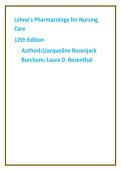
Lehne's Pharmacology for Nursing
Care
12th Edition
• Author(s)Jacqueline Rosenjack
Burchum; Laura D. Rosenthal
,TEST BANK
Question 1 (MCQ)
Clinical Scenario
A newly licensed nurse is reviewing pharmacology concepts
before administering medications on a medical-surgical unit.
During orientation, the nurse asks about the meaning of "drug
selectivity."
Question Stem
Which statement by the nurse demonstrates the best
understanding of drug selectivity?
Answer Options
A. A selective drug produces only therapeutic effects without
adverse effects.
B. A selective drug acts primarily on specific receptors or tissues
while still potentially affecting other sites.
C. A selective drug works equally well in every patient
regardless of genetics.
D. A selective drug permanently binds to receptors, producing
lifelong effects.
,Correct Answer
B
Detailed Rationale
Drug selectivity refers to a medication's tendency to act
primarily on specific cells, receptors, or organs at therapeutic
doses. Although highly selective drugs preferentially affect their
intended targets, no medication is completely selective. As the
dose increases or patient variability exists, drugs may interact
with unintended receptors, producing adverse effects.
Understanding selectivity helps nurses anticipate therapeutic
benefits while monitoring for predictable side effects and
toxicity.
Incorrect Option Analysis
A. Incorrect
Why Incorrect
No medication produces therapeutic effects without any
possibility of adverse effects.
Common Misconception
, Selective equals completely safe.
Medication Safety Risk
Failure to monitor for adverse reactions.
Appropriate Nursing Consideration
Continue routine assessment even for highly selective
medications.
C. Incorrect
Why Incorrect
Drug responses vary because of genetics, age, disease, and
concurrent medications.
Common Misconception
All patients respond identically.
Medication Safety Risk
Ignoring individualized dosing.
Appropriate Nursing Consideration
Assess patient-specific factors before administration.
D. Incorrect
Why Incorrect
Care
12th Edition
• Author(s)Jacqueline Rosenjack
Burchum; Laura D. Rosenthal
,TEST BANK
Question 1 (MCQ)
Clinical Scenario
A newly licensed nurse is reviewing pharmacology concepts
before administering medications on a medical-surgical unit.
During orientation, the nurse asks about the meaning of "drug
selectivity."
Question Stem
Which statement by the nurse demonstrates the best
understanding of drug selectivity?
Answer Options
A. A selective drug produces only therapeutic effects without
adverse effects.
B. A selective drug acts primarily on specific receptors or tissues
while still potentially affecting other sites.
C. A selective drug works equally well in every patient
regardless of genetics.
D. A selective drug permanently binds to receptors, producing
lifelong effects.
,Correct Answer
B
Detailed Rationale
Drug selectivity refers to a medication's tendency to act
primarily on specific cells, receptors, or organs at therapeutic
doses. Although highly selective drugs preferentially affect their
intended targets, no medication is completely selective. As the
dose increases or patient variability exists, drugs may interact
with unintended receptors, producing adverse effects.
Understanding selectivity helps nurses anticipate therapeutic
benefits while monitoring for predictable side effects and
toxicity.
Incorrect Option Analysis
A. Incorrect
Why Incorrect
No medication produces therapeutic effects without any
possibility of adverse effects.
Common Misconception
, Selective equals completely safe.
Medication Safety Risk
Failure to monitor for adverse reactions.
Appropriate Nursing Consideration
Continue routine assessment even for highly selective
medications.
C. Incorrect
Why Incorrect
Drug responses vary because of genetics, age, disease, and
concurrent medications.
Common Misconception
All patients respond identically.
Medication Safety Risk
Ignoring individualized dosing.
Appropriate Nursing Consideration
Assess patient-specific factors before administration.
D. Incorrect
Why Incorrect