

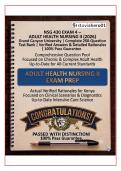
,NSG 430 EXAM 4 – ADULT HEALTH NURSING II (2026)
Grand Canyon University | Complete 250-Question Test
Bank | Verified Answers & Detailed Rationales | 100%
Pass Guarantee
SECTION 1: SHOCK SYNDROMES & HEMODYNAMICS
(Questions 1–65)
1. Which data collected by the nurse caring for a patient
who has cardiogenic shock indicate that the patient may
be developing multiple organ dysfunction syndrome
(MODS)?
A) The patient's serum creatinine level is elevated
B) The patient reports intermittent chest pressure
C) The patient's extremities are cool and pulses are weak
D) The patient has bilateral crackles throughout lung fields
Answer: A) The patient's serum creatinine level is elevated
Rationale: MODS reflects failure of two or more organ
systems. In cardiogenic shock, a rising creatinine suggests
,renal hypoperfusion and acute kidney injury, indicating
progression toward MODS. Cool extremities (C) or crackles
(D) are expected in shock/heart failure but do not alone
confirm additional organ failure. Chest pressure (B) is a
symptom of the underlying cardiac issue.
2. A patient with septic shock has a mean arterial pressure
(MAP) of 52 mm Hg despite adequate fluid resuscitation.
Which medication does the nurse anticipate
administering?
A) Dobutamine
B) Norepinephrine
C) Nitroglycerin
D) Furosemide
Answer: B) Norepinephrine
Rationale: Norepinephrine is the first-line vasopressor for
septic shock (Surviving Sepsis Campaign) when MAP
remains <65 mmHg after fluid resuscitation. Dobutamine
(A) is an inotrope used for cardiogenic shock with low
cardiac output. Nitroglycerin (C) is a vasodilator.
Furosemide (D) is a diuretic.
, 3. A patient is admitted with hypovolemic shock. Which
k k k k k k k k
assessment finding is most consistent with this condition?
k k k k k k k k
A) Elevated central venous pressure (CVP)
k k k k k
B) Bounding peripheral pulses
k k k
C) Flat neck veins and hypotension
k k k k k
D) Crackles in the lung bases
k k k k k
Answer: C) Flat neck veins and hypotension
k k k k k k
Rationale: Hypovolemic shock is characterized by decreased
k k k k k k
intravascular volume, leading to flat neck veins (low CVP),
k k k k k k k k k
hypotension, tachycardia, and weak peripheral pulses.
k k k k k k
Elevated CVP (A) and crackles (D) indicate fluid overload or
k k k k k k k k k k
cardiogenic shock. Bounding pulses (B) suggest distributive
k k k k k k k
shock.
k
4. A patient with anaphylactic shock has stridor and diffuse
k k k k k k k k k
urticaria. Which action is the priority?
k k k k k k
A) Diphenhydramine IV
k k
B) Methylprednisolone IV
k k
C) Albuterol nebulizer
k k
D) Epinephrine IM
k k
Answer: D) Epinephrine IM
k k k
Rationale: Epinephrine IM is first-line for anaphylaxis to
k k k k k k k
reverse vasodilation, bronchoconstriction, and upper airway
k k k k k k
Grand Canyon University | Complete 250-Question Test
Bank | Verified Answers & Detailed Rationales | 100%
Pass Guarantee
SECTION 1: SHOCK SYNDROMES & HEMODYNAMICS
(Questions 1–65)
1. Which data collected by the nurse caring for a patient
who has cardiogenic shock indicate that the patient may
be developing multiple organ dysfunction syndrome
(MODS)?
A) The patient's serum creatinine level is elevated
B) The patient reports intermittent chest pressure
C) The patient's extremities are cool and pulses are weak
D) The patient has bilateral crackles throughout lung fields
Answer: A) The patient's serum creatinine level is elevated
Rationale: MODS reflects failure of two or more organ
systems. In cardiogenic shock, a rising creatinine suggests
,renal hypoperfusion and acute kidney injury, indicating
progression toward MODS. Cool extremities (C) or crackles
(D) are expected in shock/heart failure but do not alone
confirm additional organ failure. Chest pressure (B) is a
symptom of the underlying cardiac issue.
2. A patient with septic shock has a mean arterial pressure
(MAP) of 52 mm Hg despite adequate fluid resuscitation.
Which medication does the nurse anticipate
administering?
A) Dobutamine
B) Norepinephrine
C) Nitroglycerin
D) Furosemide
Answer: B) Norepinephrine
Rationale: Norepinephrine is the first-line vasopressor for
septic shock (Surviving Sepsis Campaign) when MAP
remains <65 mmHg after fluid resuscitation. Dobutamine
(A) is an inotrope used for cardiogenic shock with low
cardiac output. Nitroglycerin (C) is a vasodilator.
Furosemide (D) is a diuretic.
, 3. A patient is admitted with hypovolemic shock. Which
k k k k k k k k
assessment finding is most consistent with this condition?
k k k k k k k k
A) Elevated central venous pressure (CVP)
k k k k k
B) Bounding peripheral pulses
k k k
C) Flat neck veins and hypotension
k k k k k
D) Crackles in the lung bases
k k k k k
Answer: C) Flat neck veins and hypotension
k k k k k k
Rationale: Hypovolemic shock is characterized by decreased
k k k k k k
intravascular volume, leading to flat neck veins (low CVP),
k k k k k k k k k
hypotension, tachycardia, and weak peripheral pulses.
k k k k k k
Elevated CVP (A) and crackles (D) indicate fluid overload or
k k k k k k k k k k
cardiogenic shock. Bounding pulses (B) suggest distributive
k k k k k k k
shock.
k
4. A patient with anaphylactic shock has stridor and diffuse
k k k k k k k k k
urticaria. Which action is the priority?
k k k k k k
A) Diphenhydramine IV
k k
B) Methylprednisolone IV
k k
C) Albuterol nebulizer
k k
D) Epinephrine IM
k k
Answer: D) Epinephrine IM
k k k
Rationale: Epinephrine IM is first-line for anaphylaxis to
k k k k k k k
reverse vasodilation, bronchoconstriction, and upper airway
k k k k k k


