
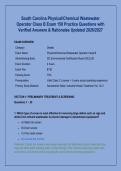
South Carolina Physical/Chemical Wastewater
Operator Class B Exam 150 Practice Questions with
Verified Answers & Rationales Updated 2026/2027
EXAM OVERVIEW
Category Details
Exam Name Physical/Chemical Wastewater Operator Class B
Administering Body SC Environmental Certification Board (SCLLR)
Exam Duration 4 hours
Exam Fee $136
Passing Score 70%
Prerequisites Valid Class C License + 3 years actual operating experience
Primary Study Material Sacramento State: Industrial Waste Treatment Vol. I & II
SECTION 1: PRELIMINARY TREATMENT & SCREENING
Questions 1 – 20
1. Which type of screen is most effective for removing large debris such as rags and
sticks from influent wastewater to prevent damage to downstream equipment?
A) Static bar screen
B) Drum screen
C) Fine mesh screen
D) Coarse bar screen
Rationale: Coarse bar screens have larger openings that effectively capture large items like
rags and sticks while allowing water to pass through. Fine screens would clog rapidly with
such debris, and drum screens are typically used for finer screening applications .
,2. In a horizontal-flow grit chamber, what is the primary mechanism responsible for
the removal of grit particles from wastewater?
A) Aeration-induced flotation
B) Settling under low velocity
C) Centrifugal force
D) Magnetic separation
Rationale: Horizontal-flow grit chambers maintain low hydraulic velocities that allow heavy
grit particles to settle by gravity while lighter organic particles remain in suspension and
continue downstream .
3. Which grit chamber design provides the highest grit removal efficiency for fine
sand particles?
A) Horizontal-flow chamber
B) Aerated vortex chamber
C) Conventional vortex chamber
D) Detritus-removal basin
Rationale: Aerated vortex chambers create a controlled swirling flow pattern that enhances
the settling of fine grit particles through increased residence time and reduced turbulence.
The aeration helps maintain organic materials in suspension while allowing denser grit
particles to settle .
4. What is the primary purpose of using a grit cyclone in wastewater treatment
operations?
A) Increase organic loading on the grit belt
B) Separate organic matter from inorganic grit
C) Reduce the moisture content of collected grit
D) Convert grit to a usable mineral product
,Rationale: Grit cyclones use centrifugal action to dewater collected grit, significantly
lowering its moisture content and reducing the weight and volume for disposal. This
mechanical dewatering process makes grit handling and disposal more economical .
5. How does a lamella plate clarifier differ from a conventional clarifier in its design
and operation?
A) Using a rotating drum for sludge removal
B) Providing multiple inclined plates to increase surface area
C) Operating at higher temperature
D) Employing chemical flocculants within the tank
Rationale: Lamella plate clarifiers incorporate multiple inclined plates that dramatically
increase the effective settling surface area within a compact footprint. This design allows for
higher hydraulic loading rates and more efficient solids separation compared to
conventional clarifiers .
6. A wastewater treatment plant is experiencing high levels of colloidal particles that
are not settling effectively in the clarifier. Which chemical addition would be most
appropriate to neutralize the negative surface charges on these particles and
promote aggregation?
A) Sodium hydroxide
B) Alum (aluminum sulfate)
C) Sodium hypochlorite
D) Sulfuric acid
Rationale: Alum hydrolyzes in water to form positively charged aluminum hydroxide species
that neutralize the negative charges on colloidal particles, reducing the zeta potential and
allowing particles to come together. This coagulation process is essential for removing fine
suspended solids .
7. During jar testing to determine optimal coagulant dosage, what does the "dose-
response curve" primarily indicate to the operator?
, A) The optimal pH for coagulation
B) The chemical cost per million gallons treated
C) The dosage that yields the highest turbidity removal with minimal chemical
use
D) The required pipe diameter for chemical feed
Rationale: The dose-response curve plots turbidity removal against coagulant dose, helping
operators identify the most efficient dosage that provides maximum solids removal while
minimizing chemical consumption and operational costs .
8. What is the typical recommended velocity gradient (G-value) range for rapid mixing
in coagulation processes to effectively destabilize fine colloidal particles?
A) 10–20 s⁻¹
B) 30–50 s⁻¹
C) 60–80 s⁻¹
D) 90–110 s⁻¹
Rationale: A G-value of 30–50 s⁻¹ provides sufficient turbulence to disperse coagulants and
promote particle collisions without creating excessive shear that would break apart newly
formed aggregates. This optimal mixing intensity ensures effective destabilization of
colloids .
9. During the flocculation process, what is the optimal hydraulic residence time (HRT)
that allows floc particles to grow to sufficient size while minimizing shear forces that
could cause floc breakage?
A) 30–60 seconds
B) 2–5 minutes
C) 10–15 minutes
D) 30–45 minutes
Operator Class B Exam 150 Practice Questions with
Verified Answers & Rationales Updated 2026/2027
EXAM OVERVIEW
Category Details
Exam Name Physical/Chemical Wastewater Operator Class B
Administering Body SC Environmental Certification Board (SCLLR)
Exam Duration 4 hours
Exam Fee $136
Passing Score 70%
Prerequisites Valid Class C License + 3 years actual operating experience
Primary Study Material Sacramento State: Industrial Waste Treatment Vol. I & II
SECTION 1: PRELIMINARY TREATMENT & SCREENING
Questions 1 – 20
1. Which type of screen is most effective for removing large debris such as rags and
sticks from influent wastewater to prevent damage to downstream equipment?
A) Static bar screen
B) Drum screen
C) Fine mesh screen
D) Coarse bar screen
Rationale: Coarse bar screens have larger openings that effectively capture large items like
rags and sticks while allowing water to pass through. Fine screens would clog rapidly with
such debris, and drum screens are typically used for finer screening applications .
,2. In a horizontal-flow grit chamber, what is the primary mechanism responsible for
the removal of grit particles from wastewater?
A) Aeration-induced flotation
B) Settling under low velocity
C) Centrifugal force
D) Magnetic separation
Rationale: Horizontal-flow grit chambers maintain low hydraulic velocities that allow heavy
grit particles to settle by gravity while lighter organic particles remain in suspension and
continue downstream .
3. Which grit chamber design provides the highest grit removal efficiency for fine
sand particles?
A) Horizontal-flow chamber
B) Aerated vortex chamber
C) Conventional vortex chamber
D) Detritus-removal basin
Rationale: Aerated vortex chambers create a controlled swirling flow pattern that enhances
the settling of fine grit particles through increased residence time and reduced turbulence.
The aeration helps maintain organic materials in suspension while allowing denser grit
particles to settle .
4. What is the primary purpose of using a grit cyclone in wastewater treatment
operations?
A) Increase organic loading on the grit belt
B) Separate organic matter from inorganic grit
C) Reduce the moisture content of collected grit
D) Convert grit to a usable mineral product
,Rationale: Grit cyclones use centrifugal action to dewater collected grit, significantly
lowering its moisture content and reducing the weight and volume for disposal. This
mechanical dewatering process makes grit handling and disposal more economical .
5. How does a lamella plate clarifier differ from a conventional clarifier in its design
and operation?
A) Using a rotating drum for sludge removal
B) Providing multiple inclined plates to increase surface area
C) Operating at higher temperature
D) Employing chemical flocculants within the tank
Rationale: Lamella plate clarifiers incorporate multiple inclined plates that dramatically
increase the effective settling surface area within a compact footprint. This design allows for
higher hydraulic loading rates and more efficient solids separation compared to
conventional clarifiers .
6. A wastewater treatment plant is experiencing high levels of colloidal particles that
are not settling effectively in the clarifier. Which chemical addition would be most
appropriate to neutralize the negative surface charges on these particles and
promote aggregation?
A) Sodium hydroxide
B) Alum (aluminum sulfate)
C) Sodium hypochlorite
D) Sulfuric acid
Rationale: Alum hydrolyzes in water to form positively charged aluminum hydroxide species
that neutralize the negative charges on colloidal particles, reducing the zeta potential and
allowing particles to come together. This coagulation process is essential for removing fine
suspended solids .
7. During jar testing to determine optimal coagulant dosage, what does the "dose-
response curve" primarily indicate to the operator?
, A) The optimal pH for coagulation
B) The chemical cost per million gallons treated
C) The dosage that yields the highest turbidity removal with minimal chemical
use
D) The required pipe diameter for chemical feed
Rationale: The dose-response curve plots turbidity removal against coagulant dose, helping
operators identify the most efficient dosage that provides maximum solids removal while
minimizing chemical consumption and operational costs .
8. What is the typical recommended velocity gradient (G-value) range for rapid mixing
in coagulation processes to effectively destabilize fine colloidal particles?
A) 10–20 s⁻¹
B) 30–50 s⁻¹
C) 60–80 s⁻¹
D) 90–110 s⁻¹
Rationale: A G-value of 30–50 s⁻¹ provides sufficient turbulence to disperse coagulants and
promote particle collisions without creating excessive shear that would break apart newly
formed aggregates. This optimal mixing intensity ensures effective destabilization of
colloids .
9. During the flocculation process, what is the optimal hydraulic residence time (HRT)
that allows floc particles to grow to sufficient size while minimizing shear forces that
could cause floc breakage?
A) 30–60 seconds
B) 2–5 minutes
C) 10–15 minutes
D) 30–45 minutes


