
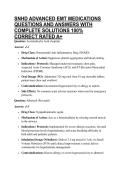
SNHD ADVANCED EMT MEDICATIONS
QUESTIONS AND ANSWERS WITH
COMPLETE SOLUTIONS 100%
CORRECT RATED A+
Question: Acetylsalicylic Acid (Aspirin)
Answer: ✔✔
Drug Class: Nonsteroidal Anti-inflammatory Drug (NSAID)
Mechanism of Action: Suppresses platelet aggregation and blood clotting.
Indications / Protocols: Managed under non-traumatic chest pain,
suspected Acute Coronary Syndrome (ACS), and ST-Elevation Myocardial
Infarction (STEMI).
Oral Dosage (PO): Administer 324 mg total (four 81 mg chewable tablets;
patient must chew and swallow).
Contraindications: Documented hypersensitivity or allergy to aspirin.
Side Effects: No common acute adverse reactions when used for emergency
protocols.
Question: Albuterol (Proventil)
Answer: ✔✔
Drug Class: Sympathomimetic agent.
Mechanism of Action: Acts as a bronchodilator by relaxing smooth muscle
in the airways.
Indications / Protocols: Implemented for severe allergic reactions, elevated
blood potassium levels (hyperkalemia), and acute breathing difficulty in
both adult and pediatric patients.
Inhalation Dosage (Nebulizer): Deliver 2.5 mg mixed in 3 mL via Small
Volume Nebulizer (SVN) until clinical improvement is noted; deliver
continuously for hyperkalemia management.
Contraindications: Known allergy or severe hypersensitivity to albuterol.
, Side Effects: Elevated heart rate (tachycardia), heart palpitations, nervous
anxiety, and headaches.
Question: Bronchodilator Metered Dose Inhaler (MDI)
Answer: ✔✔
Drug Class: Sympathomimetic agent.
Mechanism of Action: Dilates and opens narrow respiratory passages.
Indications & Dosing: Assist the patient in self-administering their
personal, prescribed metered-dose inhaler according to their exact
prescription parameters.
Contraindications: Known history of severe adverse reactions or drug
sensitivity.
Side Effects: Tremors or anxiety, racing heart rate, noticeable palpitations,
and head pain.
Question: Diphenhydramine Hydrochloride (Benadryl)
Answer: ✔✔
Drug Class: Antihistamine.
Mechanism of Action: Competitively blocks histamine receptors, exerts
drying effects (anticholinergic), and causes central nervous system
depression (sedation).
Indications / Protocols: Deployed for systemic allergic reactions, specific
overdose/toxicology scenarios, and equivalent pediatric emergencies.
Adult Dosing (All Routes): 50 mg via Intramuscular (IM), Intravenous
(IV), Intraosseous (IO), or Oral (PO) delivery.
Pediatric Injectable Dosing (IM/IV/IO): Administer 1 mg/kg, capped at a
maximum single dose of 50 mg.
Pediatric Oral Dosing (PO):
o Under 6 years old: 12.5 mg
o 6 to 12 years old: 25 mg
QUESTIONS AND ANSWERS WITH
COMPLETE SOLUTIONS 100%
CORRECT RATED A+
Question: Acetylsalicylic Acid (Aspirin)
Answer: ✔✔
Drug Class: Nonsteroidal Anti-inflammatory Drug (NSAID)
Mechanism of Action: Suppresses platelet aggregation and blood clotting.
Indications / Protocols: Managed under non-traumatic chest pain,
suspected Acute Coronary Syndrome (ACS), and ST-Elevation Myocardial
Infarction (STEMI).
Oral Dosage (PO): Administer 324 mg total (four 81 mg chewable tablets;
patient must chew and swallow).
Contraindications: Documented hypersensitivity or allergy to aspirin.
Side Effects: No common acute adverse reactions when used for emergency
protocols.
Question: Albuterol (Proventil)
Answer: ✔✔
Drug Class: Sympathomimetic agent.
Mechanism of Action: Acts as a bronchodilator by relaxing smooth muscle
in the airways.
Indications / Protocols: Implemented for severe allergic reactions, elevated
blood potassium levels (hyperkalemia), and acute breathing difficulty in
both adult and pediatric patients.
Inhalation Dosage (Nebulizer): Deliver 2.5 mg mixed in 3 mL via Small
Volume Nebulizer (SVN) until clinical improvement is noted; deliver
continuously for hyperkalemia management.
Contraindications: Known allergy or severe hypersensitivity to albuterol.
, Side Effects: Elevated heart rate (tachycardia), heart palpitations, nervous
anxiety, and headaches.
Question: Bronchodilator Metered Dose Inhaler (MDI)
Answer: ✔✔
Drug Class: Sympathomimetic agent.
Mechanism of Action: Dilates and opens narrow respiratory passages.
Indications & Dosing: Assist the patient in self-administering their
personal, prescribed metered-dose inhaler according to their exact
prescription parameters.
Contraindications: Known history of severe adverse reactions or drug
sensitivity.
Side Effects: Tremors or anxiety, racing heart rate, noticeable palpitations,
and head pain.
Question: Diphenhydramine Hydrochloride (Benadryl)
Answer: ✔✔
Drug Class: Antihistamine.
Mechanism of Action: Competitively blocks histamine receptors, exerts
drying effects (anticholinergic), and causes central nervous system
depression (sedation).
Indications / Protocols: Deployed for systemic allergic reactions, specific
overdose/toxicology scenarios, and equivalent pediatric emergencies.
Adult Dosing (All Routes): 50 mg via Intramuscular (IM), Intravenous
(IV), Intraosseous (IO), or Oral (PO) delivery.
Pediatric Injectable Dosing (IM/IV/IO): Administer 1 mg/kg, capped at a
maximum single dose of 50 mg.
Pediatric Oral Dosing (PO):
o Under 6 years old: 12.5 mg
o 6 to 12 years old: 25 mg


