

ATPL METEOROLOGY SET A reviewer
Exam Questions and Answers with
Verified Solutions | Latest Updated 2026
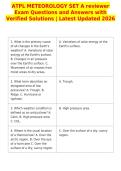
1. What is the primary cause A. Variations of solar energy at the
of all changes in the Earth's Earth's surface.
weather? A. Variations of solar
energy at the Earth's surface.
B. Changes in air pressure
over the Earth's surface. C.
Movement of air masses from
moist areas to dry areas.
2. What term describes an A. Trough.
elongated area of low
pressures? A. Trough. B.
Ridge. C. Hurricane or
typhoon.
3. Which weather condition is B. High pressure area.
defined as an anticyclone? A.
Calm. B. High pressure area.
C. COL.
4. Where is the usual location C. Over the surface of a dry, sunny
of a thermal low? A. Over the region.
arctic region. B. Over the eye
of a hurricane C. Over the
surface of a dry, sunny region.
, 5. Which event usually occurs C. Atmospheric pressure increases.
after an aircraft passes
through a front into the colder
air? A. Temperature/dewpoint
spread decreases. B. Wind
direction shifts to the left. C.
Atmospheric pressure
increases.
6. What is a feature of a C. Surface winds tends to flow
stationary front? A. The warm parallel to the frontal zone.
front surface moves about half
the speed of the cold front
surface. B. Weather conditions
are a combination of strong
cold front and strong warm
front weather. C. Surface
winds tends to flow parallel to
the frontal zone.
7. Which atmospheric factor A. Upper winds blowing across the
causes rapid movement of front.
surface fronts? A. Upper winds
blowing across the front. B.
Upper low located directly
over the surface low. C. The
cold front overtaking and
lifting the warm front.
8. In which meteorological B. Slow-moving cold fronts or
conditions can frontal waves stationary fronts.
and low pressure areas form?
A. Warm fronts and occluded
fronts. B. Slow-moving cold
Exam Questions and Answers with
Verified Solutions | Latest Updated 2026
1. What is the primary cause A. Variations of solar energy at the
of all changes in the Earth's Earth's surface.
weather? A. Variations of solar
energy at the Earth's surface.
B. Changes in air pressure
over the Earth's surface. C.
Movement of air masses from
moist areas to dry areas.
2. What term describes an A. Trough.
elongated area of low
pressures? A. Trough. B.
Ridge. C. Hurricane or
typhoon.
3. Which weather condition is B. High pressure area.
defined as an anticyclone? A.
Calm. B. High pressure area.
C. COL.
4. Where is the usual location C. Over the surface of a dry, sunny
of a thermal low? A. Over the region.
arctic region. B. Over the eye
of a hurricane C. Over the
surface of a dry, sunny region.
, 5. Which event usually occurs C. Atmospheric pressure increases.
after an aircraft passes
through a front into the colder
air? A. Temperature/dewpoint
spread decreases. B. Wind
direction shifts to the left. C.
Atmospheric pressure
increases.
6. What is a feature of a C. Surface winds tends to flow
stationary front? A. The warm parallel to the frontal zone.
front surface moves about half
the speed of the cold front
surface. B. Weather conditions
are a combination of strong
cold front and strong warm
front weather. C. Surface
winds tends to flow parallel to
the frontal zone.
7. Which atmospheric factor A. Upper winds blowing across the
causes rapid movement of front.
surface fronts? A. Upper winds
blowing across the front. B.
Upper low located directly
over the surface low. C. The
cold front overtaking and
lifting the warm front.
8. In which meteorological B. Slow-moving cold fronts or
conditions can frontal waves stationary fronts.
and low pressure areas form?
A. Warm fronts and occluded
fronts. B. Slow-moving cold


