

Asbestos Supervisor Leave the first
rating Exam Questions and Answers with
Verified Solutions | Latest Updated 2026
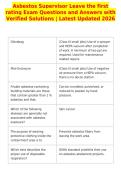
Glovebag (Class III small jobs) Use of a sprayer
and HEPA vacuum after completion
of work. A minimum of two ppl are
required. Used for maintenance
related repairs
Mini-Enclosure (Class III small jobs) Use of negative
air pressure from a HEPA vacuum,
there is no decon station
Friable asbestos-containing Can be crumbled, pulverized, or
building materials are those reduced to powder by hand
that contain greater than 1 % pressure.
asbestos and that:
Which of the following Skin cancer
diseases are generally not
associated with asbestos
exposure?
The purpose of wearing Prevents asbestos fibers from
protective clothing inside the leaving the work area
containment area is to
Which best describes the OSHA standard prohibits their use
proper use of disposable on asbestos abatement projects.
respirators?
,Under the EPA Clean Air Act Placing ACWM in a sealed, labeled
regulations, which of the 55-gal drum
following is not normally
required?
Which analytical method is Transmission electron microscopy
recommended for all buildings (TEM)
and has been phased in for
schools as a requirement to
determine successful project
performance?
Asbestos Hazard and The act directs EPA to develop a
Emergency Response Act regulatory framework to require
(AHERA) schools to inspect their buildings
every six months/3 years for
asbestos and take appropriate
abatement actions using qualified,
accredited persons for inspection
and abatement. It was signed by
president Reagan on October 22nd,
1986 and covers all K-12 schools.
Regulatory standards are
established for the following:
inspections, circumstances which
require response actions (abatement
activity), appropriate response
actions, implementation of response
actions, operations and
maintenance programs, periodic
surveillance of asbestos, transport
and disposal, and management plan
requirements for schools. Defines
asbestos as greater than 1%. Five
, control/response methods:
operations and maintenance,
enclosure (solid/air tight),
encapsulation (paint), repair and
removal. Good condition, damaged
(10% distributed, 25% localized),
significantly damaged (EPA) 40 CFR
Parts 763
AHERA Regulation (EPA) 40 CFR Parts 763
EPA Asbestos Regulations NESHAP 40 CFR 61, Subpart M
AHERA 40 CFR Parts 763 ASHAA
Public Law 98-377 ASHARA Public
Law 101-637 Worker Protection 40
CFR 763 Ban & Phase Out 40 CFR
763.160 to 763.179
NESHAP Regulation (EPA) 40 CFR 61, Subpart M
ASHARA Regulation (EPA) Public Law 101-637
Asbestos School Hazard Enacted by the EPA in 1989 as a
Abatement Reauthorization revision, AHERA's training
Act (ASHARA) requirement applies to all persons
working with asbestos in public and
commercial buildings. This means all
asbestos workers must have
EPA-approved AHERA training.
Increased required training to 40
hours (EPA) Public Law 101-637
rating Exam Questions and Answers with
Verified Solutions | Latest Updated 2026
Glovebag (Class III small jobs) Use of a sprayer
and HEPA vacuum after completion
of work. A minimum of two ppl are
required. Used for maintenance
related repairs
Mini-Enclosure (Class III small jobs) Use of negative
air pressure from a HEPA vacuum,
there is no decon station
Friable asbestos-containing Can be crumbled, pulverized, or
building materials are those reduced to powder by hand
that contain greater than 1 % pressure.
asbestos and that:
Which of the following Skin cancer
diseases are generally not
associated with asbestos
exposure?
The purpose of wearing Prevents asbestos fibers from
protective clothing inside the leaving the work area
containment area is to
Which best describes the OSHA standard prohibits their use
proper use of disposable on asbestos abatement projects.
respirators?
,Under the EPA Clean Air Act Placing ACWM in a sealed, labeled
regulations, which of the 55-gal drum
following is not normally
required?
Which analytical method is Transmission electron microscopy
recommended for all buildings (TEM)
and has been phased in for
schools as a requirement to
determine successful project
performance?
Asbestos Hazard and The act directs EPA to develop a
Emergency Response Act regulatory framework to require
(AHERA) schools to inspect their buildings
every six months/3 years for
asbestos and take appropriate
abatement actions using qualified,
accredited persons for inspection
and abatement. It was signed by
president Reagan on October 22nd,
1986 and covers all K-12 schools.
Regulatory standards are
established for the following:
inspections, circumstances which
require response actions (abatement
activity), appropriate response
actions, implementation of response
actions, operations and
maintenance programs, periodic
surveillance of asbestos, transport
and disposal, and management plan
requirements for schools. Defines
asbestos as greater than 1%. Five
, control/response methods:
operations and maintenance,
enclosure (solid/air tight),
encapsulation (paint), repair and
removal. Good condition, damaged
(10% distributed, 25% localized),
significantly damaged (EPA) 40 CFR
Parts 763
AHERA Regulation (EPA) 40 CFR Parts 763
EPA Asbestos Regulations NESHAP 40 CFR 61, Subpart M
AHERA 40 CFR Parts 763 ASHAA
Public Law 98-377 ASHARA Public
Law 101-637 Worker Protection 40
CFR 763 Ban & Phase Out 40 CFR
763.160 to 763.179
NESHAP Regulation (EPA) 40 CFR 61, Subpart M
ASHARA Regulation (EPA) Public Law 101-637
Asbestos School Hazard Enacted by the EPA in 1989 as a
Abatement Reauthorization revision, AHERA's training
Act (ASHARA) requirement applies to all persons
working with asbestos in public and
commercial buildings. This means all
asbestos workers must have
EPA-approved AHERA training.
Increased required training to 40
hours (EPA) Public Law 101-637


