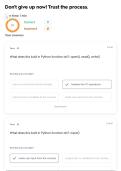
Don't give up now! Trust the process.
Your time: 1 min
Correct 0
0%
Incorrect 61
Your answers
Term 1 of 61
What does this built in Python function do?: open(), read(), write()
Give this one a try later!
returns a sorted list from an iterable handles file I/O operations
outputs text or variables to the console reads user input from the console
Don't know?
Term 2 of 61
What does this built in Python function do?: input()
Give this one a try later!
reads user input from the console outputs text or variables to the console
, returns the maximum value from a
converts a value to an integer
sequence
Don't know?
Term 3 of 61
What does Python use to define the scope of control flow statements
and structures like functions and classes?
Give this one a try later!
Selection Indentation
Casting Parenthesis
Don't know?
Term 4 of 61
What does this built in Python function do?: dir()
Give this one a try later!
lists the modules imported in the lists the keywords in the python
current session language
lists the names in the current
lists the files in the current directory
scope or attributes of an object
, Don't know?
Term 5 of 61
What are the traits of Object-Oriented Programming (OOP)?
Give this one a try later!
Organize code around objects,
Defines a set of logical rules and facts
which encapsulate data and
to deduce solutions
behavior.
Emphasizes the use of immutable data Focuses on a sequence of commands
and pure functions to be executed by the computer
Don't know?
Term 6 of 61
How can multiple Python variables of different types be output using the
print() function?
Give this one a try later!
By using the 'format()' method with By separating each variable with
placeholders a comma
By converting each variable to a string By using the '+' operator between each
and concatenating variable
Your time: 1 min
Correct 0
0%
Incorrect 61
Your answers
Term 1 of 61
What does this built in Python function do?: open(), read(), write()
Give this one a try later!
returns a sorted list from an iterable handles file I/O operations
outputs text or variables to the console reads user input from the console
Don't know?
Term 2 of 61
What does this built in Python function do?: input()
Give this one a try later!
reads user input from the console outputs text or variables to the console
, returns the maximum value from a
converts a value to an integer
sequence
Don't know?
Term 3 of 61
What does Python use to define the scope of control flow statements
and structures like functions and classes?
Give this one a try later!
Selection Indentation
Casting Parenthesis
Don't know?
Term 4 of 61
What does this built in Python function do?: dir()
Give this one a try later!
lists the modules imported in the lists the keywords in the python
current session language
lists the names in the current
lists the files in the current directory
scope or attributes of an object
, Don't know?
Term 5 of 61
What are the traits of Object-Oriented Programming (OOP)?
Give this one a try later!
Organize code around objects,
Defines a set of logical rules and facts
which encapsulate data and
to deduce solutions
behavior.
Emphasizes the use of immutable data Focuses on a sequence of commands
and pure functions to be executed by the computer
Don't know?
Term 6 of 61
How can multiple Python variables of different types be output using the
print() function?
Give this one a try later!
By using the 'format()' method with By separating each variable with
placeholders a comma
By converting each variable to a string By using the '+' operator between each
and concatenating variable