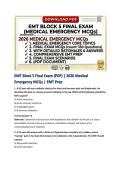
EMT Block 5 Final Exam (PDF) | 2026 Medical
1. A 62-year-old man suddenly clutches his chest and becomes pale and diaphoretic. He
describes the pain as a heavy pressure radiating to his jaw. Which of the following should the
EMT suspect?
A) Aortic dissection
B) Acute coronary syndrome
C) Esophageal spasm
D) Pulmonary embolism
Correct Answer: B
Rationale: Substernal chest pressure with diaphoresis and radiation to the jaw is a classic
presentation of acute coronary syndrome. Immediate transport and aspirin (if no
contraindications) are indicated.
2. A 55-year-old woman with a history of hypertension complains of a sudden, severe
“tearing” pain in her back that moves to her abdomen. She is hypotensive. The EMT should
suspect:
A) Myocardial infarction
B) Aortic dissection
,C) Kidney stone
D) Pancreatitis
Correct Answer: B
Rationale: Tearing pain that radiates to the back with hypotension suggests aortic dissection, a
life-threatening emergency.
3. A 28-year-old asthmatic patient is found in severe respiratory distress, using accessory
muscles and unable to speak in full sentences. Her albuterol inhaler is empty. The EMT
should:
A) Administer high-flow oxygen and transport immediately
B) Perform abdominal thrusts
C) Insert an oropharyngeal airway
D) Place her in a supine position
Correct Answer: A
Rationale: This patient is in severe respiratory distress and requires high-flow oxygen and
immediate transport. If the EMT carries albuterol, it could be administered per protocol.
4. A 45-year-old man with a history of diabetes is found confused and sweaty. His blood
glucose reads 42 mg/dL. He is able to follow commands and has a gag reflex. Which of the
following is the most appropriate intervention?
A) Administer oral glucose
B) Give insulin
C) Start an IV and administer 50% dextrose
D) Provide only oxygen
Correct Answer: A
Rationale: The patient is hypoglycemic, awake, and can protect his airway. Oral glucose is
indicated. Insulin would worsen hypoglycemia.
5. A 70-year-old man with COPD is on home oxygen at 2 L/min. He is found with increased
shortness of breath, pursed-lip breathing, and an SpO2 of 81%. The EMT should:
A) Leave the oxygen at 2 L/min
B) Increase oxygen to maintain SpO2 88–92% and assist ventilations if needed
C) Remove the oxygen to stimulate breathing
D) Administer only a bronchodilator
Correct Answer: B
Rationale: In COPD, hypoxia must be treated; target SpO2 is 88–92%. Titrate oxygen and be
prepared to assist ventilations if the patient is tiring.
,6. A 32-year-old woman who was stung by a wasp develops hives, swelling of her lips, stridor,
and a weak pulse. Her BP is 78/50 mm Hg. The priority medication is:
A) Diphenhydramine
B) Epinephrine auto-injector into the lateral thigh
C) Albuterol
D) Prednisone
Correct Answer: B
Rationale: Anaphylaxis with airway involvement and shock requires immediate epinephrine
intramuscularly.
7. A 22-year-old college student is hyperventilating after an argument, complaining of perioral
tingling and carpopedal spasms. Vital signs are normal except for a respiratory rate of 36. The
EMT should:
A) Administer oxygen by non-rebreather mask
B) Coach the patient to slow her breathing and reassure her
C) Have her breathe into a paper bag
D) Administer a sedative
Correct Answer: B
Rationale: Hyperventilation syndrome leads to respiratory alkalosis. Reassurance and breathing
coaching are effective; paper bags are no longer recommended.
8. A 50-year-old woman with a history of gallstones develops severe right upper quadrant
pain after eating a hamburger. The pain radiates to her right shoulder. She is nauseated and
afebrile. The EMT should suspect:
A) Appendicitis
B) Acute cholecystitis
C) Pancreatitis
D) Hepatitis
Correct Answer: B
Rationale: Fatty food intolerance, RUQ pain radiating to the shoulder, and nausea suggest
gallbladder inflammation (cholecystitis).
9. A 6-year-old girl has a harsh, barking cough, low-grade fever, and stridor at rest that started
suddenly at night. She is sitting up in bed, frightened. The EMT should:
A) Perform a throat exam with a tongue depressor
B) Keep the child calm, provide oxygen if needed, and transport without agitating her
C) Give her warm milk
D) Perform abdominal thrusts
, Correct Answer: B
Rationale: This presentation suggests croup. Keep the child calm, as agitation worsens stridor;
avoid throat exams which can cause laryngospasm.
10. A 58-year-old diabetic man is found unresponsive. He has deep, rapid respirations, warm
dry skin, and a fruity odor on his breath. Blood glucose reads “HIGH.” The EMT should
suspect:
A) Hypoglycemia
B) Diabetic ketoacidosis (DKA)
C) Alcohol intoxication
D) Stroke
Correct Answer: B
Rationale: Kussmaul breathing, fruity breath, and hyperglycemia indicate DKA, most common in
type 1 diabetes.
11. A 34-week pregnant woman complains of a severe headache, blurred vision, and swelling
of her hands and face. Her blood pressure is 170/110 mm Hg. The EMT should suspect:
A) Ectopic pregnancy
B) Preeclampsia
C) Placenta previa
D) Gestational diabetes
Correct Answer: B
Rationale: Hypertension, headache, visual changes, and edema in pregnancy are signs of
preeclampsia, which can progress to eclampsia (seizures). Transport with left lateral tilt.
12. A 65-year-old man who recently had hip surgery develops sudden dyspnea and sharp,
pleuritic chest pain. He is tachycardic and his SpO2 is 86%. The EMT should suspect:
A) Myocardial infarction
B) Pulmonary embolism
C) Pneumothorax
D) Pericarditis
Correct Answer: B
Rationale: Sudden dyspnea, pleuritic chest pain, and hypoxemia in a patient with recent
immobility strongly suggest pulmonary embolism.
13. A 42-year-old woman with a history of migraines describes the worst headache of her life,
which came on suddenly while exercising. She is nauseated and has a stiff neck. The EMT
should suspect:
A) Tension headache
1. A 62-year-old man suddenly clutches his chest and becomes pale and diaphoretic. He
describes the pain as a heavy pressure radiating to his jaw. Which of the following should the
EMT suspect?
A) Aortic dissection
B) Acute coronary syndrome
C) Esophageal spasm
D) Pulmonary embolism
Correct Answer: B
Rationale: Substernal chest pressure with diaphoresis and radiation to the jaw is a classic
presentation of acute coronary syndrome. Immediate transport and aspirin (if no
contraindications) are indicated.
2. A 55-year-old woman with a history of hypertension complains of a sudden, severe
“tearing” pain in her back that moves to her abdomen. She is hypotensive. The EMT should
suspect:
A) Myocardial infarction
B) Aortic dissection
,C) Kidney stone
D) Pancreatitis
Correct Answer: B
Rationale: Tearing pain that radiates to the back with hypotension suggests aortic dissection, a
life-threatening emergency.
3. A 28-year-old asthmatic patient is found in severe respiratory distress, using accessory
muscles and unable to speak in full sentences. Her albuterol inhaler is empty. The EMT
should:
A) Administer high-flow oxygen and transport immediately
B) Perform abdominal thrusts
C) Insert an oropharyngeal airway
D) Place her in a supine position
Correct Answer: A
Rationale: This patient is in severe respiratory distress and requires high-flow oxygen and
immediate transport. If the EMT carries albuterol, it could be administered per protocol.
4. A 45-year-old man with a history of diabetes is found confused and sweaty. His blood
glucose reads 42 mg/dL. He is able to follow commands and has a gag reflex. Which of the
following is the most appropriate intervention?
A) Administer oral glucose
B) Give insulin
C) Start an IV and administer 50% dextrose
D) Provide only oxygen
Correct Answer: A
Rationale: The patient is hypoglycemic, awake, and can protect his airway. Oral glucose is
indicated. Insulin would worsen hypoglycemia.
5. A 70-year-old man with COPD is on home oxygen at 2 L/min. He is found with increased
shortness of breath, pursed-lip breathing, and an SpO2 of 81%. The EMT should:
A) Leave the oxygen at 2 L/min
B) Increase oxygen to maintain SpO2 88–92% and assist ventilations if needed
C) Remove the oxygen to stimulate breathing
D) Administer only a bronchodilator
Correct Answer: B
Rationale: In COPD, hypoxia must be treated; target SpO2 is 88–92%. Titrate oxygen and be
prepared to assist ventilations if the patient is tiring.
,6. A 32-year-old woman who was stung by a wasp develops hives, swelling of her lips, stridor,
and a weak pulse. Her BP is 78/50 mm Hg. The priority medication is:
A) Diphenhydramine
B) Epinephrine auto-injector into the lateral thigh
C) Albuterol
D) Prednisone
Correct Answer: B
Rationale: Anaphylaxis with airway involvement and shock requires immediate epinephrine
intramuscularly.
7. A 22-year-old college student is hyperventilating after an argument, complaining of perioral
tingling and carpopedal spasms. Vital signs are normal except for a respiratory rate of 36. The
EMT should:
A) Administer oxygen by non-rebreather mask
B) Coach the patient to slow her breathing and reassure her
C) Have her breathe into a paper bag
D) Administer a sedative
Correct Answer: B
Rationale: Hyperventilation syndrome leads to respiratory alkalosis. Reassurance and breathing
coaching are effective; paper bags are no longer recommended.
8. A 50-year-old woman with a history of gallstones develops severe right upper quadrant
pain after eating a hamburger. The pain radiates to her right shoulder. She is nauseated and
afebrile. The EMT should suspect:
A) Appendicitis
B) Acute cholecystitis
C) Pancreatitis
D) Hepatitis
Correct Answer: B
Rationale: Fatty food intolerance, RUQ pain radiating to the shoulder, and nausea suggest
gallbladder inflammation (cholecystitis).
9. A 6-year-old girl has a harsh, barking cough, low-grade fever, and stridor at rest that started
suddenly at night. She is sitting up in bed, frightened. The EMT should:
A) Perform a throat exam with a tongue depressor
B) Keep the child calm, provide oxygen if needed, and transport without agitating her
C) Give her warm milk
D) Perform abdominal thrusts
, Correct Answer: B
Rationale: This presentation suggests croup. Keep the child calm, as agitation worsens stridor;
avoid throat exams which can cause laryngospasm.
10. A 58-year-old diabetic man is found unresponsive. He has deep, rapid respirations, warm
dry skin, and a fruity odor on his breath. Blood glucose reads “HIGH.” The EMT should
suspect:
A) Hypoglycemia
B) Diabetic ketoacidosis (DKA)
C) Alcohol intoxication
D) Stroke
Correct Answer: B
Rationale: Kussmaul breathing, fruity breath, and hyperglycemia indicate DKA, most common in
type 1 diabetes.
11. A 34-week pregnant woman complains of a severe headache, blurred vision, and swelling
of her hands and face. Her blood pressure is 170/110 mm Hg. The EMT should suspect:
A) Ectopic pregnancy
B) Preeclampsia
C) Placenta previa
D) Gestational diabetes
Correct Answer: B
Rationale: Hypertension, headache, visual changes, and edema in pregnancy are signs of
preeclampsia, which can progress to eclampsia (seizures). Transport with left lateral tilt.
12. A 65-year-old man who recently had hip surgery develops sudden dyspnea and sharp,
pleuritic chest pain. He is tachycardic and his SpO2 is 86%. The EMT should suspect:
A) Myocardial infarction
B) Pulmonary embolism
C) Pneumothorax
D) Pericarditis
Correct Answer: B
Rationale: Sudden dyspnea, pleuritic chest pain, and hypoxemia in a patient with recent
immobility strongly suggest pulmonary embolism.
13. A 42-year-old woman with a history of migraines describes the worst headache of her life,
which came on suddenly while exercising. She is nauseated and has a stiff neck. The EMT
should suspect:
A) Tension headache