

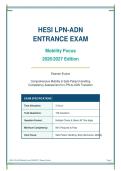
HESI LPN-ADN
ENTRANCE EXAM
Mobility Focus
2026/2027 Edition
Elsevier Evolve
Comprehensive Mobility & Safe Patient Handling
Competency Assessment for LPN-to-ADN Transition
EXAM SPECIFICATIONS
Time Allocation: 3 Hours
Total Questions: 105 Questions
Question Format: Multiple Choice & Select All That Apply
Minimum Competency: 80% Required to Pass
Core Focus: Safe Patient Handling, Body Mechanics, Mobility
HESI LPN-ADN Mobility Exam 2026/2027 | Elsevier Evolve Page 1
, Exam Overview & Content Outline
EXAM PURPOSE
This HESI LPN-to-ADN Mobility Focus assessment evaluates your clinical readiness to transition
from Licensed Practical Nurse to Associate Degree Nursing. Content aligns with Elsevier Evolve
curriculum standards and tests competencies in safe patient handling and mobility required for
ADN-level practice.
CONTENT DISTRIBUTION
• Safe Patient Handling (30%) — Body mechanics, lifting techniques, transfer methods, gait belt
application, mechanical lift operation
• Mobility Assessment (25%) — Range of motion evaluation, muscle strength testing, gait analysis,
fall risk screening
• Complications of Immobility (20%) — DVT prevention, pressure injury staging, orthostatic
hypotension, contracture prevention, respiratory care
• Assistive Devices (15%) — Cane, walker, and crutch fitting; wheelchair management; patient
education principles
• Special Populations (10%) — Post-operative mobility, geriatric care, bariatric considerations,
neurologically impaired patients
QUESTION FORMAT & SCORING
Each item presents four options. Correct answers are highlighted in green with checkmark (✓)
for efficient revision. Select-All-That-Apply questions indicate multiple correct responses. Achieve
80% competency to demonstrate readiness.
STUDY STRATEGY
Review color-coded sections systematically. Focus on emerald headers to organize content domains.
Use the comprehensive answer key for self-assessment. Rationales reinforce critical thinking
required at the ADN level.
CURRICULUM ALIGNMENT
Questions reflect 2026/2027 HESI A2 blueprint updates and Elsevier Evolve LPN-ADN Transition
program objectives.
HESI LPN-ADN Mobility Exam 2026/2027 | Elsevier Evolve Page 2
, SECTION I: Safe Patient Handling & Body Mechanics
1. When using proper body mechanics to lift a patient, the nurse should:
A. Keep feet close together and bend at the waist
✓ B. Keep back straight, bend knees, and keep load close to body
C. Twist at the waist to position the patient
D. Hold the load away from the body to protect the back
2. A patient is on complete bed rest. Which intervention best prevents complications of
immobility?
A. Active range of motion exercises every 4 hours
B. Passive range of motion exercises twice daily
✓ C. Turning and repositioning every 2 hours
D. Limiting fluid intake to prevent incontinence
3. The nurse is teaching a patient about using a cane. Which statement indicates
understanding?
A. 'I will hold the cane on my weak side'
✓ B. 'I will move the cane first, then my weak leg, then my strong leg'
C. 'The cane should be 2 inches shorter than my waist'
D. 'I should look at my feet when walking with the cane'
4. Which patient is at greatest risk for deep vein thrombosis due to immobility?
A. 25-year-old post-appendectomy patient ambulating on day 1
✓ B. 68-year-old patient with fractured hip on bed rest
C. 40-year-old patient with pneumonia on oxygen
D. 30-year-old patient with dehydration receiving IV fluids
5. Before transferring a patient from bed to chair, the nurse should first:
A. Lock the wheels on the bed and wheelchair
B. Place the patient in high Fowler's position
✓ C. Assess the patient's strength and ability to assist
D. Apply a gait belt to the patient
6. A patient with hemiplegia requires transfer. The priority action is:
A. Lift under the patient's affected arm
✓ B. Use a mechanical lift if patient cannot assist
C. Have patient bear weight on weak side
D. Transfer without gait belt
7. Which finding indicates orthostatic hypotension in a mobilizing patient?
A. BP increase of 10 mmHg when standing
B. HR decrease of 5 bpm
HESI LPN-ADN Mobility Exam 2026/2027 | Elsevier Evolve Page 3
ENTRANCE EXAM
Mobility Focus
2026/2027 Edition
Elsevier Evolve
Comprehensive Mobility & Safe Patient Handling
Competency Assessment for LPN-to-ADN Transition
EXAM SPECIFICATIONS
Time Allocation: 3 Hours
Total Questions: 105 Questions
Question Format: Multiple Choice & Select All That Apply
Minimum Competency: 80% Required to Pass
Core Focus: Safe Patient Handling, Body Mechanics, Mobility
HESI LPN-ADN Mobility Exam 2026/2027 | Elsevier Evolve Page 1
, Exam Overview & Content Outline
EXAM PURPOSE
This HESI LPN-to-ADN Mobility Focus assessment evaluates your clinical readiness to transition
from Licensed Practical Nurse to Associate Degree Nursing. Content aligns with Elsevier Evolve
curriculum standards and tests competencies in safe patient handling and mobility required for
ADN-level practice.
CONTENT DISTRIBUTION
• Safe Patient Handling (30%) — Body mechanics, lifting techniques, transfer methods, gait belt
application, mechanical lift operation
• Mobility Assessment (25%) — Range of motion evaluation, muscle strength testing, gait analysis,
fall risk screening
• Complications of Immobility (20%) — DVT prevention, pressure injury staging, orthostatic
hypotension, contracture prevention, respiratory care
• Assistive Devices (15%) — Cane, walker, and crutch fitting; wheelchair management; patient
education principles
• Special Populations (10%) — Post-operative mobility, geriatric care, bariatric considerations,
neurologically impaired patients
QUESTION FORMAT & SCORING
Each item presents four options. Correct answers are highlighted in green with checkmark (✓)
for efficient revision. Select-All-That-Apply questions indicate multiple correct responses. Achieve
80% competency to demonstrate readiness.
STUDY STRATEGY
Review color-coded sections systematically. Focus on emerald headers to organize content domains.
Use the comprehensive answer key for self-assessment. Rationales reinforce critical thinking
required at the ADN level.
CURRICULUM ALIGNMENT
Questions reflect 2026/2027 HESI A2 blueprint updates and Elsevier Evolve LPN-ADN Transition
program objectives.
HESI LPN-ADN Mobility Exam 2026/2027 | Elsevier Evolve Page 2
, SECTION I: Safe Patient Handling & Body Mechanics
1. When using proper body mechanics to lift a patient, the nurse should:
A. Keep feet close together and bend at the waist
✓ B. Keep back straight, bend knees, and keep load close to body
C. Twist at the waist to position the patient
D. Hold the load away from the body to protect the back
2. A patient is on complete bed rest. Which intervention best prevents complications of
immobility?
A. Active range of motion exercises every 4 hours
B. Passive range of motion exercises twice daily
✓ C. Turning and repositioning every 2 hours
D. Limiting fluid intake to prevent incontinence
3. The nurse is teaching a patient about using a cane. Which statement indicates
understanding?
A. 'I will hold the cane on my weak side'
✓ B. 'I will move the cane first, then my weak leg, then my strong leg'
C. 'The cane should be 2 inches shorter than my waist'
D. 'I should look at my feet when walking with the cane'
4. Which patient is at greatest risk for deep vein thrombosis due to immobility?
A. 25-year-old post-appendectomy patient ambulating on day 1
✓ B. 68-year-old patient with fractured hip on bed rest
C. 40-year-old patient with pneumonia on oxygen
D. 30-year-old patient with dehydration receiving IV fluids
5. Before transferring a patient from bed to chair, the nurse should first:
A. Lock the wheels on the bed and wheelchair
B. Place the patient in high Fowler's position
✓ C. Assess the patient's strength and ability to assist
D. Apply a gait belt to the patient
6. A patient with hemiplegia requires transfer. The priority action is:
A. Lift under the patient's affected arm
✓ B. Use a mechanical lift if patient cannot assist
C. Have patient bear weight on weak side
D. Transfer without gait belt
7. Which finding indicates orthostatic hypotension in a mobilizing patient?
A. BP increase of 10 mmHg when standing
B. HR decrease of 5 bpm
HESI LPN-ADN Mobility Exam 2026/2027 | Elsevier Evolve Page 3


