

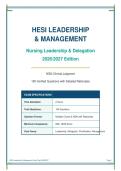
HESI LEADERSHIP
& MANAGEMENT
Nursing Leadership & Delegation
2026/2027 Edition
NGN Clinical Judgment
100 Verified Questions with Detailed Rationales
EXAM SPECIFICATIONS
Time Allocation: 2 Hours
Total Questions: 100 Questions
Question Format: Multiple Choice & NGN with Rationales
Minimum Competency: 850+ HESI Score
Core Focus: Leadership, Delegation, Prioritization, Management
HESI Leadership & Management Exam Prep 2026/2027 Page 1
, Exam Overview & Content Outline
EXAM PURPOSE
This HESI Leadership & Management Exam Prep validates knowledge of nursing leadership
principles, delegation, prioritization, and clinical judgment for RN practice. Content aligns with
NCLEX-RN Test Plan and NGN (Next Generation NCLEX) format for management of care.
CONTENT DISTRIBUTION
• Leadership & Management Principles (25%) — Leadership styles, management theories, change
theory, conflict resolution, power, decision-making
• Delegation & Assignment (25%) — Five Rights of Delegation, scope of practice RN/LPN/UAP,
supervision, accountability
• Prioritization & Time Management (20%) — ABCs, Maslow, acute vs chronic, unstable vs stable,
triage, time management
• Quality Improvement & Safety (15%) — QI processes, sentinel events, root cause analysis,
patient safety, just culture
• Ethical/Legal Issues & Communication (15%) — Nurse Practice Act, informed consent,
confidentiality, HIPAA, advocacy, assertive communication
QUESTION FORMAT & SCORING
Each item presents four options. Correct answers are highlighted in green with checkmark (✓).
Every question includes detailed rationale with nursing management principles. HESI scoring 850+
indicates readiness.
STUDY STRATEGY
Master Five Rights of Delegation and scope of practice. Practice prioritization using ABCs and
Maslow. Understand leadership styles and conflict management. Use rationales to develop clinical
judgment.
CURRICULUM ALIGNMENT
Questions reflect 2026/2027 standards: NCLEX-RN Test Plan Management of Care, NCSBN
Delegation Guidelines, ANA Code of Ethics, QSEN competencies, and NGN Clinical Judgment
Model.
HESI Leadership & Management Exam Prep 2026/2027 Page 2
, SECTION I: Leadership & Management Principles
1. A charge nurse using transformational leadership:
A. Focuses on rewards and punishments
✓ B. Inspires and motivates staff toward shared vision
C. Makes all decisions unilaterally
D. Avoids conflict at all costs
Rationale: Transformational leadership inspires, motivates, and develops followers toward shared vision.
Transactional uses rewards/punishment. Autocratic makes unilateral decisions. Laissez-faire avoids conflict.
2. The Five Rights of Delegation include:
✓ A. Right person, right task, right circumstances, right direction, right supervision
B. Right time, right place, right cost, right staff, right patient
C. Right medication, right dose, right route, right time, right patient
D. Right assessment, right diagnosis, right plan, right implementation, right evaluation
Rationale: NCSBN Five Rights of Delegation: right task, right circumstances, right person, right
direction/communication, right supervision/evaluation. Not medication rights or nursing process.
3. An RN may delegate to UAP:
A. Initial patient assessment
✓ B. Vital signs on stable patients
C. Medication administration
D. Patient teaching
Rationale: UAP can perform routine tasks for stable patients: vitals, ADLs, ambulation. RN cannot delegate
assessment, meds, teaching, or unstable patient care. These require nursing judgment.
4. According to Maslow's Hierarchy, which patient should the nurse see first?
A. Patient requesting pain medication for chronic pain
✓ B. Patient with oxygen saturation 88% on room air
C. Patient needing discharge teaching
D. Patient upset about room assignment
Rationale: Maslow prioritizes physiological needs first. Hypoxemia (O2 sat 88%) is
airway/breathing—highest priority. Pain is important but not life-threatening. Teaching and psychosocial are
lower.
5. A nurse manager practicing democratic leadership:
A. Makes decisions without staff input
✓ B. Encourages staff participation in decision-making
C. Provides no guidance to staff
D. Uses fear to motivate
HESI Leadership & Management Exam Prep 2026/2027 Page 3
& MANAGEMENT
Nursing Leadership & Delegation
2026/2027 Edition
NGN Clinical Judgment
100 Verified Questions with Detailed Rationales
EXAM SPECIFICATIONS
Time Allocation: 2 Hours
Total Questions: 100 Questions
Question Format: Multiple Choice & NGN with Rationales
Minimum Competency: 850+ HESI Score
Core Focus: Leadership, Delegation, Prioritization, Management
HESI Leadership & Management Exam Prep 2026/2027 Page 1
, Exam Overview & Content Outline
EXAM PURPOSE
This HESI Leadership & Management Exam Prep validates knowledge of nursing leadership
principles, delegation, prioritization, and clinical judgment for RN practice. Content aligns with
NCLEX-RN Test Plan and NGN (Next Generation NCLEX) format for management of care.
CONTENT DISTRIBUTION
• Leadership & Management Principles (25%) — Leadership styles, management theories, change
theory, conflict resolution, power, decision-making
• Delegation & Assignment (25%) — Five Rights of Delegation, scope of practice RN/LPN/UAP,
supervision, accountability
• Prioritization & Time Management (20%) — ABCs, Maslow, acute vs chronic, unstable vs stable,
triage, time management
• Quality Improvement & Safety (15%) — QI processes, sentinel events, root cause analysis,
patient safety, just culture
• Ethical/Legal Issues & Communication (15%) — Nurse Practice Act, informed consent,
confidentiality, HIPAA, advocacy, assertive communication
QUESTION FORMAT & SCORING
Each item presents four options. Correct answers are highlighted in green with checkmark (✓).
Every question includes detailed rationale with nursing management principles. HESI scoring 850+
indicates readiness.
STUDY STRATEGY
Master Five Rights of Delegation and scope of practice. Practice prioritization using ABCs and
Maslow. Understand leadership styles and conflict management. Use rationales to develop clinical
judgment.
CURRICULUM ALIGNMENT
Questions reflect 2026/2027 standards: NCLEX-RN Test Plan Management of Care, NCSBN
Delegation Guidelines, ANA Code of Ethics, QSEN competencies, and NGN Clinical Judgment
Model.
HESI Leadership & Management Exam Prep 2026/2027 Page 2
, SECTION I: Leadership & Management Principles
1. A charge nurse using transformational leadership:
A. Focuses on rewards and punishments
✓ B. Inspires and motivates staff toward shared vision
C. Makes all decisions unilaterally
D. Avoids conflict at all costs
Rationale: Transformational leadership inspires, motivates, and develops followers toward shared vision.
Transactional uses rewards/punishment. Autocratic makes unilateral decisions. Laissez-faire avoids conflict.
2. The Five Rights of Delegation include:
✓ A. Right person, right task, right circumstances, right direction, right supervision
B. Right time, right place, right cost, right staff, right patient
C. Right medication, right dose, right route, right time, right patient
D. Right assessment, right diagnosis, right plan, right implementation, right evaluation
Rationale: NCSBN Five Rights of Delegation: right task, right circumstances, right person, right
direction/communication, right supervision/evaluation. Not medication rights or nursing process.
3. An RN may delegate to UAP:
A. Initial patient assessment
✓ B. Vital signs on stable patients
C. Medication administration
D. Patient teaching
Rationale: UAP can perform routine tasks for stable patients: vitals, ADLs, ambulation. RN cannot delegate
assessment, meds, teaching, or unstable patient care. These require nursing judgment.
4. According to Maslow's Hierarchy, which patient should the nurse see first?
A. Patient requesting pain medication for chronic pain
✓ B. Patient with oxygen saturation 88% on room air
C. Patient needing discharge teaching
D. Patient upset about room assignment
Rationale: Maslow prioritizes physiological needs first. Hypoxemia (O2 sat 88%) is
airway/breathing—highest priority. Pain is important but not life-threatening. Teaching and psychosocial are
lower.
5. A nurse manager practicing democratic leadership:
A. Makes decisions without staff input
✓ B. Encourages staff participation in decision-making
C. Provides no guidance to staff
D. Uses fear to motivate
HESI Leadership & Management Exam Prep 2026/2027 Page 3


